Friday, December 29, 2006

THE PURSUIT OF HAPPYNESS


THE PURSUIT OF HAPPYNESS
Written by Steve Conrad
Directed by Gabriele Muccino


As the opening shots of THE PURSUIT OF HAPPYNESS establish San Francisco as the setting for this tale of adversity with the Golden Gate Bridge and hordes of people rushing up and down the steep hills to get to their important jobs, I couldn’t help but begin to worry that I was about to be fed Hollywood’s take on what it means to go through hard times. This is after all a Will Smith picture. My anxiety eased up slightly though when the view dropped down from the indistinguishable faces of the swarm to a face that blended in all too well amongst the masses of determined feet. Throughout the opening credits, Italian film director, Gabriele Muccino, drew my attention away from a race I know all too well and ever so subtly forced me to look at what I am accustomed to looking away from, the homeless. And though Smith’s Chris Gardner is currently employed, he is about to face challenge after soul-depleting challenge until he too finds himself amongst the people he turns away from as hurries about his day as a unsuccessful salesman. THE PURSUIT OF HAPPYNESS is a hollowing drama that drags both its protagonist and its audience deeper into despair than either would have expected. It is a relentless assault on the sense of security and entitlement many of us have as supposed functional members of a working society and by the time I left, I knew that I had absolutely nothing to complain about.

Chris Gardner’s story would be nothing more than one man’s pursuit of the American dream if it weren’t for one very important thing. In this case, that thing is actually a very charming, young boy, Chris’ son, Christopher (played by Smith’s real-life son, Jaden). Watching Will and Jaden quibble and endure provides for some endearing screen time but their plight and performances overshadow their off-screen family ties. If Chris fails, he will not only be begging for his food but he will lose the one thing that gives him purpose. Little Christopher’s future depends on whether his father can successfully overcome his horrible misfortune to beat out nineteen other candidates in a competitive internship for thriving brokerage firm, Dean Whitter. Today, the American dream often symbolizes an unhealthy, greedy amassment of unnecessary material goods but Chris’ fight is for the bare essentials. His son deserves a stable home and regular meals. He deserves these and other rudimentary needs in order to have the opportunity to pursue his own dreams. And while I’m certain Chris wouldn’t mind a bigger piece of the proverbial pie, he knows what he needs to survive and by chasing that, he reminds the audience that the American dream should be spread more evenly. It is not a contest to win out miles ahead while the rest clamor for scraps.


Will Smith is by far the most successful black box-office star of his generation, if not of all time. He has broken barriers around the world and yet manages to find himself facing criticism for not addressing any specific racial issues in THE PURSUIT OF HAPPYNESS. However, not verbalizing the unavoidable prejudices a black man must face competing against a room full of white faces in 1981 doesn’t mean it isn’t there. If anything, Smith’s Chris exhibits his intelligence by pushing his understandable racial frustrations aside in order to appease his potential employers. He becomes the showman who gets his foot in the door by making the white folk laugh, all the while knowing he has the goods to surpass all their expectations once he’s in. In one of the film’s many moments of desperation and impending disaster, Chris finds himself sitting in his first interview at Dean Whitter, splattered in dried paint, wearing overalls and no shirt at all. The men who sit opposite him are all white and not amused. When they leer at him, they certainly aren’t just uncomfortable with his appearance; they see his black skin just as plainly. Not focusing on the obvious showcases Muccino’s subtle grace handling Hollywood and allows Chris to be the smartest man in the room. It also allows for Smith to give a performance where he appears as though he might break at any given moment while he wears the knowledge that closing his eyes for even a second is never an option.

Without confirming whether THE PURSUIT OF HAPPYNESS actually concludes with Chris achieving the happiness he works so hard to get, I can say that it deftly humbling and certainly doesn’t allow for the viewer leaving that happy. Smith’s backwards journey towards the top speaks to anyone who has ever struggled to succeed. What it says to them is to ask themselves if they have ever truly suffered and if so, for what? Have you been fighting to make your dreams come true or fighting to beat out the next guy? More importantly, have you ever tried to be happy in exactly the spot you’re standing?


Saturday, December 23, 2006

THE HISTORY BOYS


THE HISTORY BOYS
Written by Allan Bennett
Directed by Nicolas Hytner


These boys are tight. They would have to be after the amount of time and dedication they’ve given to Allan Bennett’s play, THE HISTORY BOYS, just recently released as a feature film, directed by Nicolas Hytner. This group of eight young actors originated their roles on the London stage and stayed with the success through the year long run. They then found themselves on stage together again in the Broadway production, which ran for almost another year. And now, these talented fellas find themselves on screen together, some two years after they first formed their gang. Theirs is a gang built on brilliance and banter. These young men have all performed so well that they are all within reach of admission to Oxford, an educational pinnacle that they all believe will set them up for life. They are on the edge of completing their studies; they are on the verge of discovering their true selves; they are on the cusp of their very own lives. The energy these boys feel pushing them forward is infectious and it makes for an exhilarating film experience. All they need to do now is put aside their confusions about sex, class and identity long enough to master their field of concentration, history. For mastering history ensures these boys a bright future.

The boys are not the only ones being schooled either. THE HISTORY BOYS offers the audience its own insights that make it a rich and provocative film. As the school these boys attend also has its own interests in seeing these boys make it into Oxford, they hire a coach of sorts to give them an edge. Irwin (Stephen Campbell Moore) must show these boys that understanding history is not just memorizing facts but rather exploring the era to see what these facts are covering for. They must then take these more rounded views and learn to spin them in a fashion that grabs the readers’ attention. In other words, they must learn the art of show. What they end up learning along the way is that, while sprinkling your arguments with little known nuggets of information might make for a more colorful debate, nothing speaks louder than an effective formulation of your own original thoughts. This is quite the challenge for these boys as speaking for themselves does not fall in line with always saying exactly what everyone wants to hear.


Pleasing other people and pleasing yourself is a difficult line to tow for the “history boys.” This is especially relevant when there are students and teachers on either side of the line. The boys pit new boy, Irwin, directly against their “general studies” teacher, Hector (Richard Griffiths, a Tony Award winner for this role). Between both supposed role models, the boys take turns trying to capture their teacher’s attention, and in some cases, affection. It is as though their existence and opinions are somewhat more valid if they are applauded by their authority figures. As we rarely see any of the boys’ parents, these two teachers are the closest things they’ve got. As the boys play their games with the teachers though, it is the teachers that unknowingly and unexpectedly end up addicted to the attention feigned upon them, as though being the central figure in these boys’ lives somehow means they have the same boundless futures ahead of them. Like their parents, the boys must come to terms with the humanity of their teachers. However, unlike the boys’ parents, the teachers must conceal these vulnerable sides of themselves in order to maintain authority and protect their own emotional investments. After all, when these boys graduate, they will leave their teachers behind them.

Aside from an obsession with fondling his students, Hector also has an obsession with the subjunctive. The theme runs throughout and forces the boys, the teachers and the audience to question the fragility of fact. History is most often summed up with facts but all of these could have been entirely different if there had been a slight alteration in the circumstances in which they took place. As these boys decide whether they will be the ones to make history or to react to it, THE HISTORY BOYS affirms that their futures, no matter how bright they might seem in the present, can give way to any number of possibilities caused by circumstance. And despite all the life the boys naturally exude, despite all of their seemingly boundless opportunities, one day in the not-so-distant-future, their lives will also be the subject of history.


Thursday, December 21, 2006

VOLVER

Written and Directed by Pedro Almodovar


Spanish film auteur, Pedro Almodovar, has never shied away from death in the past. But never has he immersed himself and his viewers in so much of it before either, as he has in his latest work, VOLVER. Within the first ten or twenty minutes of the film, each scene revolves around death and how it surrounds us in time and space. Several women, including VOLVER’S heroines Raimunda and Sole (Penelope Cruz and Lola Duenas), clean the tombstones of their departed relatives during the opening credits. The graves these two clean belong to their parents who died in a fire four years prior. Their next stop after polishing the resting places of their parents, a visit to their aunt, whose visit here on earth is nearing its end. While on their visit, they drop in next door for tea with their aunt’s neighbor, Augustina (Blanco Portillo), who has cancer. She could die just as easily as Raimunda and Sole the next day but her fate seems more sealed than theirs. These sisters, neither one of which cares to deal with death, are haunted by past deaths, facing present ones and mentally avoiding those that wait in their future. The onslaught of death culminates when Raimunda returns home from her hard day to find her husband dead, more specifically, killed. Bear in mind, this is still the first twenty minutes. The seeds of complexity that enrich most of Almodovar’s work have been sewn but they too seem to die before their time. After Raimunda makes temporary arrangements for her husband’s body in an industrial-sized freezer, she seems to forget him there. The build is abruptly halted and what follows is a string of odd choices and events that make for an uncharacteristically lifeless experience.

The day after her husband’s death, Raimunda finds herself unexpectedly running a restaurant. For a moment, I feared I was about to be subjected to a WOMAN ON TOP sequel. Luckily, in the hands of the right director, Cruz can cook on screen without ruining the recipe. One could argue that what Raimunda does after she dumps her husband in the freezer is exactly what she’s been doing since her parents died. She is avoiding both reality and her pain. Almodovar will have none of that. His hand is always present and while Raimunda finds new life in a growing opportunity, a painful figure from her past returns. This figure is her mother, Irene (Carmen Maura). It is unclear whether her mother is back from the dead or just never died but what is clear is that Raimunda will now have the chance to face off against the demons she believed to be buried with her parents. The uncertainty of Irene’s life/death status brings out Almodovar’s playful side. You can feel him laughing at his characters’ confusion and all the while, laughing at ours as well. Yet at no time does he belittle the overwhelming impact of the return of a relative long thought to be dead.


The women of VOLVER continue the Almodovar tradition of being complex dichotomies of fragility and strength. Raimunda is a hard working mother who holds down as many jobs as is necessary to keep her family comfortable. Her happiness is never a priority though she seems content just being there for her daughter (Yohana Cabo). Cruz plays her with a sassy exterior protecting a sad little girl interior. She is a captivating beauty but her beauty overshadows the mess she should be considering everything she has to deal with. As the grand matriarch, Irene is perhaps the most fascinating of the bunch. She has spent the lest few years taking care of her sister and her return to Madrid allows her to get to know Sole again and make amends with Raimunda. Mothering people is what she does best yet her past with Raimunda, including an incident that scarred Raimunda without Irene ever knowing about it, has haunted her so intensely that a return was inevitable. Reluctantly, Raimunda has adopted her mother’s nurturing instincts despite herself. Watching her daughter face some of the same struggles she had to, forces her to face her past but neatly set it aside to ensure her daughter’s safety.

VOLVER is both enjoyable and meaningful to a degree but, like the lives of the people on the screen, it feels unfinished and melodramatic for the sake of the viewer and not the story itself. There is a fascination with trash television that runs throughout VOLVER. People cannot stand it but cannot look away, regardless of how it stumps their sleep or turns their stomachs. In some ways, VOLVER could be adapted into a trashy television miniseries. Somewhere buried beneath all of this death lies a secret. It is a secret that would only cause pain were it to be dug up. It is a secret that does not need to be shared with the rest of the world. Yet it is also a secret that, no matter how twisted it is, it needs to be unearthed so that all involved can move on. And while it is true that secrets that go to the grave cannot be kept secret by covering them with six feet of earth, these same secrets cannot be relied upon to give a film its ultimate meaning.


Friday, December 8, 2006

BOBBY

Written and directed by Emilio Estevez


Can’t you imagine it? Frazzled, sitting around in a housecoat at a motel outside of Los Angeles, writer/director/actor, Emilio Estevez, puts out his cigarette and picks up the phone.

“Can I get an outside line?” Moments later, he dials the number and swallows nervously while he waits for her to pick up.

Finally, the phone is answered but it isn’t her. “Whadup,” says the man’s voice on the other end of the line.

“Uh, hi. Is, uh, is Demi around?”

“Yeah, hold up.” He drops the phone clumsily to the floor. The sound of his bellowing can be heard getting more faint as he walks further away from the dangling telephone. “Baaaaaaabe! Phone!”

Emilio is waiting. This isn’t unusual, he thinks to himself. We’ve had some good times. There’s no reason why I should be nervous. He hears the phone being handled.

“Hello?”

There’s the voice he’s been waiting to hear. “Demi, hi. It’s Emilio.”

“Rodriguez?”

“No. No, it’s Emilio Estevez.”

“Jesus! Emilio! How the hell are you?” She doesn’t wait for him to answer. “What has it been already?” Again, she doesn’t wait. “I heard you moved to some motel to become a hermit or something.”

“Well, not exactly. I am at a hotel but I’m writing.”

“Writing? Wow. That’s … Wow. God, you haven’t written a movie since ‘Men at Work’.”

“Yeah, I know. This one’s different though, better, much. I’m writing a movie about the Ambassador Hotel, on the day that Bobby Kennedy was shot.”

“Uh-huh.”

He was hoping for a little more but this would have to do. “I’m having a bit of a hard time getting the money together to make it though.”

“Oh, honey, I’m not looking for a project to invest in right now.”

“No, no. I’m not asking you for any money. There’s a part I thought you might like. And I figured if I get enough people on board, the funding might come a little easier.”

“A part? Hmmm. Well, who else is doin’ it?”

“A few people. Heather Graham, Bill Macy, Helen Hunt, Larry Fishburn, Sharon Stone.”

“Wow. Anybody else?” He could tell she was coming around.

“Uh, yeah. Tony Hopkins, Christian Slater, Dad.”

“Aw, I love your father. What’s the part?” He knew he could tell her almost anything now. It didn’t matter. He had her.


“You would play Virginia Fallon. She’s a popular singer who frequently plays the hotel. She’s a total drunk too.” He hesitates for a moment. “And she’s concerned that the public doesn’t really care so much for her anymore, y’know, because of her … age.” He waits for it but it’s oddly quiet.

“Ageing, hmmm.” Suddenly, All Emilio could hear were the teenagers hitting the ice machine down the hall. Then, she finally spoke. “I bet you I could get an Oscar out of this. An actress not afraid to play her age, or at least close to it. And a drunk! I’m as good as there!”

“Yeah! There’s this great scene between you and Sharon. She is going to play the hotel stylist. She’s doing your hair and your nails. You’re drunk. She’s tired. And the two of you just talk about how nobody wants you when you’re a woman of a certain age.”

“Yeah, that sounds great but I have the better lines, right? I would hate to see her walk away with my nod.”

“Demi, please. You know she’s got nothing on you.” He didn’t know he could be such a convincing liar. Even more so in retrospect, given that Stone is the only actor featured in BOBBY to be getting any Oscar attention.

“Aw, Emilio, thanks. I’ll have to check my schedule but I should be good. So, what’s the whole thing about?” she asks after the fact.

“Well, it’s really about the death of all the necessary social and political change that Bobby represented. The last 15 minutes are gonna have everybody ballin’ their eyes out. Bobby gives his speech at the hotel and then gets shot in the kitchen. People won’t know what hit ‘em. I mean, they’ll know it’s coming but it’s still gonna be rough.”

The level of excitement in his voice is like that of a young boy. Demi is familiar with this enthusiasm. She is also wise enough to know to scale it back. “Ok but what about the hour and half that comes before the end? What happens there?”

Emilio snaps out of his zone. “Well, stuff obviously.” He hears the defensive tone in his voice. “I mean, there are so many people in this movie and so many hotel guests. It’s got so many possibilities for different things going on.”

“Alright, that’s interesting. It’s got an Altman-esque quality to it. And I guess all the different stories somehow connect with each other or have some deeper level of significance. It will be an indirect criticism on today’s society, right?”

He had not thought about bridging the divide between the centuries for his wide variety of characters. He always thought Kennedy himself would take care of that. Having the cast involved in topical and symbolic plots complicates things. Having them involved in more random, dramatic situations was a lot easier. When he thought of tying everything together in other ways than just through Kennedy’s assassination, it made him feel that his script might be weak. He didn’t like to think about that. He also didn’t want to admit it.

“Of course. Plus I managed to sign that Lindsay Lohan everyone talks about and that guy who played Frodo. There will be so many faces in this film, people won’t know where to look. And I’m planning all this moving camera aesthetic. People will be so dizzy, a good dizzy of course. And there are the costumes! I’m thinking big hair for you.”

“God, I love big hair." You could hear her smile through the phone. "Alright, I’ll have my agent call you, on one condition.”

“Name it. I really want you in this.”

“Can you put Ashton in the picture? I need to separate him from his PS3 for a while. Y’know, give the kids a chance to play.”

“I need a stoner drug dealer part filled still. Do you think he can do that?”

“Yes, I think a stoner would be fine,” she said flatly.

“Great, than it’s settled. One last thing … Do you think you could give Bruce a call?”

“Don’t push it, Emilio.”

The call now made, Emilio sits back down to the blank page in his typewriter and stares out the window.


Sunday, December 3, 2006

THE FOUNTAIN

Written and Directed by Darren Aronofsky


THE FOUNTAIN reinvigorates the meaning of “labour of love.” Writer/Director Darren Aronofsky’s ambitious offering had many eyes on it from the moment of its conception, through its disastrous pre-production period and even more so now as it finally unrolls into theatres. When his last film, REQUIEM FOR A DREAM, struck many a chord amongst many a different viewer (it is a compelling plea to not use drugs as many people watch the film high and never want to touch the stuff again), people knew they had a young genius in Aronofsky. Naturally, Hollywood wanted him all to itself. The problem is that Aronofsky is anything but Hollywood. When THE FOUNTAIN got the green light from a major Hollywood studio, conditional to Brad Pitt’s attachment to the project, Aronofsky found himself in a new world. In this world, budgets blow up to $75 million, stars back out, funding disappears and you can spend $20 million without shooting a single frame. When THE FOUNTAIN was shut down, Aronofsky would not let go. This is the film his heart wanted to make and so he scaled the budget down to $35 million and found a new cast and new funding. Somehow though, while everyone scrambled to get THE FOUNTAIN made, no one seemed to notice what a hard sell it was going to be. Aronofsky attempts to show in an hour and a half that we as humans are not of our bodies but that the soul, life and love are eternal; that the death of our physical bodies is both a natural and necessary part of what we know as life; that we should neither fear it nor fight it but accept it as peacefully as possible. He attempts to tell this by stretching his story over a thousand years. Though the vastness of his ideas lose some focus around the edges and struggle to remain congealed, THE FOUNTAIN remains incredibly beautiful with piercing performances by Hugh Jackman and Rachel Weisz that plant the seeds necessary for Aronofsky’s ethereal ideas to grow in the souls of his audience. Despite all the love given, the roots could have still used a little more water.

Jackman and Weisz play Tom and Izzi Creo in the year 2000. Izzi has an inoperable tumor in her brain and not much time left on earth. Tom is a scientist, a rational man who believes that death is no more than another disease that can one day be cured. As Tom tries to play God, Izzi embraces that she will soon meet God. Jackman plays Tom as tortured and desperate and his performance is in direct conflict with Weisz’s embodiment of Izzi as a creative beacon of repose and understanding. Yet they still manage to share a life together, one that is clearly based on a deep and engrossing love that binds them, thanks to a tender, caring chemistry between Jackman and Wiesz. The present day chemistry needs to be solid in order for the bookending to fall into place. 500 years later, Tom finds himself traveling through space towards a dying star in order have that life that is fading be reborn in the tree of life he is traveling with. 500 years earlier, Tom finds himself searching for the tree of life in order to give himself and his queen (an earlier incarnation of Izzi) eternal life. It is in these two extremes that Aronofsky exhibits his strengths and weaknesses. The future scenes are organic and spiritual making his quest seem plausible in an other-worldly fashion but the past sequences, told as a story and not confirmed as an actual past life, seem stagy and forced.


Aronofsky’s ambition opens minds to new possibilities but it also takes on too much. A common thread was obviously necessary to tie three story elements that span a thousand years but he focuses on two threads instead, causing a struggle. Tom and Izzi’s love anchors the center story but though Izzi is present in the past and future, their love is not the central issue. There is an expectation that it would be more prominent that is never fulfilled. Instead, what Tom cannot deal with in the central story becomes the focus in the later and prior. No matter when, Tom is always seeking the key to eternal life. Death brings about rebirth and Tom must spend a thousand years trying to figure that out. It is ultimately Tom’s journey but Izzi is so compelling that she draws attention away from him. Despite this, the timelessness of his quest shows how fighting against death is an unnatural exertion that limits potential when one is fortunate enough to be alive that can also only reach its true potential by crossing through death.

There is no dispute that Aronofsky is a genuine artist and genius in his own right. THE FOUNTAIN shows his insight, his openness and his innovation. How else can one describe the usage of chemical reactions in a Petri dish shot with a microphotography camera as the backdrop for the future scenes? The technique is even intrinsically linked to the themes of the film. Obviously the scientific approach is an extension of Tom’s profession but the approach was also chosen to give the film a timeless feel and avoid the dating that can sometimes happen with CGI. But for all its ingenuity, THE FOUNTAIN never feels like it has fully translated from Aronofsky’s complex mind to the screen. That being said, there are worse places to be trapped than the mind of a genius.

Sunday, November 26, 2006

FOR YOUR CONSIDERATION


Written by Eugene Levy and Christopher Guest
Directed by Christopher Guest

It starts around September and goes right through until January when the nominations are announced. Hollywood slowly unveils their most thought-provoking, most dramatic, most controversial films. Some launch in hundreds of theatres throughout North America; others launch in just dozens. Every facet of the way the film is marketed needs to be just right. The stars need to make the talk-show rounds while the critical circles lay claim to their yearly favorites. You don’t want to be oversold and disappoint nor do you want to go unnoticed. What you want is your name called at that ungodly hour. When it is, you will no longer be introduced by your name alone. From now on, your name will always be preceded by Academy Award Nominee. The moniker will open doors for you, get you better scripts with better directors and better paychecks. If you’re none too careful though, it could also get you an overinflated ego that could cause major rifts on set. The doors that open lead to bigger rooms which means bigger possibility for public humiliation when you start to think you’re so much better than you actually are. All of this also means huge potential for laughs and jabs should the entire process of an actor’s performance on it’s way to an Oscar nomination be parodied, especially if it is to be parodied by writers, Christopher Guest and Eugene Levy, of BEST IN SHOW and WAITING FOR GUFFMAN fame. Huge potential can go either way though and sadly for Guest, Levy and the rest of the gang, their latest, FOR YOUR CONSIDERATION, a movie about a movie that starts to generate Oscar buzz, does not live up to its own awards season hype.

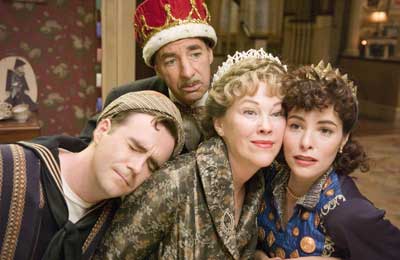
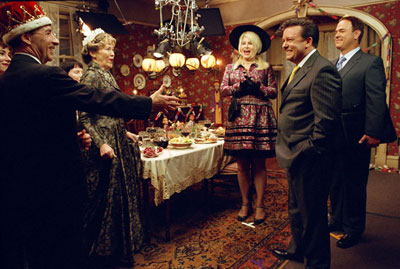
As the cast of characters is introduced and the scene is set, promise is shown. Guest himself plays Jay Berman, the director of the small Hollywood production, “Home for Purim.” The film stars veteran film actress, Marilyn Hack (Catherine O’Hara), as a mother nearing her death whose family has come home for the Jewish holiday. Joining Hack in front of the camera are Dad (Harry Shearer), son (Christoper Moynihan), daughter (Parker Posey) and her (scandal!) girlfriend (Mary Pat Hooligan). Other Guest regulars like John Michael Higgins as a neurotic PR guy and Jennifer Coolidge as a vapid producer fill out the space behind the camera. Bob Balaban and Michael McKean play the possessive writing team while Fred Willard and Jane Lynch play entertainment show hosts with permanent smiles hiding their empty souls. The size of the cast stretches so far that when Marilyn learns that an internet site believes her performance to be Oscar worthy, the reaction ripples further than it should. There is no time to develop anyone past the quirkiness that exemplifies most Guest character creations. With a running time of under an hour and half, clearly the time could have been taken. O’Hara’s Hack does receive more focus than any other but even her storyline seems to be missing an enormous chunk as her progression goes from intriguing to perplexing. The Oscar buzz leads to more attention and more focus on the cast and then suddenly, the film ends. I felt as though nothing had happened when so much should have.


While the film does not satisfy on the surface, it does make a strong statement on the ridiculousness of the awards season. Now I’m an Oscar enthusiast but even I can acknowledge how silly the whole thing is. The title, FOR YOUR CONSIDERATION, comes from a common practice for production companies to take out full page ads in Variety asking Academy voters to consider a particular performance when they are making their picks. In the context of Guest’s film, it seems to be asking voters to consider something else entirely, like how out of control this process has become. Recognizing certain performances over others negates the craft itself and creates a hierarchy of status amidst the acting community. As if actors didn’t doubt their abilities enough to begin with, the need for an Oscar to validate your career choice forces talent to become second to recognition. Guest’s inclusion of the entertainment show or film critics and fair-weather executive producers only further criticizes all the hands that manipulate the machine. No role in Hollywood goes untouched by Guest; they all get swept up in the false reality of the pinnacle of success known as the Academy Awards.

Ironically, Catherine O’Hara’s performance in FOR YOUR COSIDERATION has begun to generate some Oscar buzz of its own (which I just contributed to). But anyone who knows a thing or two about what gets a name onto an Oscar ballot knows that no matter how good a performance is (and this one is pretty darn good but not that good), if said performance is better than the film it comes from, the walk to the podium gets that much longer. Christopher Guest better make sure he books ad space in Variety early.

Sunday, November 19, 2006

FAST FOOD NATION


Written by Eric Schlosser & Richard Linklater
Directed by Richard Linklater

I’ve tried on a number of occasions to eliminate McDonald’s from my diet. The first time I tried was a few years back, after reading Eric Schlosser’s non-fiction work, FAST FOOD NATION. I remember going to buy fries for the last time before reading the chapter entitled, “Why the Fries Taste so Good.” I had to go for that last fry before I could never look at them the same way again. I went for months without a Big Mac or a Quarter Pounder with cheese but it didn’t last. Eventually I succumbed to my cravings that persisted despite the time that had elapsed. I knew what I was doing was wrong but as I bit into my two all-beef patties, special sauce, lettuce, cheese, pickles and onions on a sesame seed bun, I conveniently forgot about all the chemicals in the meat, the subliminal advertising geared towards toddlers and the migrant, illegal workers in dangerous meat rendering factories that made my burger possible. No sooner had I had my last bite did my stomach twist into a tangled mess. The pain was both horrible and familiar. Unfortunately, Richard Linklater’s narrative interpretation of Schlosser’s novel is nowhere near as nauseating or as a big a turn-off as the feeling of a Big Mac sitting at the bottom of your stomach.

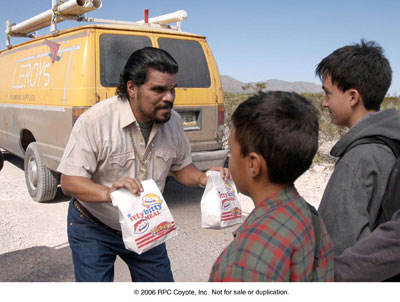
The decision to translate FAST FOOD NATION from a non-fiction work of in-depth investigative journalism into a narrative film is a bold one. I was apprehensive at first but Schlosser’s involvement co-writing the screenplay with Linklater made me less so. Shaping facts into a story certainly humanizes the global implications of the fast food industry but if the narrative is not compelling then there isn’t much of a point. FAST FOOD NATION tells different stories to show the wide reach of how many are affected by the fast food industry. Greg Kinnear plays Don Anderson, an advertising executive responsible for The Big One, the latest burger success at Mickey’s, the fictional fast food chain at the center of the film. Don must investigate reports that there are significant traces of cow manure in the meat (Fun!). Ashley Johnson plays Amber, a teenage Mickey’s employee who juggles school and work while she begins to see her role in the corporate machine that is waiting in her future. Wilmer Valderrama and Catalina Sandino Moreno play Raul and Sylvia, two Mexican illegal immigrants who have been brought into the United States specifically to work at the rendering plant that manufactures the millions of patties that become The Big One. Very little is revealed about the characters themselves as they are merely symbols for the bigger picture. Consequently, there is very little identification with the film. A film that is trying to tell everyone, “America … this is what you’ve become,” needs the audience to feel like this is their America.


What FAST FOOD NATION best exemplifies is America’s complacency with the progression of its society. The problems don’t stop at Mickey’s. The fast food industry is merely just one faceless industry that is driving the American people into hopeless futures. Kinnear’s Don is a prime example. He has spent his life packaging products, feeding them to people the way they like it. All the while, he has also been feeding his convenient lies to himself as well. A successful burger comes at a cost and as he travels from his board room to the assembly line and begins speaking with people who don’t have any stake in the production of The Big One, he understands that there are truths under his lies that he cannot go on ignoring. By the time we see him bite into his third burger, his apprehension to do so is rampant. Yet, he still takes that bite. This is what we do. We get fed a ton of information from different angles. The product pushers tell us how wonderful it is and the non-believers prove otherwise. Schlosser’s book, which clearly details all the subtle atrocities the fast food industry unleashes into the fabric of America to make one more dollar at the expense of its loyal customers, is well researched and fact-checked. The flip side to the convenience of fast food, from obesity to the exploitation of underage employees, is being discussed by too many people and with increasing validity to be ignored. Yet millions still take that bite.

Linklater does not shy away from expressing his disappointment in the American people nor does he mince words about his lack of optimism relating to making change on the subject. Each character’s story is brought to a close and none of them are any better for any of their efforts. Some end up exactly where they wanted not to. Some end up continuing to support the industry despite their newfound knowledge. All these choices are made to ensure money is still coming in, to ensure the American dream is still within reach. Even the youth of tomorrow fail at their attempts to affect the future. The attempt itself does show a trace of Linklater’s hope, albeit it fleeting. Despite all this, Linkalter still wants to do his part. The last ten minutes of FAST FOOD NATION bring about some of the more gruesome footage found in the film. We finally get a tour of the “kill floor” at the rendering plant, with plenty of blood and eaad cow to go around. The nausea comes too late in FAST FOOD NATION but you certainly won’t be rushing for another burger any time soon.

Friday, November 17, 2006

LITTLE CHILDREN


Written by Todd Field and Tom Perrotta
Directed by Todd Field

Writer and director, Todd Field has a special talent. He has a knack for making his audience squirm in their seats while their stomachs turn. He is not a master horror filmmaker but rather a minimal dramatist with a keen understanding of the peculiarities of human behaviour. I left his latest film, LITTLE CHILDREN, feeling like I might throw up, just as I had when I left his first and last film, IN THE BEDROOM. Only this time, I left with more than just feeling that I had been emotionally hollowed; this time I left feeling puzzled. At this point, I would ordinarily explain briefly what LITTLE CHILDREN was about but that is a task I cannot do briefly. Put simply, without grasping any of its scope at all, LITTLE CHILDREN is another slice of life picture about the banalities of suburban existence. The mommies meet in the park on a daily basis and ogle the one single dad amongst them as their kids run amuck. Husbands turn to internet pornography or other women to get the fixes they stopped getting from their wives before sitting down to dinner with them. And this particular neighborhood welcomes back a former resident, fresh from his stint in jail for exposing himself to a minor, by plastering every post on the street with signs that ask, “Are your children safe?” Field’s timely reveal of the story elements and skillfully vigorous visuals draw you in to the raw unraveling of his characters, gracefully played by Kate Winslet, Patrick Wilson and Jennifer Connelly. LITTLE CHILDREN is fascinating and compelling without having any clear reason why it is either of these things. You may ask yourself where this is all going when you watch but you won’t care to know the answer.

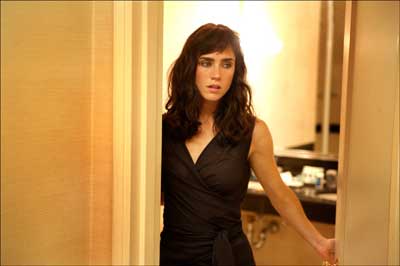
Life gets stale when you aren’t paying attention or even when you’re just trying to master the juggling act. Life is also very good at throwing another ball into the mess when you’ve just gotten the hang of juggling three. On one day, in the park and on a dare, Sarah Pierce (Winslet) introduces herself to Brad Adamson (Wilson). She has wagered five dollars with the other mommies that she can get Brad’s phone number. Both Brad and Sarah are married but that doesn’t factor into this game. At least it doesn’t until the bet somehow goes too far and the two kiss. They catch themselves and each other completely off guard. Sarah is married to a man she doesn’t love and has a three-year-old daughter for whom she has more distaste than love for. Brad has not been able to pass the bar exam since finishing law school and spends his evenings away from his wife (Connelly) watching teenagers skateboard when he’s supposed to be studying. Their kiss is meant to taunt the other mommies but instead it cracks their worlds open to reveal new possibilities. It isn’t long before they meet again and it isn’t long after that until they end up naked in Sarah’s laundry room. Given what an inattentive sap her husband is, it is a joy to watch Sarah send Brad signals, showing off her new bathing suit at the public pool or asking Brad to rub lotion on her back. It is also exciting to watch Brad reluctantly respond to these signals. He has a stunning and brilliant woman in his life and yet he navigates towards Sarah. It isn’t love that is growing between them but an energy that affirms to each that they are in fact alive.


LITTLE CHILDREN’s secondary plot is also brilliantly executed but adds a level of depth to a film that was already dug pretty deep to start with. When Ronnie (Jackie Earle Haley) moves back in with his mother (Phyllis Somerville), there is outrage amongst the residents of this suburb at the “pervert’s” arrival. Whereas Ronnie’s return defines the period in which Sarah and Brad’s affair takes place, it also makes the film seem as if it were trying to tackle more than it should have. The abuse Ronnie endures from some of the locals encourages sympathy for him but he is not reformed. Tying both plots together seamlessly, Ronnie violates his parole and, with flippers and snorkel in place, crashes the public pool in the middle of a heat wave, while Sarah and Brad flirt carefully in the shade. Ronnie lusts for all the tiny legs treading in the water until he is discovered. Amidst hysteria, all the children exit the pool into the arms of their parents and they all stare horrifically as authorities escort him out. What happens next is the perfect example of the dark humour that runs throughout LITTLE CHILDREN. Panic turns back into play in a split second as all the children jump back into the pool and the parents resume their previous conversations. Is Ronnie’s presence in the neighborhood truly causing anyone to lose sleep or is it just the drama that they all love? Crave? Need?

It was only after I left the theatre that I was able to reel in all my thoughts on LITTLE CHILDREN. A conversation in a yellow cab led me to see that the key lies in the title. As Sarah runs from the responsibility of having a daughter, as Brad plays football with his buddies when he should be studying, as Sarah’s husband surfs for porn while he’s at work, as Brad’s wife purposefully drops her spoon on the floor so she can look under the table to catch her husband playing with Sarah’s feet, it becomes clear that every one of these adults is doing the exact same thing; they are all acting like little children.

STRANGER THAN FICTION


Written by Zach Helm
Directed by Mark Forster

“Life is stranger than fiction,” or so the saying goes. Borrowing from the expression, Mark Forster’s STRANGER THAN FICTION is about one man’s life that has become the subject of soon-to-be published fiction. An as yet undetermined narrator announces at the very start that, “This is a story about a man named Harold Crick.” That narrator is revealed to be author Karen Eiffel (the always absorbing Emma Thompson), whose previous novels have all ended with her protagonists dying to serve the story’s greater purpose. Somehow, her voice has found its way from the pages that tell Harold’s story to the head of a man actually named Harold Crick (Will Ferrell). As she pushes through the novel that has taken her a decade to complete, Harold begins to hear her voice wherever he goes. As she points out his obsessive-compulsive behaviour, he begins to question the strict structure that has kept his life in order for years. When Eiffel announces that he is unknowingly spiraling towards his imminent death, he has heard enough. The funny thing is Harold’s death was imminent before someone told him it was. He just needed someone to remind him that he should probably get around to doing some living while he was still alive.

But is this actually a story about Harold Crick? Is it not just as much a story about Karen Eiffel? After all, she knows the story she is telling so well that her words and voice have torn some line in the fabric of the universe to make it into Harold’s head. I don’t know how likely that is in real life but I’m pretty sure it would never happen if there weren’t an intense cerebral connection between the two parties involved or if he weren’t a complete fabrication of one’s imagination. At first glance, Crick and Eiffel seem like people on entirely opposite ends of the spectrum. After a closer look, they are clearly in opposition to each other but they inhabit the very same spectrum. Both are shown as obsessive-compulsive people. Harold counts his brush strokes and goes to bed at exactly the same time each night. Karen lives a reclusive life in a starkly white apartment, extinguishing her cigarettes in spit-damp tissues she tucks away in her pockets. Both attempt to exert high levels of restraint in their lives to maintain the illusion that they command the direction their lives will take, one through chaos and the other through control. It is also a convenient way to avoid experiencing anything frighteningly unknown.


Eiffel struggles with how to kill Crick for most of the film. How do you kill someone to make a literary point when their life barely has any relevance to begin with? Meanwhile, Harold’s recent bout with schizophrenia has him seeing how the tiniest changes in his life can make it all the more exciting. Funny how the knowledge that death may be around the corner acts as a good kick in the ass. The connection between Crick and Eiffel also exposes their attitudes towards life and death while helping each of them heal their apprehensions towards both realities. Crick had conveniently eliminated the possibility of death from his calculated existence. Eiffel’s eerie fascination with death had stopped her from seeing her own possibilities for happiness in life. As the two become more aware of the other’s existence, and subsequently more comfortable with that, they each begin to see what they were not seeing prior. Life will not be and will never seem worth living if you don’t take risks, no matter how small they may be; from wearing a sweater instead of a tie for a change to stepping outside your apartment and meeting new people.

STRANGER THAN FICTION is smart without being superior, funny without being asinine. Forster’s previous work has either bored me (MONSTER’S BALL), frustrated me (STAY) or filled my heart with warmth and my eyes with tears (FINDING NEVERLAND). Here he creates a poignant piece about a woman telling the story of a man because its easier than telling her own story. Her real problem with killing Harold Crick is that she no longer knows if she wants to. Killing Harold would just mean metaphorically killing herself again. Writing Harold’s newfound appreciation for life has sparked her own and Forster hopes her reminder will be one to us as well. Not to sound too morbid but our deaths are as imminent as Harold’s. The film’s subtle layers expose a simple insight about the distance between our lives and the stories we tell about our lives. These stories are told to create meaning and give shape but we all run the risk of missing out in the process if we don’t allow for the unexpected.

Sunday, November 5, 2006

BABEL


Written by Guillermo Arriaga
Directed by Alejandro Gonzalez Inarritu

Mexican director Alejandro Gonzalez Inarritu has a point to make with his second Hollywood offering, BABEL. He wants us to see how we don’t listen to each other and to what extent that is making all of our lives more difficult. To do this, he tells four different stories where characters find themselves in situations where they are not understood despite all their efforts to be. These stories stretch across the globe, from Tokyo to Mexico and center around an incident in Morocco that sparks an international scandal. Inarritu treats his imagery like poetry and has created a stunning picture with pacing that ranges from peacefully prophetic to tensely wrenching. But despite its unmitigated design, there is a larger irony undermining BABEL. It is a film concerned with the struggles faced when trying to get your point across that also wants to show how our lives are all connected yet its four storylines stretch to connect to each other and the point gets somewhat lost in that process.

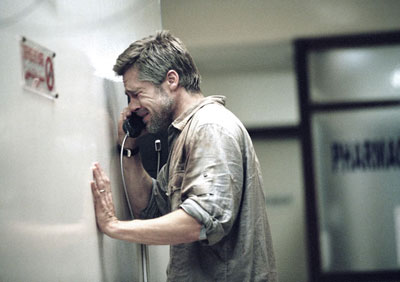
Brad Pitt and Cate Blanchett play Richard and Susan, an American married couple on a sour vacation in Morocco. Their youngest child has just died of natural causes and they have come to try to forget. Instead, the guilt and anger they could not express at home has only become more prominent in their isolation. A stray bullet hits Susan in the shoulder while she glares out her tour bus window and her vacation goes from bad to potentially tragic. The unfolding of this scenario best exemplifies Inarritu’s views on the frustration that often goes alongside communication. A desperately frightened Richard must get his wife medical attention in a town without a hospital and where no one speaks his language. He finds one tour guide who carries him through the experience, facilitating his translation. Speech is not his only barrier as this small Moroccan village’s medical treatment is far from what Richard is accustomed to in his privileged life at home in California. He then runs into trouble where one would not expect him to. He is unable to convey the seriousness of his wife’s condition to the remaining tour bus passengers, most of them American. He requires their support but they don’t listen to a word he says, focusing solely on their own needs, some selfish and some reasonable. As Richard is rightfully focused on his wife’s needs, he isn’t listening to them either and arguments ensue. Richard’s communicative difficulties also extend to one other person, Susan. Writer Guillermo Arriaga brings us to the most intimate frustration with understanding here when these two people require a brush with death to get them to be quiet enough to hear how afraid each other is and how responsible each feels for the death of their child.


The remaining plots branch out from this incident but whereas the execution of the plights is poignantly told, the connections themselves are weak or vice versa. Richard and Susan’s children run into trouble of their own when their Mexican Nanny, Amelia (Adriana Barraza) takes them over the border so that she can attend her son’s wedding. When reentering the United States, the border patrol are suspicious and begin asking many questions. Amelia does not have difficulties speaking English but does not answer their questions as well as she should. The film loses some focus here, as the patrollers’ approaches are more racist in nature than anything else. Whereas racism is certainly another form of fear and misunderstanding, this dire situation feels easily unavoidable and contrived to serve the film’s purpose. Meanwhile, in Tokyo, a deaf and mute teenage girl deals with the loss of her mother and fights to be heard when she can’t make any noise. Cheiko is played by Rinko Kikuchi; it is a vibrant and commanding performance. She herself cannot hear what others are trying to say and is limited in how she can communicate her own feelings and desires. Her struggle is only intensified by her lack of physical connection to other people, as she is an aggravated virgin. All of her attempts to entice are thwarted by her silent aggression and her incapacity to get anyone to hear her is heartbreaking. In many ways, her storyline is the most effective but it is only tied to the whole of the film because her father’s rifle was used in Susan’s shooting in Morocco.

The word “babel” finds its roots in an association to the Hebrew verb “balal,” which means to confuse or confound. Hence, when someone is said to be babbling, they are not communicating their point properly, just spewing out a bunch of unnecessary words that end up being entirely pointless. All of Inarritu’s words and images are carefully chosen and constructed in a concise fashion that is on many levels successful, but by trying to get across so much, he ends up narrowly but sadly missing his own point.