When asked to look back at the year 2000, or more specifically, the year 2000 in film, I remember distinctly being torn between not just two films that year but rather being torn over what constituted the true value of a film worthy of the title, “Best Picture of the Year”. The first of the two films in question captured my mind. It is a distinctly cerebral experience in its carefully plotted design and intricate balance of several different stories told simultaneously and the serious nature of its subject matter. The other film captured my heart. It is achingly romantic in tone and theme but it never crosses over into the saccharine. Instead, it honours the emotion itself as the governing force of life. What holds more value when it comes to film appreciation? An interaction with your emotional core or the provocation of thought? An appeal to one’s intellect or a plea to the soul? Which film is better? Steven Soderbergh’s TRAFFIC or Ang Lee’s CROUCHING TIGER, HIDDEN DRAGON?

The moment Li Mu Bai (Chow Yun Fat) and Yu Shu Lien (Michelle Yeoh) appear on screen in the same space in, the attraction between them is undeniable. Yet, the same can be said for their restraint. And so CROUCHING TIGER, HIDDEN DRAGON establishes its largest question; if love is the greatest gift that can bestowed upon man, so great that warriors such as these two fight in its name, why then deny this gift for yourself in favor of respect for social obligation? Li Mu Bai and Yu Shu Lien cannot be together because she was once promised to his greatest warrior brother. The two bonded after his death but have never acted upon their feelings as not to disrespect his memory. In many ways, Li’s fallen brother brought he and Yu together but in just as many ways, he made it impossible for them to be together. Now, Li is debating leaving his battles behind him and pursuing that which his heart has longed for for so long but duty almost seems bent on stopping this from happening as no sooner does he hang up his sword, it is stolen, forcing him to confront his oldest nemesis. It would seem that love and honour go hand in hand but honouring love in this case makes it impossible to experience it.

The romantic core of CROUCHING TIGER, HIDDEN DRAGON is certainly honoured by Ang Lee, who infuses the picture with fluidity and intensity, establishing a tone that can only be described as magical. (I suppose it could also be described as mystical, majestic or mesmerizing as well but you get my point.) The sword robbery prompts a sequence of battles that combine seamless excellence in cinematography, score, choreography and of course, performance (including breakout, Zhang Ziyi). Running on air across shingled rooftops or through towering treetops is visually stunning but also heightens the passion of an already fiery experience. When on the ground and engaged in combat or sword play, the actual fighting is so perfectly timed and executed against Tan Dun’s drum heavy score that it is often impossible to distinguish between what is fighting and what it dance. As usual, Lee’s gentle directorial hand allows for a vast canvas that takes on an enlightened stance all its own. In a film where all who have honour are bound by decorum and tradition, flying is possible and seems boundless but they are ultimately grounded by the same properties that make flight possible.

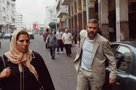
TRAFFIC is no less a technical feat. Based on the British mini-series, “Traffik”, writer, Stephen Gaghan, scaled down over 300 minutes of story to a scant 147. In it, he explores the war on drugs, from sales to distribution to border crossing to addiction and treatment. The severity of the situation is not glazed over in TRAFFIC and Soderbergh makes directing this enormous undertaking all look so easy. Considering the title, it is ironic that the film travels so easily back and forth between Mexico, San Diego, Washington and Ohio. The different locales and stories are all differentiated by color schemes – a yellow tinged Mexico stimulates our nervous systems while demonstrating a fragile city controlled by drug cartels and corruption and a blue Ohio allows us to dive deeper into the lows of addiction with a sedated effect. San Diego rather is painted in much more naturalistic hues, perhaps highlighting the normalcy of the drug sales in America. The action taking place in all these locations makes for its own contradictions as well, thanks to Gaghan’s delicate and precise screenplay. How else could one explain a film that is essentially anti-drug that exposes some of its more insightful musings during drug-addled hazes?

What is traffic after all but being stalled and surrounded by an endless see of obstacles ahead of you, stopping you from getting to where you’re going? It never feels as though it will ever let up or you will ever find a way to get through it all. While TRAFFIC is not entirely pessimistic, it is decidedly realistic. It never insinuates that the war on drugs is one that cannot be won but that perhaps the idea of winning needs to be modified. It seems almost naïve to think that drug usage will ever be irradiated from the human experience but with all the extreme violence that the trade creates, clearly the consumption needs to be scaled down significantly. Soderbergh is also careful not to suggest that he has all the answers. To him, it is clear that the Mexican drug cartels must be taken down; that the flow of drugs and firearms across the Mexico/US border needs to be cracked down on; and that we must no longer be afraid to look inside out own houses, at our own family members and friends to help bring them back to a place where they can truly see the world as it is. As Brian Eno’s “Ascension” plays over the film’s final frames, the idea of progress seems at the very least, possible.
Both films were released in December of 2000; both went on to earn roughly around $125 million at the box office; and both went on to win four Oscars each. It would appear that I am not the only one split on the two films. And as neither actually went on to win the Oscar for Best Picture, perhaps the debate will never be settled as to which film truly deserves the crown. Of course, it is fair to say that neither film actually needs to be regarded as better than the other. I can love them both equally for different reasons as I’ve got plenty of love to go around. After all, I spend so much time trying to get my mind and my heart on the same page, why would not apply that same logic to these two beautiful pictures? And as GLADIATOR actually went on to win the title that year, perhaps brawn is more appealing than brains and beauty combined anyway.
Both films ...

Black Sheep’s Top 10 Films of 2000
(in alphabetical order)
Best in Show
Billy Elliott
Chicken Run
Chuck & Buck
Crouching Tiger, Hidden Dragon
In the Mood for Love
Requiem for a Dream
Traffic
The Virgin Suicides
Wonder Boys