Showing posts with label gore. Show all posts

Wednesday, August 4, 2010

Images of MURDER

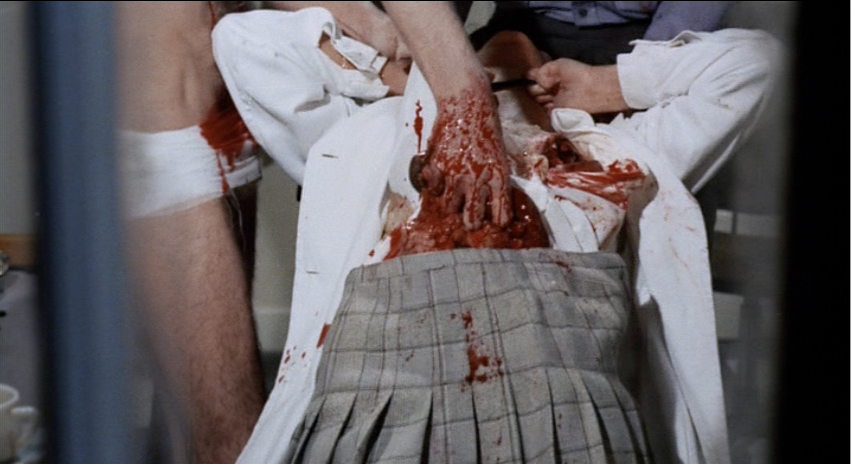
Horror is a very image-driven genre, centered as it is on eliciting primal emotional responses. And so, it's perfectly suited to the brand-new meme bouncin' around the blog-o-sphere, on which yours truly has been tagged. That's because it's an image-based meme, in which bloggers are urged to come up with a series of screen grabs, all focusing on a specific theme. The whole thing was kicked off a little while back over at the blog Checking on My Sausages, and I got pulled in after being tagged by my dear colleagues/readers Leopard13 of Lazy Thoughts from a Boomer and John Kenneth Muir of Reflections on Film/TV.

Seeing as this is a horror blog, don't be expecting this thing to resemble an Anne Geddes calendar. The theme I chose goes to the very root of what I believe makes horror horror--the fear of death. Or more specifically in horror's case, the fear of being killed. And so I've chosen a whole bunch of scenes of people being offed which I found particularly striking.

But before I get to that, I must get to this. As one of the conditions, I must now tag five other bloggers to continue the meme if they so choose. And so I select:

BJ-C at Day of the Woman
Andre Dumas at The Horror Digest
T.L. Bugg at The Lightning Bug's Lair
Stacie Ponder at Final Girl
C.L. Hadden at Fascination with Fear

And now, bring on the murder...

Night of the Living Dead (1968)

The Silence of the Lambs (1991)

Shaun of the Dead (2004)

Creature with the Atom Brain (1955)

A Nightmare on Elm Street Part III: The Dream Warriors (1987)

An American Werewolf in London (1981)

The House by the Cemetery (1981)

Frankenstein (1931)

Day of the Dead (1985)

Halloween (1978)

The Invisible Man (1933)

Grace (2009)

The Texas Chain Saw Massacre (1974)

Let Sleeping Corpses Lie (1974)

Nosferatu (1922)

Zombi 2 (1979)

Theater of Blood (1973)

The Shining (1980)

The Return of the Living Dead (1984)

Alien (1979)

That was some pretty heavy, grim stuff, wouldn't you say? Maybe we should cleanse the palate with this:


Awwwwwwwww. Much better.

Saturday, June 12, 2010

The Lucky 13: Week Four: Gore!


Although I may not be one of them, for many, the words "horror" and "gore" are just about synonymous. Let's face it--for many of us, it's why we got into the genre in the first place. There's nothing like some blood and guts to grab your attention, that's for sure; and ever since the demise of the Hays Code some 40+ years ago, horror fans have been treated to some of the most unthinkably grisly imagery imaginable.

This week in The Lucky 13, in conjunction with Brutal as Hell, we take a special look at our favorite splatter flicks--the movies that set the gorehound in us baying for more...

B-Sol on Dead Alive

The early '90s was a heady time for direct-to-VHS horror, with mom-and-pop video store new release racks filled to the brim with disposable frights, packaged in garish cardboard boxes. I can honestly say I might never have discovered Peter Jackson's Dead Alive back in 1992, had it not been for that striking box cover art, still among the most memorable I've ever seen. Of course, once I got the tape home, I quickly discovered that this movie was more than just a flashy cover. As I soaked in the cornucopia of deliciously over-the-top gore and literally laugh-out-loud humor, I found myself asking the question, how have I not heard of this movie??

The best way to describe it based on that first impression would be to say that if Monty Python had ever made a horror movie, this would be it. Off the top of my head, I'd have to call it the goriest flick ever made, and yet the gore is so outrageous that the movie somehow successfully remains a comedy right up to the end. The violence, as insanely graphic/imaginative as it is, is also firmly in the realm of the cartoonish. And quite frankly, I was eating up every erupting pustule, flesh-stripped skull and glistening digestive tract with a spoon.

Dead Alive is overflowing with more classic horror gags than you can shake a severed arm at. Who can forget the infamous graveyard priest vs. zombie kung fu melee? Or Baby Selwyn on the rampage in the park? And let's not forget, Jackson gave us zombie sex back when the guy who made Dance of the Dead was still begging his mommy to buy him Count Chocula at the supermarket. And just when you think the movie has gone completely insane, it takes you bravely into a whole new level of madcap insanity. Cap it all off with what has to be described as the single most bizarre, Freudian climax in movie history, and you have a film that fairly crackles with creative energy, showing the passion of its makers on the screen for all to see. I instantly fell in love with it, and made it the official movie I would use to completely freak out any of my friends who weren't used to horror movies.


From Beyond Depraved's Joe Monster on Aftermath

In this day and age of the horror film, gore seems to be used as more of a positive accommodation, a way to draw the bloodthirsty pre-teens into the theater seats. You can probably spot at least five DVDs at your local retail store that advertise the fact that they’re “COMPLETE AND UNCUT—ALL EXTREME SCENES INTACT!” or something along those lines. I can’t help but find this funny. Instead of shocking and repelling viewers, the gore in horror films is used as a marketing ploy to bring in more customers. One may ask “Is gore ever used to disturb audiences anymore in a horror film?” If you ever had the (dis?)pleasure of viewing Aftermath, you would be completely assured of gore’s damaging power.

Aftermath shows what happens behind the closed doors of an autopsy room when no one is looking. A demented medical examiner (portrayed with brilliance by Pep Tosar) lives out his twisted fantasies with a female victim of a car accident. He lovingly caresses her stiff skin with his gloved hands and gleefully cuts her clothes off. The imagination can fill in the gaps of what comes next. But that’s one of the factors that makes this film so brutal; it doesn’t let your imagination take over. Everything is played out with absolute clinical precision and detail. The camera never flinches as it depicts the horrid defilement of the corpse. It’s all carried out in such a mundane way that you begin to feel as if what you’re watching is completely normal. Tosar goes about setting up his camera, removing his pants, and applying lubricant to his gloves in a way that makes you realize that this isn’t the first of the character’s after-dark routines.

As for the red stuff, it is all too plentiful in this film. Within the span of 30 minutes, Aftermath packs in more gruesome set pieces than some of the “extreme” PG-13 flicks of today have in their entire running time. The very first thing we’re exposed to is the squashed carcass of a dog on a street. It only gets worse from there. Dissections of cadavers are performed with medical accuracy as skulls are ripped open with pliers and slimy organs are shoved inside ribcages. The examiner’s handling of his midnight partner is no better, especially seen in a squirm-inducing moment when he savagely uses a knife to penetrate the corpse. This isn’t delicate material, and director Nacho Cerda doesn’t spare us one agonizing moment.

But despite all the grue and viscera that assaults our eyes during the film, there’s an underlying feeling of beauty that permeates through the bloodsoaked images. The operatic score that accompanies the ghastly proceedings adds to the transcendental sensation. What we are exposed to may be horrible, but Cerda masters his use of stark, clear images and sound to create a work of art. In this way the audience begins to have conflicting feelings over the film. Is it a piece of beauty or nothing more than schlocky trash? In some ways it’s both, and can only be characterized as being beautifully disgusting. This is definitely the movie horror fans should watch if they’re looking for something to challenge both their stomachs and their minds.


365 Movie Reviews' Spencer Churchill on Guinea Pig: Flower of Flesh and Blood

The title alone arouses curiosity, and all that are willing to look will find the darker side of gore in the Guinea Pig films. Out of the series of seven doses of shock treatment, the second installment, Flower of Flesh and Blood, always captivated my attention. Flower of Flesh and Blood is dark and confrontational in an almost Mondo-esque way, with a pseudo-documentary approach. The foundation that the film is based on is that writer and director Hideshi Hino was contacted by a crazed fan, and sent a snuff film.

The film itself is not a full length feature, clocking in at a little over forty minutes, but is nevertheless very disturbing. The thing that stands out the most for me is the artistry behind the special effects. Since the vast majority of the film is set in the dingy, torture dungeon, I could not help becoming fascinated with the sheer brutal realness of the effects. If you find yourself becoming equally fascinated with the special effects, I highly recommend you look into the added "Making of" DVD that eventually proved their innocence against claims of snuff.

In my opinion, to an American viewer, this film contains a particularly horrifying element, namely the element of unfamiliarity. I have no idea how the Japanese people handle crimes or violence in general, so there is a great sense of unfamiliarity that haunts me the most. It is this added sense of fear that really puts this film above all other gore films in my book. Those who can stomach the visceral gauntlet that is Flower of Flesh and Blood will find that it is certainly worth its notoriety.


Cinema Suicide's Bryan White on The Story of Ricky

There are gory movies and then there is The Story of Ricky. In 1988, T.F. Mou's World WarII atrocity flick, The Men Behind The Sun, required the Hong Kong film industry to add a new category to its rating system. The hardest rating a movie could get at the time was Category IIB, which was a pretty hard R, but Men Behind The Sun was so incredibly hardcore that it required a new rating entirely. Category III came along and opened the door for producers to go off the reservation and come up with some of the most taboo-shattering movies the world has ever seen. Rapists and cannibals seemed to be the order of the day (and a healthy portion of explicit sex comedies) but in 1991, The Story of Ricky was released, adapted from a Japanese manga, and they added movies about guys punching people so hard their heads explode to that list.

Ricky is a prisoner in a near-future dystopia where the prisons have been privatized. He's in for killing the drug dealer responsible for the death of his girlfriend. The prison population lives in fear of the Warden's Gang of Four, four super powered criminals who eviscerate anyone who so much as look at them funny. As luck would have it, Ricky is also a super powered martial artist, and he's going to stand up to the Gang of Four and the evil Warden... mostly by punching holes in everyone.

The Story of Ricky isn't really a horror movie, but it has blood and guts out the wazoo. It's a stone-cold serious story about a guy in a corrupt prison setting and everything about it is played straight. The moment Ricky starts uppercutting people's jaws off, however, the movie takes a sharp left turn on its way to crazy town. The entire movie, start to finish, is a blur of bloody violence and the overall tone is akin to a Kool-Aid sugar rush. Talking about the violent highlights of the movie makes you sound crazy, or as though you're making it all up as you go along. Ricky punches a fat guy in one side of the stomach and his fist erupts through his stomach lining, resulting a flood of gore as everything falls out. Another scene involved Ricky being strangled by the intestines of a Gang of Four member who had just cut them out on his own. Tops of heads erupt from being hit, brains fall out, Ricky ties his own severed tendons back together with one hand and his teeth! Ricky punches a guy in the face so hard that the movie, in a tribute to Sonny Chiba's The Street Fighter, cuts to X-ray vision so we can see the skull cave under the force. Every gory and outrageous scene tops the last and the film's conclusion inspires peals of hysterical laughter when the Warden finally Hulks out and fights Ricky.

Not too put to fine a point on it, but I'm glad I live in a world where The Story of Ricky exists.


Fandomania's Paige MacGregor on Eden Lake

I can’t say that I chose to watch Eden Lake the first time because I’m a fan of the director or because the plot piqued my interest. In fact, I’d never heard of James Watkins and I decided to watch Eden Lake before I even read a plot synopsis. I can’t even credit my burgeoning interest in the academic side of the horror genre for turning me on to Eden Lake. The reason that I was so determined to watch this movie is both simple and embarrassing, and can be summed up in two words: Michael Fassbender. Little did I know how gruesome and disturbing my latest foray into the world of one of my favorite new actors would prove to be—nor did I expect that I was about to discover what has become one of my favorite horror films—when I popped the movie into my DVD player. In fact, by the end of the film’s 91-minute run-time I positively despised Eden Lake. It was only later, after reflecting on the profound effect the film had on me, that I realized how brilliant Eden Lake really is. But I’m getting ahead of myself.

Although the violence and gore featured in Eden Lake initially turned me off, it is that very gory violence that made such a lasting impression on me and later made me realize how well crafted this movie is. It’s true that films like Eli Roth’s Hostel and Hostel II are exceedingly gory and arguably highlight violence for the sake of violence (although yes, an argument can be made that there is purpose behind the violence in those films—but that’s a conversation for another time), but many films of that nature lack a certain degree of authenticity, which Eden Lake possesses. The brutal depravity displayed by the adolescent antagonists in the film is both horrifying and at the same time disturbingly realistic, a fact that contributes to the polarizing nature of the film.

The horror genre has a long history of exploring the concept of children as dangerous or frightening, and Eden Lake takes this notion to a whole new level. Inevitably some viewers will dismiss the actions of the youths in Eden Lake as unrealistic, but in my opinion nothing could be farther from the truth. In fact, antisocial personality disorder (the clinical terminology for sociopaths) is diagnosed in individuals over the age of 18 based in large part due to their actions in childhood and early adolescence. In other words, just because viewers might not want to believe that kids are capable of willfully and purposefully slicing and dicing someone like Steve doesn’t mean that it can’t or won’t happen—and it does so much more frequently than you might think, too.

As a person with a profound interest in both psychology and film, Eden Lake satisfies my interests on multiple levels. Not only is the film entertaining for viewers looking for nothing more than some gore and a good, suspenseful chase, but it will also speak to individuals on an intellectual basis—if they’re open to it, that is. Aside from its previously mentioned characteristics, Eden Lake is an excellent example of the unspoken preoccupation with the penetration and mutilation of the human body so inherent in the horror movie genre, especially in the gore subcategory that we’re examining this week. When you consider what gory horror movies like Eden Lake would be without violent, gruesome, or brutal penetration of the human body, whether with a machete à la Jason Voorhees, an axe, or a utility knife like that used by Brett and his followers in Eden Lake, the only conclusion is that the sub-genre would cease to exist altogether.

In summary, Eden Lake might not be the goriest of gory horror movies, but it succeeds in hitting several of my hot buttons, and therefore earned its place as my favorite gory horror film—and after only one viewing, too! I highly recommend that every horror fan check it out.


* * * * * * * * * *

Head over to Brutal as Hell to see what Marc Patterson and his crew have come up with. And if you're interested in taking part in the future, just give Marc or myself a holler.

Week 1: Grindhouse & Exploitation
Week 2: Creature Features & Monster Movies
Week 3: Demons, Witches & The Devil

Join us next week, when we'll be yucking it up with our favorite horror comedies!

Thursday, September 17, 2009

Retro Review: The House by the Cemetery

"Anne? Mommy says you're not dead... Is that true?"

Let me make this perfectly clear. I LOVE Lucio Fulci. Not everyone does. This is an argument that can never be won one way or another. Some love him, some hate him. Over the years, he's become one of my all-time favorite horror directors. It's been said that his films resemble nothing so much as "fever dreams" or nightmares, and I find this to be very true. Especially in a film like this, which may very well be my favorite of his.

Only Zombi 2 equals The House by the Cemetery among Fulci's body of work, in my opinion, and it is my personal favorite amongst his revered "Lovecraftian" trilogy. It may be because it's the most conventional, linear and plot-oriented of the three, I don't know. I just get a major kick out of seeing Fulci take on the tried-and-true haunted house subgenre, and adding his gore-soaked fingerprint to it. As I've written before, this is his take-off on The Shining.

First off, the thing that grabs me is what may be the finest of all the scores for Fulci's films, and that's saying quite a bit. This one comes not from Fabio Frizzi, Fulci's usual collaborator, but rather Walter Rizzati.

The lovely Catriona MacColl returns yet again in this final installment of the trilogy, playing Lucy Boyle, wife of Dr. Norman Boyle, and mother of young Bob (odd name for a little boy, no?) Just as in the other two films (City of the Living Dead and The Beyond), MacColl is something of an anchor for the film, with her excellent performance conveying so much of the horror.

And what a monster we have in Dr. Freudstein (great name!!), the bizarre, ghoulish undead denizen of the Boyle's creepy-as-hell basement. A deranged scientist who has somehow managed to prolong his life indefinitely by consuming the blood of the living, he is a truly dread-inspiring creation. We experience all the terror and slowly building panic of the Boyle family, and little Bob in particular, as we learn the truth of what evil resides in this new home they are trying to settle into.

Despite this being supposedly the most linear of the trilogy, it certainly has its fair share of surreal Fulci-ness. There's the prolonged scene in the kitchen with the vampire bat. The freaky housekeeper mopping up blood, and not even being questioned by her employer as to how the blood got there. And that ending, which makes about as much sense as any of the other endings to Fulci's films. But I think what most people misunderstand about Fulci is that these are not signs of poor filmmaking--rather, this was Fulci's exact intention, to throw you off your guard and create this not-quite-right version of reality.

As with any Fulci flick, the gore is here on full display. Few brought the grue like Senior Fulci, and this movie is no exception: necks spouting blood, maggot-filled wounds, throats ripped out, and the usual eye trauma is all here for you weirdos to enjoy. And for some reason, I care more about the victims this time around than in most of Fulci's other movies, which makes it all the more difficult to sit through.

I'm always a sucker for a horror flick that puts children in peril--this will always elicit a visceral terror response from me. And in this respect, The House by the Cemetery pushes all the right buttons. Although reviled by some Fulci fans, little Giovanni Frezza in the role of Bob is the perfect cherubic target for the demonic horrors of Freudstein, and he does well portraying a child for whom the irrational fears of nearly every child are actually real.

I will say this with regards to Bob, and this goes for the entire movie--at least the American print. Unfortunately, to my knowledge, there is no American version in Italian with English subtitles, which would've been my preference. And so, the only version I've seen is the one dubbed in English. More specifically, dubbed very badly into English. So bad, that it does occasionally take something away from the film, particularly in the case of the grown woman they chose to record Frezza's lines. I really wish this wasn't the way I experienced the film, but even through the bad dubbing, the movie's excellence shines through. I urge you to be patient with this one major flaw.

One of the most underrated of the films of Lucio Fulci, The House by the Cemetery is well worth discovering for any fan of haunted house films, gore flicks, or Italian horror.

* Thanks once again to the lovely Marilyn Merlot for this week's Retro Review suggestion!

Thursday, September 3, 2009

Retro Review: From Dusk Till Dawn

Horror fans have long lamented the genre wasteland that was the 1990s, and so this week I turn my attention to a film which, for me, is one of the bright lights of the entire decade. Robert Rodriguez' From Dusk Till Dawn may, in fact, be my favorite horror film of the entire decade. Or at least one of a handful of gems. For my money, it's just about the only fright flick from that era that captured the feel and attitude of the much grittier and more brutal horror fare of the 1970s and '80s.

Interestingly, it's actually two different movies in one, with the first half being your typical Rodriguez/Tarantino grindhouse action/crime flick. Then, in the midst of Salma Hayek's alluring striptease as the unforgettable Santanico Pandemonium, it totally shifts gears and turns into a balls-out, horrific gorefest. It's quite amazing, and in a way is a precursor to Rodriguez and Tarantino's Grindhouse of a decade later--an actual two-part flick consisting of both genres in two different films, Death Proof and Planet Terror. Only in my opinion, From Dusk Till Dawn did it so much better.

Back in 1996, the idea of Quentin Tarantino and Robert Rodriguez directing a vampire flick was pretty incredible. And boy did this duo deliver, giving us a horror movie with more style, attitude and sheer enthusiasm than most of the tame stuff that passed for horror around this time.

Actually, From Dusk Till Dawn resembles a Romero zombie movie more than it does a vampire movie, which is no surprise given Tarantino's professed love for Dawn of the Dead (before making it big, he even used to claim falsely to have been an extra in DOTD, to help him get acting roles). This especially shows itself in the concept of former friends and family members turning against each other without remorse, and the need to coldly do away with them once they do.

Particularly, the scene in which Harvey Keitel's character bites his own teenage son has always stayed with me, and is especially rough, especially for a movie that at other points takes such a comedic, almost light-hearted approach to the material. This is what makes this movie so much fun to watch, the way that Tarantino's script moves so deftly from one tone to the other, with Rodriguez' masterful touch keeping up with it every step of the way.

Only these two guys could've gotten Keitel to be in a movie like this, and it is a great thing that they did, because he is just terrific as a fallen priest trying desperately to hang on to his faith enough to be an effective vampire killer. On the cusp of a big-time Hollywood career, former TV star George Clooney is also on-point as the reluctant leader of the ragtag crew of vamp stakers.

And given this is a film made by lovers of the grindhouse aesthetic, we are treated to a plethora of cult actor appearances, including Tom Savini, Fred Williamson, Cheech Marin, Danny Trejo and John Saxon.

The violence and gore is at a level that wasn't seen all that much anymore in mainstream American horror at the time. For the most part, the '90s was kind of a reaction to the excessive stuff depicted in the '70s and '80s. But this movie bucks the trend big time, giving us graphic bloodletting and vampire feasting galore.

There's so much to recommend here. Juliette Lewis in another of her memorable performances. Some great chemistry between Clooney and Tarantino as the Gecko brothers during the film's early, more Pulp Fiction-esque sequences. Cheech's classic monologue outside the saloon. And did I mention Salma Hayek's striptease?

In closing, for anyone newer fans who have been disappointed in what the '90s had to offer in the way of horror, check out this movie. If you're a long-time fan of the genre who bemoaned the lack of quality films at that time and somehow missed this one, correct the omission immediately. In the past 15 years, only Let the Right One In (a very different film) could be considered a superior vampire movie.

Forget Grindhouse--this is Tarantino/Rodriguez horror at its best.

Sunday, June 14, 2009

The VOH Roundtable: Does Horror Ever Go Too Far?

This week in the Vault of Horror Roundtable, we three blowhards answer the touchy question, do horror movies ever go too far? I'm really proud of the variety of responses we've got this time around, so let's jump right in...

B-Sol
This is a very tough question for me to pose, because in my estimation, the answer has changed over time. If someone had asked me 10 or 15 years ago if horror movies ever go too far, I would have definitely said absolutely not. Bring on the gore, the sicker the better! I reveled in it, and look, I'll be honest, to a certain degree, I still do.

And yet, I think some things have changed for me and the way I watch horror movies over the years. Some will no doubt accuse me of going soft because of this. Be that as it may, in recent years I have found I have a much harder time watching certain things than I ever used to. Maybe it's the changes wrought on my psyche by bringing children into the world, or just the accumulated effects of being a grown-up and dealing with the daily horrors of the actual world we live in on a mature level.

Whatever the case, I truly believe that in the past few years, I have found my limit. And that happens to be what is now commonly referred to as "torture porn". Now that term is often used unfairly and inaccurately, so allow me to specify. I think it's probably safe to refer to Hostel that way, since that's basically the flick that the term was invented for. And that's specifically the movie which, after watching a copy of it lent to me by a coworker who heard I liked horror movies, taught me that I do indeed have a limit.

My main problem with Hostel was that I found it to be a movie created for the sole purpose of showing me graphic depictions of dramatized torture. The plot was paper thin, as were the characters, and it was quite obvious that Eli Roth's goal was to titillate through violence, without even the flimsiest of dramatic justifications. Now slasher movies, in their day, were accused of showing contempt for their characters--but that's nothing compared to the way a movie like Hostel invites us to take a sick kind of pleasure out of watching people be mutilated and killed.

I found the movie to be the complete antithesis of entertainment, and could not imagine wanting to ever see it again. Now, don't get me wrong, I believe that not all works of art are required to be entertaining. Watching Schindler's List, for example, is not something I would ever describe as entertaining, but that movie serves a purpose, has something to say, and isn't all about pruriently depicting scenes of concentration camp brutality.

I was shaken up by watching Hostel, and not in the good way I expect great horror films to shake me up. In a disgusted, "what has the genre come to" sort of way. And following Hostel, I came to find the same type of thing popping up in other movies. Saw III, for example, gave me a lot of trouble watching it in a movie theater when it first came out. The original Saw was a clever, original, suspenseful film, that wasn't at all about sadism and gore. But this third installment abandoned all that in favor of following in the footsteps of Hostel, and I found myself depressed by the result. I remember thinking, "Why am I sitting here watching this? What is there that's entertaining or interesting about this?"

One last example I'd like to point out is The Strangers. This was a movie I enjoyed, but there was a bit at the end that really bothered me. It's the scene in which the couple is finally killed. I felt dirty watching this scene, and the simple reason was that I found it to be shot the way it was and included for a sad, sadistic, and anti-dramatic purpose. There was so suspense or narrative function to it at all. We knew there was no chance they could ever escape, and in the end what we are afraid is going to happen is exactly what does. It was drawn out, cruel, and demonstrated a kind of sick glee in forcing us to sit and watch two characters slowly tortured and killed. Honestly, it was repellent.

And so, after all, it seems that B-Sol, the shameless horror fanatic, does indeed have his limits. I will admit that the passage of years has had something to do with it. Extreme, prolonged and utterly gratuitous violence no longer does it for me like it used to. Ah, to be young again...

BJ-C
When B-Sol asked me "When do Horror Films Go Too Far?" I kept racking my big ol' brain trying to pinpoint an example to rant about for being disgusting, inhumane, disgusting, or emotionally scarring. You know what? I couldn't think of a damn thing. Sure there are topics that upset me like killing children, graphic rape scenes, or eye mutilation, but I in no way would ever claim that exploiting these said actions is going "too far". Torture Porn, Animal Cruelty, Rape Revenge, or Home Invasion Films tend to be the ones that get the most slack for going "too far". My argument is however, who are we to judge? I personally can stomach just about anything, but my Mormon friend (that is one of 17 children) can barely handle Shaun of the Dead.

As a theatre major, I have been trained to see things from all angles. The thing I love the most about cinema, theatre, and the performing arts in general; is that they are all open to interpretation. Everything artistic is always in a matter of perspective. If beauty is in the eye of the beholder, doesn't that mean repulsiveness should be as well? Da Vinci even said that "an extremely ugly person is just as unique and special as an extremely beautiful person". Although it is off-putting and sometimes uncomfortable to see these "too far" horror films, I feel that it is just as impressive and draws me in just as much as a beautiful and moving film.

I feel that it also goes along with the saying of "there's no such thing as bad publicity". Just recently, the film Anti-Christ has been getting a lot of shit for having genital mutilation, and unnecessary sex/violence. However, is there any other film at that festival that was getting as much news as Anti-Christ. The answer is no. Human beings retain memory that consist mostly of two options. Extremely wonderful things like a wedding day or a birth of a child or absolutely heart wrenching things like a family death or a traumatic experience. For us to claim that horror films can go "too far" is denying the human psyche to have a contrast to the more "acceptable film".

I had written on Day of the Woman as a hot topic if rape was ever acceptable in horror films. As much as it makes me sound like a cruel and unusual person, I came to the conclusion that Yes. It is acceptable. We cannot sugar coat reality when we put it into a film. Most people are under the impression that performing arts must be "entertaining" however, that was in 1950, and we are long from that. Films and plays have begun to completely say "fuck the audience, i'm going to write what i want to write" and i must say i find that incredibly inspiring. As much as we may not like to hear it, the world is a disgusting, cruel, brutal, and terrifying place. This isn't to say that I don't believe there is hope, but I'm not going to lie and say we live in a peaceful environment. Art is imitating life after all and why should we put a barrier on what is acceptable? Look at the evening news...no one talks about a dog who saved Billy from the well or barn fire, we talk about gang shootings, wars, and the tragic tale of Caylee Anthony. How can we have no problem spreading these stories like herpes on our nightly news, but we can't have a child being murdered in a film? That sounds not only hypocritical, but boarderline unconstitutional.

The same could be said for the Animal massacres in Cannibal Holocaust. However, as much as I personally cannot agree with killing animals for the sole purpose of "entertainment", the film was killing the animals to make a point. I can understand along side the creative minds behind the animal killings, however I can not personally justify the actions. I am however only a 19 year old girl, so I have no room to tell anyone how to make a film. Which is like most audience members. It doesn't matter how many films I've seen, how many reviews I've written, or how much research I have done...the films I see are not MINE and the only people who have the true liberty of critisizing or measuring a piece of work, is the creator. You know "God is the only one who can judge me?" Well that's because he is the creator. So who are we to judge other's creations?

Again, I'm about to sound like a heartless bastard, but I LIKE when films push the envelope for me. It sort of pimp smacks you in the face and shoves a hell of a lot of reality down your throat, which to be honest, is something I think we need from time to time. So many people live in this fairytale fantasy land where everything is wonderful and squeaky clean. Which I will firmly say is the single strongest reason why the Twatlight series has such a following. Teenage girls don't WANT fanged, bloodied, nocturnal boyfriends. They want ones that sparkle in the sunshine...so in that sense, I guess I can finally understand why the hell people missed their classes the day after the film came out on DVD. I will however say, I was NOT one of those people. Same thing with the PETA videos. They know exactly how to push the button and make you so incredibly disgusted, you don't want to ever eat meat again. It's a tactic, and it works.

So to put it simply, I don't think films can EVER go too far. Art is meant to be a perspective and what bothers you, may fill others with delight. My whole thing is that if its going to bother you, then don't watch it. No one is forcing you to sit through something, you have the ability to either leave a theatre, or eject your DVD. We as mere audience members however, cannot put a scale in which to measure the fucked-up-ness of a film. Is it mildly fucked up to say that some people get off at seeing torture porn? Mildly. But hey, diff'rent strokes for diff'rent folks.

RayRay
My first reaction to the question of whether a horror movie can go too far was "of course." There have been horror movies that have gone too far and disturbed me. One right off the top of my head was Se7en, with it seemingly never ending mortification of human flesh.

But now I have been asked to think about it and give real examples.

The horror genre, be it by film or novel, is wholly wrapped up in giving us terrible visions of what we would we never normally see. We vicariously experience many things, be they monsters, or ghosts, or killers, or natural events. Part of the point is to shock us.

To that end horror movies have shown us terrible, terrible things: graphic gore, child death, violent rape, intense cruelty, advanced decomposition.

So, even when it is most disturbing, an argument can be made that, in the name of art and terror, that a horror movie cannot go too far. But we all know that isn't true.

So now it becomes my task to figure out a movie has gone too far.

Typically, extreme violence and the resultant gore are the major culprits of going too far. There was an article in the New York Times asking this same question. It was in 1982, and was in response to the gore and slime of John Carpenter's The Thing. Carpenter had just appeared on David Letterman's show, and had showed the clip of the dog-thing. Back then The Thing was widely panned, and the amount of gore, etc., was the cited reason. Yet the massive cult following indicates that The Thing, now hailed as one of the best horror movies of all time, did not go too far

Movies like Cannibal Apocalypse [which truthfully I have yet to see, but am familiar with many of its images], Last House on the Left, and the recent House of a Thousand Corpses all are incredibly violent, sadistic, gory, and while pushing every envelope I can think of, did not go too far. In fact, all three are classic horror movies in their own right.

At the same time, movies like the Hostel series and Turistas, and other so called 'torture porn' I can consider having gone too far. Why? I suppose this has something to d with my distaste of the unnecessary cruelty embodied by such films. "Unnecessary cruelty? But that's what those movies are about!" some might retort. Yes, and that is all they are about. One might even then question me about the difference between House of a Thousand Corpses and Hostel. And I would say that the difference lies in the stresses the director one puts on what we see.

In House of a Thousand Corpses, the director created characters to identify with and against that had substance, and in one or two, they were more than a little campy. The violence was a means to an end, as well as a symptom of some greater sickness in those characters. There was more to the movie than just violating the human form.

In Hostel violence was the goal. While the premise wasn't terrible, the story never carried further than the murder of tourists. When you think about it, the most clever thing about Hostel is the director makes you into one of the purveyors of snuff, because the big payoff is all about watching what's going to happen to that Asian girl. In Turistas the payoff was watching a dissection of a girl. Is it the violence and the guts, though? No. Rather, it is the lack of story to contextualize the violence.

And when you consider that Se7en has some scenes, and puts some truly terrible ideas in one's head to replace what was not graphically depicted, I can conclude that going too far is not about the blood and guts, and therefore violence. Even such things, like violent rape, as in The Hills Have Eyes, or child death, like Pet Semetary or Jaws, are not verboten, so long as the underling storyline supports the relating of these acts or events.

Even mass death is not, in itself, going too far, though film makers might fear it. In the 80's we were treated to docudramas like the unforgettable The Day After and the even more compelling BBC production, Threads [shout-out to my girl BJ-C for reminding me of Threads]. To those of us who have grown up after the threat of nuclear annihilation is no longer an ever present threat to civilized existence, both films depict, at times graphically, the run up, actual event of, and aftermath of a full scale nuclear exchange. The Day After was so graphic [for a TV production] that there were warnings before and during its broadcast, and was even credited by Ronald Reagan in altering his thinking about nuclear weapons. Yet there are tales, as always, about the even more terrible and disturbing scenes left on the cutting room floor.

Threads was an even more graphic telling of a nuclear exchange, often using stock war photos of masses of strewn bodies from the Second World War and other conflicts to bolster the charred corpses actually used on its sets. Yet, considering the purpose and the topic, there is no limit to how much gore a director might use.

And let's be honest: the most terrible thing I can see in a movie is nothing when compared the the very real events of the tribal war between the Hutus and Tutsis, the mass rape and genocide in Darfur, and all other genocides. Even much smaller tragedies, like the euphemistically termed mass suicide at Jonestown is a more terrifying, and was more graphically disturbing to me when, as a young boy, I saw the news footage of all those bodies from the air, than anything I can imagine reproduced by special effects on film. Even "just" wars leave charred bodies in unnumbered piles.

Therefore, I will conclude my meandering with this result: yes, a horror movie goes too far when it seeks to do nothing but to shock without trying to do anything more. If the movie is but violence for violence sake, without story or context, then it is probably going too far. If that's what you want to see, go rent Faces of Death or surf the web for photos of the Holocaust. But if the writer and director give the audience a story, a reason, a cause, a lesson, anything other than rote brutality, then the sky just might be the limit.

Wednesday, May 20, 2009

IFC Picks Up Distribution Rights to Year's Most Controversial Flick

The net has been awash with buzz regarding the Lars Von Trier shocker Antichrist ever since it resulted in a major blowup on Monday at the Cannes Film Festival. But now, it looks like all that controversy did was land the movie a distribution deal. Which anyone with any media savvy could've predicted anyway.

The blowup revolved around what has been described as "explicit sexual gore" in the picture, referring presumably to scenes depicting such things as bloody masturbation (that should rack me up some Google search hits...) Apparently, some members of the press took serious offense, and a shouting match actually ensued between journalists and the rather eccentric Von Trier, who laughed off their outrage dismissively.

"Since it premiered at Cannes on Monday, we haven't been able to stop 
talking or thinking about Antichrist," IFC Entertainment president Jonathan Sehring said in a story reported today on Horror-Movies.ca.

The film stars Willem Defoe and Charlotte Gainsbourg, who play a couple recovering from the death of their child who retreat to a lonely cabin in the woods (and if horror movies have taught us anything, it's that nothing good could ever happen in such a place). The movie apparently also hinges on the conceit that the world was in fact created not by God, but by Satan.

IFC will be handling the American release of the film, although it is not yet announced whether that will be theatrical or direct-to-DVD. The German production will be making the rounds in theaters across Europe throughout the summer and fall.


P.S. If you've read and watched all this and don't immediately want to board a plane to Europe to see this thing, then you're reading the wrong blog.

Thursday, May 14, 2009

Retro Review: Zombi 2

For my first installment of Retro Review, I've selected a movie that is now one of my absolute favorites, but which I put off watching for years: Lucio Fulci's exploitation epic, Zombi 2 (a.k.a. Zombie).

Let me explain a bit. I had been hooked on zombie flicks ever since age 15, when I watched Dawn of the Dead in my best friend's girlfriend's house while said best friend was busy georging said girlfriend's romero in the other room. You could probably go back a couple years earlier, when The Return of the Living Dead first tore through my pre-teen psyche. But the one movie I kept avoiding was Zombi 2.

I think it was that horrifying box cover I had seen glaring at me for years in the video store. Or all the heinous things I had heard about it, how it made Day of the Dead look like Fried Green Tomatoes and such. Back in those days, I really did have the benefit of a much more visceral reaction to horror movies than my more cynical, world-weary self can muster up these days. And zombie movies in particular drew me in with all the power of a five-car pileup on I-95 that you can't help but stare at, despite the fact that it would really mess you up. In short, I absolutely loved them at the same time that they filled me with legit dread.

I knew Zombi 2 would be the ultimate adventure. And when I finally crossed paths with it, I turned out to be right.

It happened about ten years ago, when this cheesy, third-string pay-per-view provider I used to have presented a Halloween double-bill of Zombi 2 and I Spit on Your Grave (trick or treat, kids!!). Having the movie all but dropped in my lap, I knew I simply had to tape it. The time had finally come to confront Fulci.

I don't think I can understate the sense of raw terror that filled my gut as I sat there watching it for the first time, completely alone in my newlywed apartment. From the second that astounding Fabio Frizzi score kicks in, I was off to the races. Easily one of the most powerful horror scores of its era.

Yes, it was filled with all the cheesiness we've come to expect from exploitation flicks of this ilk. A plot that often bordered on the irrelevant. A pace that might pose a challenge to the more attention-span-deprived viewer. But, truth be told, I was drawn in by the "fever dream" quality of Fulci's work, the effortless way that the man created atmosphere, zealously throwing all his efforts into grabbing hold of your emotions in that very Italian way--logic and continuity be damned!

Richard Johnson delivered pure, bleak desperation in his performance as Dr. Maynard--and this was years before I would come to love him as another doctor authority figure in The Haunting. And Tisa Farrow--boy did it screw with my mind trying to process the fact that the sister of Woody Allen's leading lady was the girl fleeing from cannibal corpses in a Euro-trash grindhouse flick!

There are so many aspects that have been discussed ad nauseum, but which were all new to me. The breathtaking zombie vs. shark scene, which to this day impresses me for the sheer ballsiness of it. The nearly impossible-to-watch eye impalement scene, a prime example of Fulci's innate ability to locate the core of what revolts the average viewer and poke at it relentlessly with all the ardor of a little boy pouring salt on a slug.

And then there was that moment I had seen bits and pieces of, and dreaded most of all--the conquistador graveyard scene, in which one of our heroines has her voicebox torn out in lovingly graphic detail by a worm-eyed zombie who--despite his extreme groadiness--had actually held up quite well for being dead and buried for 400 years. Maybe I'm just a big detail person, but I can never get over the way that Fulci's makeup genius Giannetto de Rossi went to the trouble of simulating mucus spewing forth from Auretta Gay's severed trachea. Blood is one thing, but that, my friends, is what you call going the extra mile.

God bless the Italians and their twisted Roman Catholic fixation on the perverse horrors of the undead. Because the gore is really what it's all about when you sit down to watch a Lucio Fulci picture, isn't it? And Zombi 2 delivered beyond my wildest dreams. Stripped of all the pesky social commentary and humor that Romero peppered throughout his films, Zombi 2 is instead a veritable orgy of mercilessly graphic and unspeakable violence. I always hear about the small budget they had to work with, and the corners they cut, but I'll be damned if this still isn't some of the most terrifyingly realistic looking stuff I've ever seen in a horror movie, period.

Fulci is definitely an acquired taste, and he isn't for everybody, no question about that. But I'm here today to declare whole-heartedly that he is for me--and it all goes back to my discovery of this 1979 classic. Now, there are those who will point to his later "trilogy" of City of the Living Dead, The House by the Cemetery and The Beyond as being all superior, but I disagree. While I enjoy those films very much, particularly House by the Cemetery, Zombi 2 will always be my favorite Fulci. It could very well be, plain and simple, the purest zombie film ever made.