Showing posts with label Charlize Theron. Show all posts

Friday, November 27, 2009

THE ROAD

Written by Joe Penhall
Directed by John Hillcoat
Starring Viggo Mortensen, Charlize Theron and Kodi Smit-McPhee


Man: I think it’s October but I can’t be sure.

We all walk it. At times, we might think we know where it’s headed but we would be lying to ourselves if we said we knew that with utter certainty. The fact is that the world outside your window is constantly changing and one day, it may not even be there. It is the manner in which you handle that fact that defines a significant part of who you are. You could not bother with any of it seeing as how it is all essentially meaningless anyway. On the other hand, you could see the time before you as precious and infuse it with everything you have in order to create your own meaning in this great, big world. There is no right or wrong way to do it but your shot is now and you’re walking down that road whether you want to or not. Do yourself a favour though and see John Hillcoat’s post-apocalyptic reflection on the human spirit, THE ROAD, while you’re out there.


Just as it is in the Pulitzer-prize winning novel by Cormac McCarthy that the film is based upon, there is no confirmation as to what halted life as we knew it. It could have been a nuclear disaster or a solar explosion but how it happened hardly matters. What does matter is what is done after it happens. Viggo Mortensen and Charlize Theron are a seemingly happy couple before and tragically divided after. All he can see is how fortunate they are for having survived and how they must persevere given this particular fortune. All she can see is how everything worth living for before is now gone. Caught between them is the young boy (fresh face, Kodi Smit-McPhee) that was conceived before and born after the world ended. There isn’t much plot to speak of, just a journey to find hope in the form of food or comfort or warmth and security. Luckily, Mortensen leads with a strong command and a determined sense of purpose that both impresses and inspires a similar determination in the viewer.


The road for the movie itself was a lengthy one. THE ROAD was due to be released last fall but the studio felt that the marketplace was crowded and that the film could benefit from a stronger post-production period. I can’t say how the film stood up a year ago but it certainly stands up straight and tall now. Cinematographer, Javier Aguirresarobe (VICKY CRISTINA BARCELONA, NEW MOON) paints bleakness with so many shades of gray that the absence of colour becomes a colour all unto itself. Of course the canvas he has to fill is inspired by an incredibly detailed and realistic production design. This is a world covered in ash and littered with abandoned vehicles and discarded belongings. Barren trees crash to the ground without warning and empty basements might be filled with much sought after canned food or people simply wasting away and waiting to be eaten by other people. It isn’t an easy world but it is still the only one they've got.
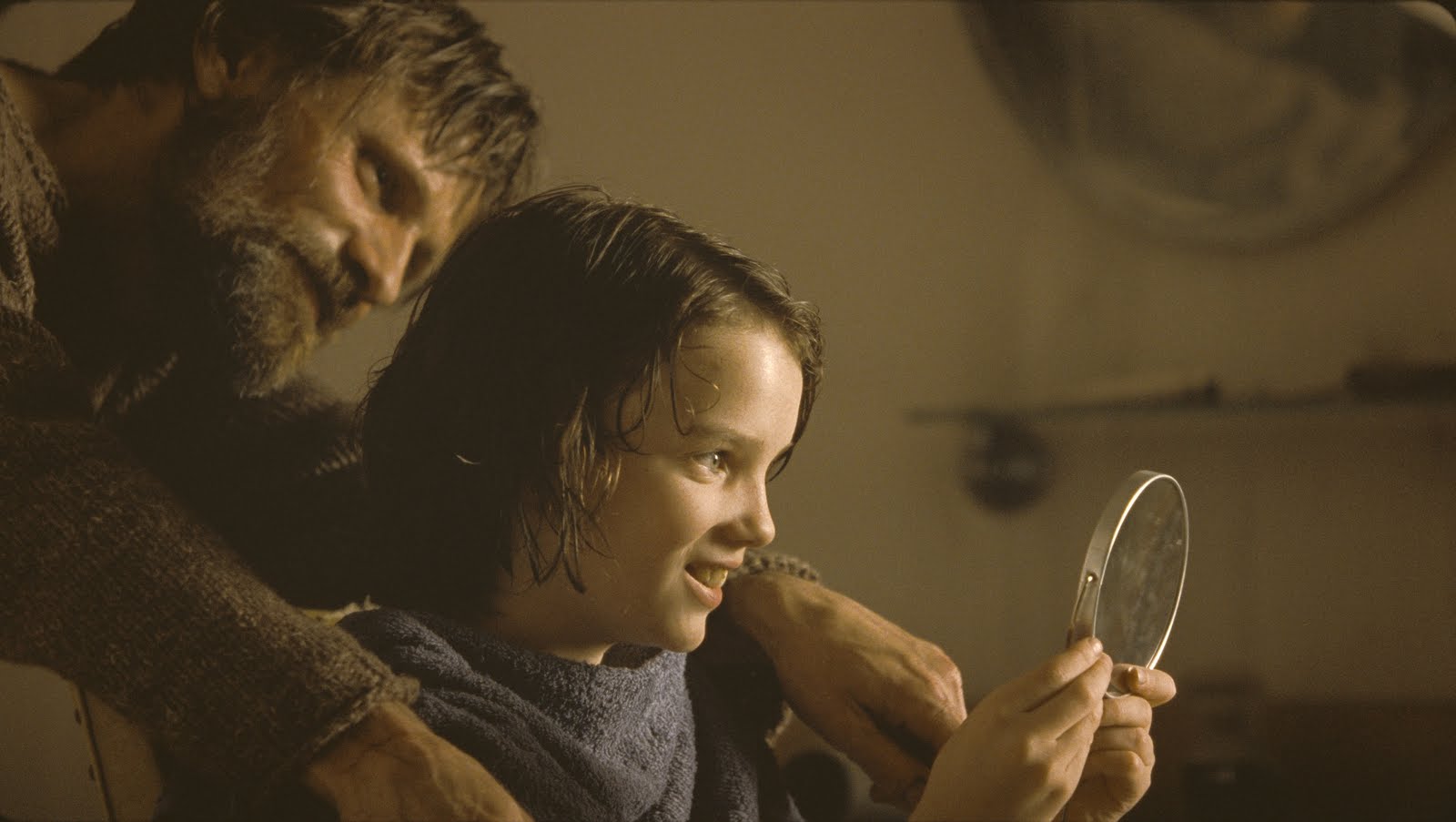

You know what they say, right? It isn’t at all about the destination. As Mortensen and Smit-McPhee make their way south, they teeter back and forth between belief and defeat. They don’t know what’s waiting for them; they just know they have to keep heading there. Just like the road underneath your own feet, THE ROAD is not an easy experience. It is however one of unconventional beauty that is rich with meaning and that leads to a place of deeper understanding. You just have to walk it.

Monday, October 13, 2008

Black Sheep Previews: BATTLE IN SEATTLE


In 1999, five days of chaos took over Seattle when what were intended to be peaceful demonstrations at the World Trade Organizations Ministerial Meeting turned into riots so ugly that a state of emergency was declared by the mayor. It took two years to organize the event and it was the first of its kind to be held on American soil. Still, despite all efforts on both the parts of the peacekeepers and the protesters, mayhem erupted. Flash forward to 2008 and the whole event has been turned into a provocative exploration of the humanity behind all the unintended violence, called BATTLE IN SEATTLE.

Stuart Townsend is best known as an actor who has appeared in some unfortunate failures like AEON FLUX and THE LEAGUE OF EXTRAORDINARY GENTLEMEN. Not one to give up though, Townsend has changed his personal career direction and with BATTLE IN SEATTLE, he gives us his first screenplay and his first directorial efforts. His years as an actor, which incidentally have not stopped, have made him some strong contacts, including the romantic link to fiancee and Academy Award winner, Charlize Theron. Theron appears in BATTLE IN SEATTLE as a pregnant wife of a police officer (Woody Harrelson) who is on duty for the riots.

BATTLE IN SEATTLE has already been heralded by top critics like Entertainment Weekly's Owen Gleiberman as a directorial debut that exhibits "stunning passion and skill." Roger Ebert calls is "not quite a documentary and not quite a drama but interesting all the same." Having already worked the festival circuit, the film is finally ready for it's national release October 17 and I personally am very curious to see how Townsend manages to make sense of such a monumental mess.

For more information on BATTLE IN SEATTLE, click here.

Tuesday, July 1, 2008

HANCOCK

Written by Vincent Ngo and Vince Gilligan
Directed by Peter Berg
Starring Will Smith, Charlize Theron and Jason Bateman


John Hancock: Call me an asshole one more time.

It isn’t fair to write a film off in the first few minutes but you can sometimes get a pretty good sense as to what you’re in store for from the way the film introduces itself. The film opens on an L.A. freeway, where four punks are being chased in their van by countless police cruisers while they fire their semi-automatic weapons into the air. Where’s Spider-Man when you need him? (Right, I forgot – Spidey’s a New Yorker.) Cut to a passed out bum on a park bench. Who is this man? Of course, we know it’s our hero, Hancock (Will Smith), because we know a thing or two about the film before sitting down to watch it. Director, Peter Berg, takes this for granted though and it soon becomes apparent that convention and presumption will drive this unconventional tale. In HANCOCK, Berg, and Smith team up with writers, Vincent Ngo and Vince Gilligan, to debunk superhero iconography as well as the genre itself. The goal, and a noble and exciting one it is, is to rip the superhero out of the sky, strip him of his glory and send him hurdling toward the earth. Only Hancock is pulled down to an earth that is an awful lot more like a movie than the world I know.


It wouldn’t be so terrible to set this enormous Hollywood action film in typical scenarios if Berg weren’t trying so hard to give the film a decidedly un-Hollywood look. The aesthetic is often shaky and unstill, crossing back and forth between odd close-ups and frames finding their focus. Berg seems bent on giving HANCOCK a gritty, guerilla filmmaking tone but the erratic style is at odds with the predictability of the plot. The borrowed independent style works in its original context because independent films are, ordinarily, about something deeper. Removing the gloss from a Hollywood feature only allows the viewer to see how little there is underneath it all. In HANCOCK’s case, the man beneath the lacking luster is a reluctant hero who would rather waste his days drunk in a dive than diving into the action itself to save the day. There is some loose discourse on realizing your destiny but little else. Again reluctantly, Hancock agrees to some help from a struggling public relations person (Jason Bateman) and is set on the path to making the most of his life and abilities. Hancock is such a complex character (lonely, disinterested, depressed) that it would seem ripe with possibility but this is mostly squandered in favor of half funny humour and sometimes hokey special effects that it feels at times like a over produced Nike ad.


Luckily for HANCOCK, the film is still somewhat enjoyable thanks to the strong performances of all its leads. Smith continues his streak for picking complicated characters with broad appeal and he also continues his streak of pulling them off. After a heartbreaking turn that pushed his dramatic abilities in THE PURSUIT OF HAPPYNESS and his commanding yet vulnerable turn that pushed his presence in I AM LEGEND, Smith plays a character we don’t ordinarily see him as. His impossible-not-to-like face is covered in stubble and his physique is hidden by baggy, dirty clothes but his eyes are what give away his disenfranchised soul that shows his hurt for being shunned by society and disinterest in placating to that same society. Smith is joined by the modern master of comedic timing, Bateman and Charlize Theron, as Bateman’s wife, who is simultaneously frightened and intimidating. This trio of talent is HANCOCK’s salvation. Their grasp of their characters in unfailing and they pull the elements of the film together despite how flimsy the elements are to begin with.


HANCOCK is occasionally astounding but mostly mundane. Above all, it is a disappointment. This original premise has been sloppily slapped together and most of its potential was squandered in the process. It didn’t show me that superheroes are people too. If anything, it just made me miss the real deal. If the goal was to truly bring the superhero down to earth, then there was still a long, long way to go before this guy would have touched the ground.

Wednesday, October 3, 2007

IN THE VALLEY OF ELAH

Written and Directed by Paul Haggis


Soldier: Before I went, I would never say this, but if you ask me now, I’d say we just nuke ‘em all and watch it all turn back to dust.”

Before going to Iraq, a soldier would not likely even think this, let alone say it out loud in any serious manner. The times have changed though and eyes have seen more than any one pair should. Take Jo Anne’s husband for instance. He’s just returned from Iraq to Fort Rudd, New Mexico, a town built around its army base. You might think this would make Jo Anne very happy but, much to her dismay, this is just not the case. Instead, she doesn’t feel she still knows this changed man. When she goes to the police after he snaps a dog’s neck as punishment for biting, no one listens. Instead, they snicker at her. She is enraged but her anger is not enough to rattle any one out of their apathetic trance. Despite there being a clear need for Jo Anne’s husband to get help, there just isn’t anything to be done. He’s just another returning soldier whose mental stability has been fried under the Iraq sun. This is the side of America that is not often seen – a population exhausted by the weight of the war, be that by supporting it or questioning it or participating in it. And while the fighting is taking place overseas, writer/director Paul Haggis’ IN THE VALLEY OF ELAH aims to show America’s eyes what’s been happening in their homes while their focus was elsewhere.

IN THE VALLEY OF ELAH is Haggis’s first time directing since his Best Picture winning CRASH. In the time since then, he has gone on to work on the screenplays for CASINO ROYALE and LETTERS FROM IWO JIMA. The experience seems to have taught him some valuable lessons about subtlety. While CRASH was intense and moving, it was also contrived and convenient. The pay off may have been worth the trouble but concessions were made for the bigger emotional impact. IN THE VALLEY OF ELAH does not resort to gimmicks to make its mark. Instead, the events unfold like any good mystery, where the pieces come together to reveal that what you’ve been trying to figure out all along is really just a fraction of what’s really going on. This particular mystery begins when Hank Deerfield (Tommy Lee Jones) gets a call from the Fort Deer army base, informing him that his son has gone missing after returning from active duty. Hank has no helpful information as he didn’t even know his son had come back. It becomes clear pretty quickly that something foul has happened and that Hank didn’t know his son very well at all. Yet as he gets to know his son through the clues he comes across while searching for him, Hank realizes that he knows just as little about how the army has changed as he does his son.


IN THE VALLEY OF ELAH is able to make understated commentary about the mental and emotional burden of the Iraq war thanks mostly to Haggis’ direction of his stars, Jones and Charlize Theron. Theron is a single mother and a detective who struggles daily to prove that a woman can make just as good a detective as her sloppy male counterparts. She braves the testosterone that beats down on her from all sides but it is Deerfield’s arrival that shows her how fighting against oppression is taking away from her work. Jones achieves a similar effect on Theron’s performance. He is so strong, so internally tormented and still so unfaltering despite the overwhelming evidence that is chipping away at his impression of his great American hero of a son, that Theron cannot help but step up her game as an actress to avoid looking bland in front of the veteran. As Deerfield, Jones is the silent, proud father and husband. He’s the kind of man who cannot be around a lady while simply wearing an undershirt. He is an old-fashioned army boy in a world where he can watch unscrambled video image from a digital camera his son carried with him in Iraq. All the seedy revelations he is discovering must be made proper again and resolving his two conflicting minds becomes the challenge he needs to overcome in order to find both his son and his peace of mind. Jones is not just up for this challenge; he owns it.


With its simple tone and steady pace, IN THE VALLEY OF ELAH laments the loss of America’s blanketed support and gusto for a war that was meant to protect their way of life and freedom. It is not so much a movie designed to criticize the decision to go to war in the first place. Haggis is too smart to give that tired argument. Instead, it is an expression of grief for the damage the war has weathered on the country, its citizens and the principals that it was initially meant to protect.