Showing posts with label Brad Pitt. Show all posts

Thursday, June 10, 2010

ABC: F is for FIGHT CLUB


FIGHT CLUB

Written by Jim Uhls
Directed by David Fincher
Starring Edward Norton, Brad Pitt and Helena Bonham Carter

Editor's Note: They say the first rule of Fight Club is not to talk about Fight Club.  I'm actually pretty certain that this is also the second rule of Fight Club.  I am breaking both of these rules in this piece but, to be fair, I'm not a card-carrying member of Fight Club so I don't think I have to abide by the group's rules.  Anyhow, you have been warned ...


When David Fincher’s FIGHT CLUB was released in 1999, it was one of those movies that not only made you stop and take notice but had you wondering what the fuck had just happened.  Even though the century was about to turn, people didn't know what to make of it at first.  How could they really?  Here you have this violent, aggressive piece of filmmaking that is hellbent on literally blowing up most of the institutions that modern society has grown entirely complacent to.  More importantly, all of this unrest stems not from a growing revolt amongst the masses but rather the increasingly debilitating delusions of just one man’s mind.


“This is your life and it is ending one minute at a time.” 

The man in question is never even named.  He is simply the Narrator and he is played by the seamlessly talented Edward Norton.  Norton is the perfect choice for our hero.  His earnest face and effortless charm make him very easy to like and to relate to.  Our Narrator, who is not coincidentally reminiscent of Malcolm McDowell’s narrator in A CLOCKWORK ORANGE, starts out just like us.  He has put in countless hours at a thankless job to afford his ideally located condo and to amass the multitude of perfectly suited furniture pieces to fill that space.  He has done everything according to the great design but yet he is in a constant state of unrest.  He can’t even sleep unless he has the chance to shed all of his pain in the arms of people facing their own mortality at nightly support groups for a variety of cancer patients.  He is an exacerbated version of who a great majority of us actually are.  And thanks to Norton’s uncanny ability to draw in his audience, our dormant anger grows with his.


“This chick, Marla Singer, did not have testicular cancer.”

Of course, the Narrator does not have testicular cancer himself but the fact that he actually has testicles at least suggests that he could.  Marla (Helena Bonham Carter) is something of a monster.  She too does not step in time with the rest of the world – chain smoke getting caught in her wildly untamed hair as she walks in and out of laundromats stealing people’s clothing before walking directly into traffic without skipping a beat.  Marla is what sends the Narrator over the edge.  Her presence disturbs him but he cannot figure out how.  He just knows that he can’t sleep again now that Marla has made herself known.  It might have something to do with his addiction to cancer support groups.  He appreciates the sincerity of humanity when death is looming and Marla essentially wants to die.  Her death is close, or so she would like it to be, but, unlike her cancer patient friends, her death is one of her own choosing.  Where is the sincerity in that?  To be fair, I would probably lose a wink or two over that conundrum too.


“I know this because Tyler knows this.”

The pressure of life’s trappings starts to hit our Narrator a little too hard at this point and what was waiting patiently to emerge this entire time finally does.  Fincher has been giving us subtle hints; they’re blink-and-you’ll-miss-them moments but Tyler Durden, played by Brad Pitt in his prime, has appeared in frame a few times before this for split seconds at a time.  We don’t know it then, unless we’re super geniuses or have read the Chuck Palahniuk novel, but Tyler is a complete fabrication of the Narrator’s mind.  The impact of the story rests on the audience not knowing this bit of information until later because they need to believe the bloody reality of these two men beating each other rotten in the parking lot of some dive bar.  They need to believe this because it needs to inspire legions of other men to do the exact same thing.  These men and their nightly brawls are FIGHT CLUB.


“I want you to hit me as hard as you can.”

I am not a fighter but I, like the Narrator, beat the living crap out of myself from time to time.  The difference, or at least the one I am choosing to focus on right now, between the Narrator and myself is that I beat myself up under my breath when I don’t think anyone is looking.  He beats himself senseless and he does it right there for everyone to see.  And while he may be beating himself up, he is still fighting back for the first time in his seemingly insignificant single-serving life.  Aside from sincerity, there is something else the Narrator took from his life moonlighting on the support group circuit.  The imminent promise of death is a pretty good reminder for most that they’re still alive.  Pain, the intense kind that leaves scars and ringing in your ears while it drips your blood to the floor, has a similar effect.  This is especially true for those of us who don’t even realize we still haven’t slept in years.


Saturday, August 22, 2009

INGLORIOUS BASTERDS

Written and Directed by Quentin Tarantino
Starring Bard Pitt, Eli Roth, Diane Kruger, Michael Fassbender, Christoph Waltz and Melanie Laurent


Col. Hans Landa: What a tremendously hostile world that a rat must endure. Yet not only does he survive, he thrives. And that, Monsieur, is what a Jew shares with a rat.

This might sound odd at first but bear with me. Without giving anything away, the final shot of Quentin Tarantino’s sixth film, INGLORIOUS BASTERDS – this is where I need you to bear – shows two characters looking directly into the camera and one declares to the other that this may be his best work yet. It’s just another one of those cheeky Tarantino moments we, that is “we” as in fans of his work, have come to expect and relish in his mostly masterful works. There are times though when a moment like this one ceases to be witty and serves only to allow Tarantino’s gigantic ego to overpower his usually inspired words. This is precisely one of those moments for me. Seeing this, or rather hearing this, did not make me want to stand up and cheer to show how desperately I agree with his assessment of his own work. Instead, it gave me slight pause and allowed me to remove my Tarantino-tinged glasses and ask, “Really, Quentin? You think this is your best work?”


INGLORIOUS BASTERDS opens and is almost instantly a parody of itself and Tarantino’s previous work. I can’t say this for certain but I don’t think this was his intention. A dramatic spaghetti western score plays over the bold-faced, colorful credits and you watch to see which obscure actors Tarantino handpicked to pop up at pivotal moments (in this case, Mike Myers as British military officer) and more importantly, to see how Tarantino will bill his own credit (in this case, the surprisingly humble, “A film by”). And then the title announces that we are about to witness “Chapter One”, just as we did in KILL BILL. There is nothing wrong with adapting a similar structure for your films to distinguish your style – heck, Woody Allen does it all the time – but, while Allen’s touches are understated, Tarantino’s tone is so distinct and loud that it borders more on bravado than brilliance. Seeing as how the story hasn’t even started at this point, it feels as though he has already shot himself in the foot.


At a 2½ hour running time though, it is hardly fair to judge the film based solely on its opening credits. What follows is a scene that justifies and gives some much needed context to the film’s obnoxious marketing campaign – You haven’t seen a WWII movie if you haven’t seen Tarantino do it (or something relatively like that). It is no secret that Tarantino likes to hear himself speak. His scenes go on far longer than most other directors would allow and the dialogue wraps around itself so many times that it’s a small miracle that his players don’t get dizzy when they stand up. And while this is all play when you have a bunch of guys sitting around a table debating the meaning of Madonna’s “Like a Virgin”, it is something else entirely when the scene involves an SS officer known as “The Jew Hunter” and a French farmer suspected to be hiding a Jewish family in his home. The longer it goes on, the more tense it becomes and by the time it inevitably turns violent, Tarantino takes no prisoners, just like the Nazis. The style flows about as abundantly and as smoothly as the Nazi blood for the rest of the run time.


At times, INGLORIOUS BASTERDS seems unfocused and overtly gratuitous, even by Tarantino’s standards. (When Brad Pitt’s Aldo Raine declares that he wants his scalps, he isn’t kidding.) While it is technically fantastic (safe for a continuity error with Pitt’s unfastened bow tie at one point that I can’t believe Tarantino didn’t notice) and also deeply engrossing, it is the liberties with history that just don’t sit too well with me. During a chilling climax, there are so many dying Nazis surrounded by burning swastika banners that one can practically feel Tarantino watching from the wings to see just how uproarious the cheers from the audience will be. It is hard to cheer though when you know that none of this happened really, that we are being manipulated as an audience to revel in this alternate reality where the doers of one of history’s greatest evils, get what they deserve, Tarantino style. This is especially true when what really happened was already horrific enough.

Wednesday, January 28, 2009

Black Sheep @ The Oscars: BEST ACTOR

This past spring, I caught Thomas McCarthy’s THE VISITOR and found myself unexpectedly taken with Richard Jenkins. I had only known him as the infamous Nathaniel Fisher on “Six Feet Under” and suddenly felt as though I had never seen him before. In October, I caught a press screening of FROST/NIXON and thought Frank Langella had it locked after his pitch perfect incarnation of Richard Nixon. Then I saw Sean Penn in MILK. I’m not a huge Penn fan but, as soon as I was through weeping, I was consumed with how transformative his performance was. I couldn’t imagine it getting any better but then I saw THE WRESTLER. Aside from being completely floored by Mickey Rourke’s comeback performance, I was most excited to know that the Best Actor race at the Oscars would be the most exciting race around. Oh wait, I forgot about Brad. This is probably because I found him and THE CURIOUS CASE OF BENJAMIN BUTTON fairly forgettable.

Richard Jenkins in THE VISITOR

For five years, all anyone knew of Richard Jenkins was that he was one of the coolest dead guys around and that he certainly did a number on his adopted television family. In THE VISITOR, Jenkins plays Walter Vale, a widow who hasn’t lived a day since his wife passed. It isn’t until he meets visitors from foreign lands in a home that is supposed to be his own, that he realizes that he is a visitor in his own life.

Jenkins was always a dark horse to get the nomination in this category and this is certainly a case where the nomination will be the ultimate honour. The nod will open plenty of doors though and Jenkins will walk right through them. We may hear his name here again before very long.

Frank Langella in FROST/NIXON

Langella’s Nixon is a tricky one indeed. He is always on top of whatever game is being played. He always has his sights on a grand return to the public eye, one that he never doubts he is fully entitled to. It is the moments where he finds himself alone though that reveal the most surprising aspects of a very guarded personality – fear and uncertainty. Langella makes Nixon human.

Langella originated this role on the stage and has been in Nixon’s skin long enough to make everything look so easy. He was the early favorite this year, with the added sympathy bonus for missing out last year on a nod for STARTING OUT IN THE EVENING, but this race comes down to only two horses really.

Sean Penn in MILK

Penn is considered to be one of the most prolific living actors of his generation. As I mentioned earlier, I’m not always sold on this. As Harvey Milk though, he embodies the spirit of progress, equality and life, all of which made the real Harvey Milk so incredibly charismatic and convincing. Penn’s portrayal of the first openly gay man elected to American public office is no caricature; it is tender and human.

Unfortunately, Penn won the Oscar a few years ago for MYSTIC RIVER, a performance I never felt was that impressive in a film that I always felt was horribly overrated. Having one statue already on his mantle or his toilet (I don’t know where he keeps these things), puts him at a disadvantage here as voters might choose to reward someone who has never won before. That said, he just picked up the SAG award and that has a lot of sway.

Brad Pitt in THE CURIOUS CASE OF BENJAMIN BUTTON

Pitt is hit or miss most of the time. He definitely hit it in David Fincher’s 13 times nominated epic but was it really him who hit it? Pitt’s facial expressions were captured using CG and subsequently graphed onto a number of other actors’ faces and bodies to show the character’s transition from old and dying to young and new. Personally, I never felt like I truly ever came to know Benjamin Button despite the technical marvel.

Pitt may have gotten swept up in Benjamin Button buzz here because he is way out of his league considering the competition. That’s saying a lot considering the gravitas of this particular superstar. Still, many have argued that Pitt’s performance is a collective collaboration with a handful of other actors, all of which had Pitt’s face pasted on theirs.

Mickey Rourke in THE WRESTLER

It only takes about five minutes of watching Darren Aronofsky’s return to form, THE WRESTLER, before you are amazed by how perfect Rourke is as Randy "The Ram" Robinson, an aging professional wrestler who still has to play in order to pay for his lackluster life. Rourke’s performance inspires such intense sympathy but remains authentic and realistic. It is no exaggeration when people say Rourke was born to play this part.

After picking up the Golden Globe for this performance, it pretty much comes down, in my opinion, to a final death match between Rourke and Penn. Rourke’s recent announcement that he will be fighting in a legitimate WWE wrestling match a few months from now is a little odd but Rourke still has one major advantage over Penn, the comeback vote. Who doesn’t love a comeback … especially when it is this damn good?

All in all, this a very hard one to call. I’m going to have to flip a coin now and make the big decision at the last second. Heads, it’s Penn; tails, it’s Rourke … And Rourke it is!

Sunday, December 28, 2008

THE CURIOUS CASE OF BENJAMIN BUTTON

Written by Eric Roth
Directed by David Fincher
Starring Brad Pitt, Cate Blanchett, Taraji P. Henson, Julia Ormond and Tilda Swinton


Daisy: What’s it like growing younger?
Benjamin: Can’t say; I’m always looking in my own eyes.

THE CURIOUS CASE OF BENJAMIN BUTTON certainly has no trouble living up to its name. It is very curious indeed, for instance, how a man can be born to this world the size of an infant but with the physical affliction of a man at death’s door. It is remarkable that a two and a half hour epic can be so consistently beautiful to behold and breathtaking until its final moments. While it isn’t the least bit unusual to catch Cate Blanchett on top of her game, it is certainly impressive to see Brad Pitt exhibit such restraint and internalized inquisitiveness. It is definitely intriguing to witness a director as dark as David Fincher (ZODIAC, SE7EN, FIGHT CLUB) abandon the genre that made him who he is and side step into such a grand, romantic piece with such apparent ease and enthusiasm. But it is perhaps most curious how this film, where every element is so delicately placed and nurtured to a point where it borders on technical perfection, can be so cold and empty an experience despite itself.


Of course, within the context of the film, the curious thing about Benjamin Button is that he is aging backwards while all of humanity is progressing naturally. Benjamin must suffer through his childhood in the body of an old man who has already lived his life when he is really just discovering it. Too frail to participate, he must watch life happen from the front porch of the old age home that has taken him in. Here, he bears witness to life in its final stages and grows accustomed to the constant presence of death. His perspective is undeniably unique as he is always moving forward despite the reversed nature of his physical growth. Yet, this view and the wisdom it could bring are not shared with Benjamin’s most ardent observers, the audience. We are here for his story and the meaning it could bring to our relatively uncomplicated existences but instead, all we are given is the story itself. This amounts to little more than the long life of Benjamin Button, which would not be particularly different if it weren’t for the whole aging backwards thing.


It is one thing certainly to have all of the characters who encounter Benjamin accept him for who he is but that expectation is mildly unrealistic to ask of an audience. Still, this film has been bouncing around Hollywood for years for a number of reasons, not the least of which was figuring out how to make it look realistic. Fincher finally settled on having graphs of Pitt’s face drafted onto actors of different sizes and stature playing him at various stages of his aged infancy. The results are entirely believable and the makeup work, which so often detracts in such extreme cases such as these, is quite complimentary. And so visually, we buy into it. The performances also guide us to do the same as they are natural and heartfelt. And as if this weren’t enough to transport us to this historic, fantasyland, Claudio Miranda’s rich, contrasting cinematography does everything needed to fill in whatever gaps were left. With all this effort spent to make sure we believe what we are seeing, it is an awful shame that equal time wasn’t spent on giving us something to believe in.

I blame Eric Roth. With so many things going for THE CURIOUS CASE OF BENJAMIN BUTTON, I have to lay the blame somewhere and Roth is the easiest person to point at. Roth’s script is epic in proportion but minute in terms of purpose and meaning. Having proven his ability to carry people on long life journeys, such as that of FORREST GUMP, it is clear why he would be chosen to expand F. Scott Fitzgerald’s short story into such a long film. In the process though, he took an unconventional concept and told it as conventionally as he could (did I mention that Benjamin’s entire story is read from a diary at Blanchett’s hospital deathbed). He created a character that is not so unlike the naïve Forrest. Benjamin is an observer of life; he watches it move forward from a perspective that none of us can truly comprehend and one that sadly, Roth and Fincher never allow us to see.

Sunday, December 21, 2008

What to rent, what to rent ...

The last piece of turkey has finally been devoured by the dog; the dishes have been crammed into the dishwasher; and the last house guests have taken their gifts and gone home. You can finally change into the jammies your mom bought you and plop yourself down in front of the TV for some much needed and well deserved down time. Luckily for you, there are plenty of great releases available to rent just in time for precisely this moment in time. You’re even luckier still because Black Sheep is make sure that moment isn’t followed by a bad movie.


If you're in the mood for entirely off the cuff, whacked out comedy, plenty of A-list celebs and hearty laughs on top of it all, then the Coen Brothers' BURN AFTER READING is perfect for you. The premise itself is certainly amusing, if not a little scattered, but it is the top-notch ensemble that solidifies this work as quintessentially Coen-esque. Regulars like George Clooney and Frances McDormand return as two particularly kooky people who find each other online while pretending to be different versions of themselves. Tilda Swinton and John Malkovich are a married couple on the way to divorce. Both are, to a fault, cold and crazed respectively, as well as formidable performers. Richard Jenkins turns in another self-effacing, understated performance (after this year’s THE VISITOR) that should nab him more work with high profile directors. And while all of these performances are top notch and so delightfully exaggerated, it is Brad Pitt that shines brightest for the simple reason that he is entirely ridiculous. Pitt plays Chad Feldheimer, a fitness trainer who has perhaps been running on endorphins for one too many laps, and the only character in this film who isn’t pretending to be anything he isn’t. This could have a lot to do with his character not being smart enough to pull off disguise but Pitt himself is more than capable. We never quite forget that we’re watching Pitt but that’s what makes his unbridled exuberance as he bounces around to the music in his headphones so darn funny.


Now I know that when it comes to famliy film, I can clearly not say enough aout WALL-E, but I actually have an alternative for you that you may have forgotten about considering it took from March until now for this film to finally get its home release. HORTON HEARS A WHO! is by far the funniest big screen Dr. Seuss adaptation I've ever seen and plenty of great lessons for the kids to learn while you leave them to watch for hours on end in front of the TV. When the book was originally published in 1954, Dr. Seuss gave his young readers an important lesson about how any voice, no matter how small it may appear to be, can change the world. Screenwriters, Ken Dario and Cinco Paul, have developed the confidence-boosting tale into a much grander take on societal hierarchies, the power of the imagination and the possibility that we are not alone in this universe. The very big elephant, Horton (voiced in a lovably whimsical fashion of fancy by Jim Carrey), randomly finds the tiniest world in the most unexpected of places, a spec of dust that has flown past him to eventually rest comfortably on a clover. It turns out that this world is known as Whoville. It plays home to hundreds if not thousands of Who’s and is run by a Who known only as The Mayor. You can only imagine The Mayor’s surprise when Horton finally makes contact with him. Now imagine that surprise voiced by the self-deprecating, neurotic genius of Steve Carrell. Together, Carell and Carey play perfectly off each other as their performances are based in the knowledge that Horton and The Mayor are not nearly as different as they initially appear. Though one is huge and one is small, they both know the meaning of responsibility and importance of helping all who need.


And for all you Christmas matriarchs out there, I have just the thing for you. Sure, you could rent MAMMA MIA! and sing along with your girlfriends one night but when you want a good, deep cry, pick up the underrated period piece, THE DUCHESS. Keira Knightly carries the weight of this film on her shoulders while carrying the weight of the wigs on her head with poise and prominence. Her big brown eyes go from playful to shy to distraught and defeated. When we first meet her, she is free and seemingly unaware of the heavier world outside of her backyard games. Before long though, she is face to face with adulthood. This particular face belongs to Ralph Fiennes as the Duke of Devonshire. It is here that director, Saul Dibb steps in to add another layer to the played out trajectory. With an age difference that is only matched in vastness by the distance between them, the Duke undresses his Duchess and asks why women’s clothing must be so complicated. There is no better occasion for small talk than before two practical strangers go to bed for the first time. Knightly, trying desperately to hide her nervousness, replies to the obviously rhetorical question though, claiming that this is the only way for women to express themselves in the times they live in. It is clear she is not sure that a reply is necessary or even allowed but it is also clear that she speaks to ensure that she is seen, that her person is present. Her clothing falls to the floor and the imprints of her corset can still be seen on the smooth of her back. THE DUCHESS is shocking on many levels but perhaps mostly in how harsh it is underneath its polished finish and how new this old tale feels.

Now, get out there and rent, rent, rent!

Friday, September 12, 2008

BURN AFTER READING

Written and directed by Joel Coen and Ethan Coen
Starring George Clooney, Frances McDormand, John Malkovich, Tilda Swinton and Brad Pitt


Osborne Cox: With all due respect, what the fuck is this? Whose ass did I forget to kiss?

The now infamous Coen brothers make a lot of movies and they know that people out there see a whole lot of movies too. A population distracted by constant film watching is a population led to see the world in a truly dramatic fashion. Finding a computer disc in the ladies locker room of a fitness club would ordinarily be just another occasion to throw something left behind in a lost and found box, likely never to be reclaimed. If you’ve seen one too many movies though, and you don’t have a whole lot going on in your own little life, you might see finding this disc as an opportunity to blackmail the owner of said disc for contents you believe to be top secret C.I.A. intelligence. There’s just one thing the movies don’t tell you about capers such as these though, and that is that none of it is real. In BURN AFTER READING, the Coens decide it’s time for a little fun and serve up a hearty dose of signature comedy that both highlights the influence of film and perpetuates it further at the same time.


BURN AFTER READING begins with a thunderous, percussion heavy score and an all too familiar opening shot of the planet we call home. Slowly but persistently, the worldview becomes more focused and as we descend, we zero in on the city of Washington. The titles appear on the screen, digitally processed as though you were reading them off a computer. Have the Coens made a super spy movie, I wondered, and with that, they had me exactly where they wanted me. Though you wouldn’t know it from the way they speak in public, the Coens are big jokers; they like to play with their audiences. They get you thinking one way and then take you in a whole other direction. It’s almost like they’re laughing at you sometimes but really, they just want you to have as much fun as they seem to be having. And fun is to be had in BURN AFTER READING. After perfecting the art of suspenseful drama with last year’s NO COUNTRY FOR OLD MEN, the brothers have returned to more familiar waters for zaniness that is entirely offbeat while still sharp and biting.


The premise itself is certainly amusing, if not a little scattered, but it is the top-notch ensemble that solidifies this work as quintessentially Coen-esque. Regulars like George Clooney and Frances McDormand return as two particularly kooky people who find each other online while pretending to be different versions of themselves. Tilda Swinton and John Malkovich are a married couple on the way to divorce. Both are, to a fault, cold and crazed respectively, as well as formidable performers. Richard Jenkins turns in another self-effacing, understated performance (after this year’s THE VISITOR) that should nab him more work with high profile directors. And while all of these performances are top notch and so delightfully exaggerated, it is Brad Pitt that shines brightest for the simple reason that he is entirely ridiculous. Pitt plays Chad Feldheimer, a fitness trainer who has perhaps been running on endorphins for one too many laps, and the only character in this film who isn’t pretending to be anything he isn’t. This could have a lot to do with his character not being smart enough to pull off disguise but Pitt himself is more than capable. We never quite forget that we’re watching Pitt but that’s what makes his unbridled exuberance as he bounces around to the music in his headphones so darn funny.


Despite the title, nothing actually gets burnt after being read at any point in the film. The act itself though is so dramatic that to name your movie this essentially announces the intended tone. BURN AFTER READING definitely makes good on its promise and has a blast doing it. The Coen Brothers are sitting pretty atop their throne as two of Hollywood’s most celebrated filmmakers and their latest plays out almost effortlessly. Even switching over to a new cinematographer, Emmanuel Lubezki (rather than long time collaborator, Roger Deakins), happens without a beat missed. It’s as though they could do all of this in their sleep. Now, that would be one hell of a dream that would make one heck of a good movie. We just have to make sure we can spot the difference between that and the real thing.

Thursday, August 7, 2008

BLACK SHEEP'S WEEKLY NEWS WRANGLE


THE DARK KNIGHT TRIPS OVER A PINEAPPLE AND A PAIR OF PANTS
Opening early to avoid having to compete with the China Olympics, PINEAPPLE EXPRESS was smoking right out of the (hot) box. Earning the superfluous title of best August Wednesday opening of all time, the new stoner action comedy from the house of Apatow pulled in $12.1 million. THE DARK KNIGHT was forced not only down t second place but all the way down to third for the first time in its entire record breaking run. Yes, opening in second place on Wednesday is THE SISTERHOOD OF THE TRAVELING PANTS 2 with $5.7 million, just ahead of Batman's $5.1 million. It remains to be seen what the weekend will hold but it looks like the stoners might be able to do what the Mummy could not.
Source: Box Office Mojo

ANG LEE GRABS THE BOYS AND GOES BACK TO WOODSTOCK
Teaming with producer James Schamus for the 12th time, director Ang Lee is adapting original Woodstock organizer, Eliot Tiber's memoir, "Taking Woodstock: A True Story of a Riot, Concert, and a Life" from a screenplay written by Schamus. The Focus feature is set to start filming later this month after a postponement to make way for an impending actors' strike. Though this still could happen, the threat has decreased and seeing as how the cast is ready, it's best not to waste any time. The cast in question is includes Emile Hirsch, Imelda Staunton, Liev Schreiber and from "The Daily Show with Jon Stewart", Demetri Martin as Tiber himself.
Source: JoBlo

STREEP GETS SAPPY
After two proven summer blockbusters - 2006's THE DEVIL WEARS PRADA and this year's MAMMA MIA! - leading lady, Meryl Streep is in serious negotiations to star in Nancy Meyers' next feature. The project is yet untitled but essentially Streep would be at the center of a romantic triangle with two other men. This would mark Streep's first romantic comedy since, geez, does DEATH BECOMES HER count? It seems like Streep is tired of serious and I'd say she deserves the break.
Source: Variety

QUENTIN TARANTINO THIS ...
Brad Pitt has officially signed on to Quentin Tarantino's remake, INGLORIOUS BASTARDS. The World War II epic drama is a drastic departure for the director on some levels but not on others, given the original film's B-Movie roots. This would be Pitt's first time working with the contemporary genius and Quentin secured his partcipation just shortly after Pitt welcomed his new twins into the world. Also in negotiations to join Pitt on the project are Nastassja Kinski and Simon Pegg. Fellow director, Eli Roth has already commited to acting in the project. Tarantino intends to shoot this October and have the project ready for next years's Cannes film festival.
Source: Variety

QUENTIN TARANTINO THAT
While the last Tarantino story is actually based on fact, there are also plenty of Tarantino rumours circulating. Apparently, the B-movie obsessed director intends to remake another film when he's finished with BASTARDS. He hopes to put his own personal spin on Russ Meyers' FASTER, PUSSYCAT! KILL! KILL! Now, whether he wants it to be any good or not is a whole other issue. The bigger rumour here is that Tarantino is seriously consdiring Britney Spears for the role of Varla, a killer lesbian, stripper. I guess the B-movie tone would be perfect for Spears' particular acting talents. We shall see if this actually happens.
Source: Telegraph

Saturday, June 16, 2007

OCEAN’S 13

Written by Brian Koppelman and David Levien
Directed by Steven Soderbergh


Turk Malloy: Is it in yet?
Virgil Malloy: I hate that question.

I am a member of minority group. This group is made up of a small number of people who actually enjoyed OCEAN’S 12. Sure it was somewhat unbelievable and occasionally ridiculous but it kept a good groove on while filling the screen with some slick style. The boys all looked like they were having a good time, perhaps too good a time. Maybe audiences felt like they had taken it all too far; that the Ocean gang was having fun without them. And so, a director and a cast who generally don’t seem to pay much heed to appeasing the masses, have returned to the original scene of the crime, Las Vegas, for their third and final caper in OCEAN’S 13. The main goal for this reunion is to make up for their supposed misfire last time out and every possible effort to do so is made diligently. With the exception of Julia Roberts, the original players have all returned. From Clooney to Pitt to Damon to Affleck (no, not that one, the younger one), the stars are all out. Even Al Pacino has come on board to lend more weight to this already heavy load. And with Mr. Style himself, Steven Soderbergh, at the helm, the dream is kept alive. So why then, with every element so perfectly placed, has the fun disappeared almost entirely?


Perhaps perfection is part of the problem. The Ocean gang is a smart bunch, crafty fellas. They are also often prone to making mistakes. The situations they find themselves in stem from their own decisions and almost always lead them to the brink of unraveling. The cracks they need to squeeze through get tighter and tighter, creating both intrigue and urgency for the viewer. OCEAN’S 13 finds Danny Ocean et al plotting sweet revenge against Willie Bank (Pacino) for putting Ocean member, Reuben Tishkoff (Elliott Gould), in the hospital after screwing him out of a huge hotel/casino deal. The plan is to ruin his prestigious grand opening and milk him for hundreds of thousands of dollars all in one night. The execution is vast, ranging from rigging the dice at the source of manufacturing in Mexico to orchestrating an earthquake to disarm the stronghold security system that stands between them and the prize. Clearly, the good guys are going to win but never does it feel that there is a chance this might not happen. The urgency and intrigue were bet and lost.


Pacino is a welcome addition to the mix. His portrayal of hotel mogul, Willie Banks, is so sinister and egotistical that you can’t wait for the Ocean boys to bring him down. However, while Pacino is stepping it up, Clooney and Pitt might as well have had their stand-ins play their parts. The camaraderie that brought such joy and laughs to the Ocean film experience in the past has grown tired. When the boys laugh now, it almost seems like the joke is on us; that getting us into the theatre with their pretty faces was all they were obliged to do. Once there, entertaining us was not part of their contract. These two haven’t left it to just showing up for work in a while and the effect weighs you down. Luckily, Damon, Affleck, Scott Caan and Don Cheadle are still working for their paychecks, bringing wit, charm and humility to an often-lifeless script. Sadly, the sporadic laughs are not enough to call this film funny, or even fun for that matter.


So if OCEAN’S 13 isn’t fun, what is it? Well, it’s neatly packaged and pristinely presented. Soderbergh has a fantastic eye. He has a knack for crafting colorful films that are visual worlds unto themselves, which draw the viewer in to a point where the real world can look somewhat drab in comparison once you leave them. Only this time out, he spent too much time setting everything up that no room was left for error or chance. It’s like a perfectly dealt hand that just isn’t played with any finesse. It’s ironic really how a film set against the gambling capital of the world takes so few risks. Soderbergh sets out to distract the audience with OCEAN’S 13, like any good casino would. With all the flashing lights, pretty colours and fireworks, you might not realize that you’ve been playing the slots for longer than you should.

Sunday, December 3, 2006

THE FOUNTAIN

Written and Directed by Darren Aronofsky


THE FOUNTAIN reinvigorates the meaning of “labour of love.” Writer/Director Darren Aronofsky’s ambitious offering had many eyes on it from the moment of its conception, through its disastrous pre-production period and even more so now as it finally unrolls into theatres. When his last film, REQUIEM FOR A DREAM, struck many a chord amongst many a different viewer (it is a compelling plea to not use drugs as many people watch the film high and never want to touch the stuff again), people knew they had a young genius in Aronofsky. Naturally, Hollywood wanted him all to itself. The problem is that Aronofsky is anything but Hollywood. When THE FOUNTAIN got the green light from a major Hollywood studio, conditional to Brad Pitt’s attachment to the project, Aronofsky found himself in a new world. In this world, budgets blow up to $75 million, stars back out, funding disappears and you can spend $20 million without shooting a single frame. When THE FOUNTAIN was shut down, Aronofsky would not let go. This is the film his heart wanted to make and so he scaled the budget down to $35 million and found a new cast and new funding. Somehow though, while everyone scrambled to get THE FOUNTAIN made, no one seemed to notice what a hard sell it was going to be. Aronofsky attempts to show in an hour and a half that we as humans are not of our bodies but that the soul, life and love are eternal; that the death of our physical bodies is both a natural and necessary part of what we know as life; that we should neither fear it nor fight it but accept it as peacefully as possible. He attempts to tell this by stretching his story over a thousand years. Though the vastness of his ideas lose some focus around the edges and struggle to remain congealed, THE FOUNTAIN remains incredibly beautiful with piercing performances by Hugh Jackman and Rachel Weisz that plant the seeds necessary for Aronofsky’s ethereal ideas to grow in the souls of his audience. Despite all the love given, the roots could have still used a little more water.

Jackman and Weisz play Tom and Izzi Creo in the year 2000. Izzi has an inoperable tumor in her brain and not much time left on earth. Tom is a scientist, a rational man who believes that death is no more than another disease that can one day be cured. As Tom tries to play God, Izzi embraces that she will soon meet God. Jackman plays Tom as tortured and desperate and his performance is in direct conflict with Weisz’s embodiment of Izzi as a creative beacon of repose and understanding. Yet they still manage to share a life together, one that is clearly based on a deep and engrossing love that binds them, thanks to a tender, caring chemistry between Jackman and Wiesz. The present day chemistry needs to be solid in order for the bookending to fall into place. 500 years later, Tom finds himself traveling through space towards a dying star in order have that life that is fading be reborn in the tree of life he is traveling with. 500 years earlier, Tom finds himself searching for the tree of life in order to give himself and his queen (an earlier incarnation of Izzi) eternal life. It is in these two extremes that Aronofsky exhibits his strengths and weaknesses. The future scenes are organic and spiritual making his quest seem plausible in an other-worldly fashion but the past sequences, told as a story and not confirmed as an actual past life, seem stagy and forced.


Aronofsky’s ambition opens minds to new possibilities but it also takes on too much. A common thread was obviously necessary to tie three story elements that span a thousand years but he focuses on two threads instead, causing a struggle. Tom and Izzi’s love anchors the center story but though Izzi is present in the past and future, their love is not the central issue. There is an expectation that it would be more prominent that is never fulfilled. Instead, what Tom cannot deal with in the central story becomes the focus in the later and prior. No matter when, Tom is always seeking the key to eternal life. Death brings about rebirth and Tom must spend a thousand years trying to figure that out. It is ultimately Tom’s journey but Izzi is so compelling that she draws attention away from him. Despite this, the timelessness of his quest shows how fighting against death is an unnatural exertion that limits potential when one is fortunate enough to be alive that can also only reach its true potential by crossing through death.

There is no dispute that Aronofsky is a genuine artist and genius in his own right. THE FOUNTAIN shows his insight, his openness and his innovation. How else can one describe the usage of chemical reactions in a Petri dish shot with a microphotography camera as the backdrop for the future scenes? The technique is even intrinsically linked to the themes of the film. Obviously the scientific approach is an extension of Tom’s profession but the approach was also chosen to give the film a timeless feel and avoid the dating that can sometimes happen with CGI. But for all its ingenuity, THE FOUNTAIN never feels like it has fully translated from Aronofsky’s complex mind to the screen. That being said, there are worse places to be trapped than the mind of a genius.

Sunday, November 5, 2006

BABEL


Written by Guillermo Arriaga
Directed by Alejandro Gonzalez Inarritu

Mexican director Alejandro Gonzalez Inarritu has a point to make with his second Hollywood offering, BABEL. He wants us to see how we don’t listen to each other and to what extent that is making all of our lives more difficult. To do this, he tells four different stories where characters find themselves in situations where they are not understood despite all their efforts to be. These stories stretch across the globe, from Tokyo to Mexico and center around an incident in Morocco that sparks an international scandal. Inarritu treats his imagery like poetry and has created a stunning picture with pacing that ranges from peacefully prophetic to tensely wrenching. But despite its unmitigated design, there is a larger irony undermining BABEL. It is a film concerned with the struggles faced when trying to get your point across that also wants to show how our lives are all connected yet its four storylines stretch to connect to each other and the point gets somewhat lost in that process.

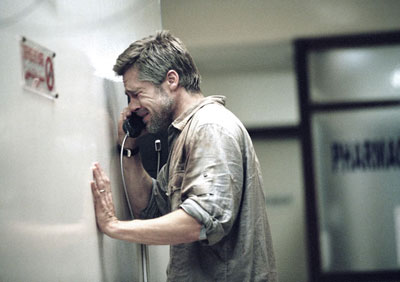
Brad Pitt and Cate Blanchett play Richard and Susan, an American married couple on a sour vacation in Morocco. Their youngest child has just died of natural causes and they have come to try to forget. Instead, the guilt and anger they could not express at home has only become more prominent in their isolation. A stray bullet hits Susan in the shoulder while she glares out her tour bus window and her vacation goes from bad to potentially tragic. The unfolding of this scenario best exemplifies Inarritu’s views on the frustration that often goes alongside communication. A desperately frightened Richard must get his wife medical attention in a town without a hospital and where no one speaks his language. He finds one tour guide who carries him through the experience, facilitating his translation. Speech is not his only barrier as this small Moroccan village’s medical treatment is far from what Richard is accustomed to in his privileged life at home in California. He then runs into trouble where one would not expect him to. He is unable to convey the seriousness of his wife’s condition to the remaining tour bus passengers, most of them American. He requires their support but they don’t listen to a word he says, focusing solely on their own needs, some selfish and some reasonable. As Richard is rightfully focused on his wife’s needs, he isn’t listening to them either and arguments ensue. Richard’s communicative difficulties also extend to one other person, Susan. Writer Guillermo Arriaga brings us to the most intimate frustration with understanding here when these two people require a brush with death to get them to be quiet enough to hear how afraid each other is and how responsible each feels for the death of their child.


The remaining plots branch out from this incident but whereas the execution of the plights is poignantly told, the connections themselves are weak or vice versa. Richard and Susan’s children run into trouble of their own when their Mexican Nanny, Amelia (Adriana Barraza) takes them over the border so that she can attend her son’s wedding. When reentering the United States, the border patrol are suspicious and begin asking many questions. Amelia does not have difficulties speaking English but does not answer their questions as well as she should. The film loses some focus here, as the patrollers’ approaches are more racist in nature than anything else. Whereas racism is certainly another form of fear and misunderstanding, this dire situation feels easily unavoidable and contrived to serve the film’s purpose. Meanwhile, in Tokyo, a deaf and mute teenage girl deals with the loss of her mother and fights to be heard when she can’t make any noise. Cheiko is played by Rinko Kikuchi; it is a vibrant and commanding performance. She herself cannot hear what others are trying to say and is limited in how she can communicate her own feelings and desires. Her struggle is only intensified by her lack of physical connection to other people, as she is an aggravated virgin. All of her attempts to entice are thwarted by her silent aggression and her incapacity to get anyone to hear her is heartbreaking. In many ways, her storyline is the most effective but it is only tied to the whole of the film because her father’s rifle was used in Susan’s shooting in Morocco.

The word “babel” finds its roots in an association to the Hebrew verb “balal,” which means to confuse or confound. Hence, when someone is said to be babbling, they are not communicating their point properly, just spewing out a bunch of unnecessary words that end up being entirely pointless. All of Inarritu’s words and images are carefully chosen and constructed in a concise fashion that is on many levels successful, but by trying to get across so much, he ends up narrowly but sadly missing his own point.