Showing posts with label David Cronenberg. Show all posts

Saturday, December 4, 2010

The Lucky 13 Returns! Week Five: Hanukkah


Mel Brooks gave us Jews in Space, but this week in The Vault of Horror--as well as Brutal as Hell--we're giving you Jews in horror! That's right, it's Hanukkah, the Festival of Lights! And this time around in The Lucky 13 series, we're casting our oil lamps on Jewish horror directors. Specifically, I've chosen to write about my very favorite horror film by a Jewish director, and my dear colleague Ms. BJ-C of The Vault's sister blog Day of the Woman has taken an even broader approach, spotlighting three of her very favorite horror directors among the Chosen People.

So put down that dreidel, stop giving your poor mother so much shpilkes with all your meshugass, grab a bissel cake and read on...

B-Sol on The Exorcist

It may seem a tad silly selecting this film, since it could very easily top the list of most people's favorite horror movies, period--let alone horror movies from Jewish directors alone. Nevertheless, since The Exorcist went mysteriously absent from the original Lucky 13 series (Not even in the Devil & Demons category?? Come on, people!), this is my chance to right that heinous wrong.

What can possibly be said about this classic to extol its greatness that hasn't already been said? It was nominated for the Oscar for Best Picture, and remains the highest-grossing horror movie ever made. And although it has its detractors--as all great films do--there can be little doubt that The Exorcist is one of the all-time triumphs of American cinema, a crown jewel from an era that gave us so many.

With stellar performances from Ellen Burstyn, Max Von Sydow, Linda Blair and especially Jason Miller in particular as the beleaguered Father Damian Karras, this is a film of great depth and weight, finished in a way in which few horror films are finished, with the deft touch of a master auteur. It's unfortunate that Friedkin never quite equaled the heights he achieved with The Exorcist, his masterpiece, but it nevertheless remains as what it has been for much of the past four decades--not just a great horror film, but the great horror film.

BJ-C of Day of the Woman on David Cronenberg, Eli Roth & Sam Raimi

Cronenberg:
Okay, so I'm sort of splitting hairs on this one, considering Cronenberg has denounced his Jewish faith and identifies himself as an atheist. Regardless, he was raised in a Jewish household and that's good enough for me. Cronenberg is easily the king of venereal horror films. No one can make a film as gruesomely intelligent as Cronenberg. His films often times explored the fear factors humans possess when it comes to infection and bodily transformations. For me, someone with an uncontrollable fear of being diagnosed with leprosy, he hits the nail on the head every. single. time. A small little tidbit is that Cronenberg was considered to be the director for Return of the Jedi, and I can honestly say that the world wouldn't have been able to handle that much awesome in one film, and the results would have been the equivalent to dividing by zero... So I guess it's a good thing he didn't pick up that job. But Cronenberg will forever be the king of body horror.

Eli Roth:
Oh, Eli Roth, you sexy sexy bear Jew, you. As much as the world is fully aware of how much of a douchebag you are in real life, I can't take away the fact that you directed some of the most highly thought-of horror films of the last decade. Personally, I disliked Hostel, but I'd be a fool if I denied the fact that his films have developed an almost cult-like following. Roth definitely has a fiery passion for the genre and for that, he has my respect. As for his actions on Twitter towards other horror journalists... he's on the fence ;)
Sam Raimi:
Alright, Sam Raimi is the God of my world. He gave me our savior, Bruce Campbell, and his Necronomicon Ex Mortis serves as my Holy Word. There is absolutely nothing that this man touches that didn't turn to perfection. I'm including Spider-Man 3. There, I said it.

* * * * * * * * * *

Join us next wee for an edition of the Lucky 13 that will be very near and dear to my heart... as we commemorate Frank Sinatra's birthday weekend with a look at our favorite musical horror films! Ring-a-ding-ding, baby!

Week 1: Halloween
Week 2: Man vs. Nature
Week 3: Veteran's Day
Week 4: Thanksgiving

Friday, April 2, 2010

VAULTCAST: Conversations in the Dark... w/The Divemistress

Delve down into horror's murky underwater depths with me this week, as I'm joined by the Divemistress, of the blog Zombots! and The Avod podcast. DM is probably the best horror blogging oceanographer around, and she's also Canadian--which is why we've devoted the Vaultcast this week to talking about Canuck horror.

Listen in as we discuss the inevitable greatness of Cronenberg and try to figure out why Fido never gets the attention Shaun of the Dead does--plus, get a handy crash course in Canadian economic history! You may even hear about some horror movies you love that you never even knew were Canadian. And best of all, we get through an entire half hour without once saying "The Great White North", so give us some credit for that.

As always, check it out on the embedded player below, the actual Vaultcast page, or download it right here!


* * * * * * * * * *
On the Manic Monday front, for those still curious about the movie, I encourage you to check yesterday's post and take note of the first letter of each paragraph ;-) My apologies to the clever readers who felt compelled to let the world know they had figured it out. Sorry about deleting or ignoring your comments--nothing gets past you folks, that's for sure! But I had to commit myself fully to the effort. Kayfabe! (It's a wrestling thing, Google it.)

Monday, April 13, 2009

Marilyn Chambers 1952-2009

Although it may not have been her best-known work, David Cronenberg's 1977 zombie chiller Rabid was undoubtedly the most mainstream piece of work on the infamous resume of Marilyn Ann Briggs, a.k.a. Marilyn Chambers, who was found dead yesterday in her trailer home of as-yet-undetermined causes.

Her most well-known work would have to be Behind the Green Door, the 1972 film that made her the very first bona fide superstar of the exploding adult movie industry--ironically mere months after she had appeared as a model for Ivory Snow detergent.

Interestingly, it wasn't Cronenberg who wanted her for the starring role of Rose in his second motion picture. Cronenberg wanted Sissy Spacek, who had just kicked ass in the starring role of Brian DePalma's Carrie. But it was producer Ivan Reitman who instead suggested Ms. Chambers, to give the flick more sex appeal. And you thought porn was mainstream today!

Thursday, February 12, 2009

An exploration of fear, what disturbs me.

Greetings once again Vault dwellers, it is Karl Hungus of karlhungus.com here, so do not adjust your set, I am now in control of the transmission. It's amazing how much excitement can be derived from exploring our own anxieties in this way, with a good Horror film, we come face to face with so many negative emotions, and come out thrilled at the end. The genre itself is a multi-headed beast, and there are so many different feelings it can stir, many films have to many different ways to scare, disturb, unsettle, sicken, repulse or otherwise tap in to our subconscious. I'd like to talk to you about my own fears and what strikes a nerve with me when I'm deep in the experience. For me, it's not always the things that go bump in the night.

One thing that's always sure to creep the bejesus out of me is Body Horror. Films like The Fly or Tetsuo will always unsettle me deeply, no matter how many times I've seen them, the physical transformation that the main characters go through set my skin crawling every single time. I don't quite know why, perhaps it's an innate or subconscious fear of disease, of something malignant that's going on beneath the surface, the notion of helplessness that our own bodies could betray us. Whatever it is, this frightens and sickens me very deeply.

Maybe it's not something innate though, maybe this is a fear that was set in early? In which case, Ron Howard has a lot to answer for, because the scene in Willow where the evil Bavmorda turned everyone into pigs was pretty horrific for a kid's film. Or it could be earlier than that, I remember watching re-runs of The Incredible Hulk as a child and hiding behind the couch whenever Dr. Banner turned into a green Lou Ferrigno.

I suppose that also has to do with why I find there are very few good Werewolf movies. An American Werewolf in London was the pinnacle merely because of the chilling and amazing shapeshifting scene, and I've never seen another that has effected me so much. I feel kind of cheated sometimes when a film depicts someone turning into a werewolf as a quick change, or where it will happen offscreen. AAWiL set the standard, and if it's not a horrifying change, it just isn't a proper Werewolf movie.

Now, I don't really believe in desensitization, at least not to a huge degree. What's scared me for many years before still scares me now. I don't mean that I'd watch Willow and be as freaked out as I was when I was just a wee nipper, but that Body Horror still effects me as it always has. British Sci-Fi series Doctor Who has had some pretty creepy moments, the episode Blink was one of the most genuinely terrifying things I've seen on TV in a long time ("Don't blink, blink and you're dead!"), it was creepy stuff. But it wasn't that episode that freaked me out the most, it was a later episode called Planet of the Ood, and towards the end, one of the characters was turned into a grotesque cthulhu-like alien lifeform. True to form, I was utterly creeped out and the scene left me with a knot in my stomach. I'd say the old fears just don't leave us.

One film that certainly left it's mark on me was Stephen King's Pet Sematary, it effected me two-fold. First of all, the scene with Rachel's sister Zelda, just looking at her had my senses screaming, it was horrific. I later found out that the character of Zelda was played by a man, because they couldn't find a woman skinny enough for it, and that made a lot of sense. I'd say it's because a man has a broader frame, this made the character look that bit more emaciated, the bony shoulders and elbows that bit more exaggerated than if it had been a woman playing the role. A recent horror film pulled the same trick (I won't mention which as it's a bit of a spoiler, but if you've seen it you'll know the film I mean) of having an extremely thin man playing a female character, and it still had the same unedging effect on my senses.

The other thing in Pet Sematary that effected me was the scene where Jud Crandall gets his achilles tendon cut. The very thought of it makes me wince, it really unsettles me, and no matter how many times I see a scene of tendon-trauma in various films, it's something that I have never gotten used to. That's another reason that I don't truly believe in the idea of desensitization, I just can't see myself ever getting used to violence to that particular area, it cuts through me and sets my teeth on edge. There's a scene in Hostel where one character's achilles tendons are cut, and we don't even see it happen, we see is a reaction shot and the aftermath, but to me that was by a vast margin the most disturbing scene of the entire film.

That's not to say that any old scene of body horror or scene of physical violence against the ankle area will make a good horror for me. I would say that to make a truly great horror film, it can't just contain something that will scare or unsettle you. Pet Sematary is a great film in its own right, even without the scenes I've mentioned, and I've seen elements of what scares me in other films and they've fallen completely flat. I think a film has to engage you first and foremost, and that's why The Fly or An American Werewolf in London are absolute classics. If it doesn't have interesting characters that you care what happens to, then the film will fail.

I know it's not exactly a popular choice, but Hostel: Part II was an absolute triumph for me, and I think Eli Roth is a far better director than people give him credit for. The whole bloodbath scene was something that left me absolutely shaken, it was one of the most downright horrific things I've seen in a film in recent years, and it worked so well because Roth starts off with the characters. It was because he wrote Lorna (played so sympathetically by Heather Matarazzo, who was by far the best actor in the film) to be someone we empathised with, not some cut-out cheerleader that nobody cared about. When the above scene finally comes, it has all the more impact because we're emotionally invested in the character. The gore itself was very disturbing, and just thinking about the sound of the blade against her skin sets my teeth on edge, but it's not why the scene has such impact, and seeing it again it doesn't get any less disturbing, simply because of the character of Lorna.

Violence and gore certainly isn't everyone's bag, but I think in the right context it can be extremely effective and provide for a truly powerful film experience. That's not to say I don't love the more traditional ghost story, because the likes of Don't Look Now and Ringu count as some of my all time favourites. There's simply nothing like a good horror that piles on the atmosphere and doesn't really on cheap shock-tactics to scare the audience. The Others and The Blair Witch Project were two films that built up the tension slowly, and they were truly fantastic horror films.

Atmosphere is one of the hardest things to put your finger on. David Lynch is one of my favorite directors by far, and you couldn't really call any of his film Horror exactly, yet some of them can be so wholly unnerving and disturbing, more so than many Horrors. Lost Highway (above) is a perfect example, so much of it can be greatly unsettling, and watching it can really set me on edge. A lot of the time I can easily see why something disturbs me, I can point it out and say it's that, but here I don't know quite what it is, whatever magic Lynch works just gets to me. It was the same with Mulholland Dr. and Inland Empire, something just had me on edge. Roman Polanski's The Tenant is another film that had me very unsettled throughout, much in the same way that Lost Highway did, something I can't quite explain, but very potent none the less.

I hope this has been an interesting read. It's been fun for me trying to lay out my fears, to relate what disturbs me, and what makes a powerful Horror experience for me. I'm sure that just as everyone has their own preferences when it comes to the genre, we've all got different things that will scare and disturb us, things that we've never gotten used to in films and things that can still freak us out. I'd love to hear from you, what is it that effects you most in a Horror?

What scares you?

Wednesday, January 14, 2009

Horror Remakes: Then vs. Now

There was once a time when news of a remake was pretty exciting for many horror fans. At least the ones I hung out with. That may be hard to believe, given the current glut of remakes flooding the market, but it's true. I can still remember a time when a horror remake stood a damn good chance of equaling, or even surpassing the original on which it was based. But that's all changed now. And it's time to ask why.

SHEER NUMBERS

The halcyon time to which I'm referring was roughly 20 to 30 years ago--an era still revered as a latter-day golden age for the genre. It was a time of great creativity, with new ideas being put forth, and expressed in ways that were previously off-limits to filmmakers in the days of the Hays code. Remakes weren't nearly as common back then as they are now, in part because writers and directors were too busy exploring uncharted territory, and studios had the confidence to back their efforts.

But when remakes did occur, you can bet they were very often quality pieces of business. Because filmmakers and studios weren't all hung up on desperately returning to past material over and over again, when they chose to do so, it was usually for a good reason.

The Fly--one of the high watermarks of the remake subgenre--is a great example. David Cronenberg had already established himself as a unique visionary of horror, with a lot to say and an unusual way of saying it. He chose to remake The Fly partly because he wished to comment on the original, and to say something new about certain aspects of life in the 1980s, most notably the AIDS phenomenon.

In contrast, today remakes are greenlit without rhyme or reason. Churned out left and right without any real reason for being beyond the bottom line, they represent the ultimate in cynical thinking on the part of studios and distributors completely unwilling to take a chance and looking for nothing more than a quick, easy buck each and every time out.

REVERENCE FOR THE MATERIAL

Some may say I'm idealizing, but there was a time when those who made these films came at them with a great deal more respect for and interest in the source material than you find today. John Carpenter has gone on record as a huge fan of Howard Hawks' The Thing from Another World. And consequently, his remake (arguably the best of them all) is made with an affection for that film. Not that you need to be familiar with the original to enjoy the movie, but it adds another dimension of enjoyment if you are.

The Thing, and others of its kind, were made by people who revered the originals, and who expected at least part of their audience to have the same familiarity/fondness for them that they had. There was a certain amount of intertextuality to them. These were films that were definitely commenting on the films that had come before them.

Conversely, today's remakes are very often greenlit before any creative folks are involved, and then foisted upon filmmakers who are not nearly as connected to the source material. They are also, by and large, made with the assumption that their audience has never seen/heard of the originals on which they're based. For all intents and purposes, they are meant to overwrite the originals.

Mention House of Wax to anyone under the age of 30, and I can guarantee you they're 100 times more likely to bring up Paris Hilton than Vincent Price. Yet, as a kid, despite being 30 years removed from the 1950s original, I was still keenly aware of it, and it was a favorite of mine. Today's remakes do not invite further exploration into the genre; rather, they impede it.

CHANGING TIMES

A big part of the excitement that surrounded the remakes of yore had to do with what had become possible in the intervening years since the originals came out. Vast improvements in special effects meant that the Blob would no longer look like a jello mold, but rather a truly living, elastic, acidic entity. We could still love the originals, but our interest was piqued to see what the new breed of special effects wizards could do with the classic monsters of yesteryear.

There was also the very real fact that unrestricted filmmakers could now tell more intense, more violent, and less "safe" stories. This was another aspect that made for a golden age of horror in the 1970s and 1980s--the notion that the gloves were off, and we were seeing things we had never seen before. And this even carried over into remakes.

To go back to The Thing, Carpenter's version contains a much greater sense of urgency than Hawks', and Carpenter's characters convey a much more real and intense sense of abject terror and paranoia. Remakes like The Thing were also free to end on much bleaker notes than their originals, which still hearkened back to the era when most monster flicks were forced to wrap things up nice and neat in the end.

That era of pioneering has long since passed. For the most part, many of today's fans would agree that the practical special effects of those days are, in fact, superior in some ways to what we get today. Is there anyone hankering to see what the great movie monsters of the past would like as CGI? And as for tone, the recent horror movie upsurge may have returned gore to the level of prominence it once held in the genre, but these are still films of a decidedly "safer" nature. The new Texas Chainsaw Massacre, for example, may display more blood and guts than Tobe Hooper's version, but it lacks any kind of socio-political subtext, and becomes nothing more than a mindless date movie.

EXCEPTIONS TO THE RULE

My regular readers know I'm far from close-minded in my viewing habits. When I see quality, I recognize it. And I admit, therefore, that not all remakes of today are bad. A few, in fact, are quite good--and it's worth looking into why that is in order to even further understand why it is that most don't work.

I hold up Zack Snyder's Dawn of the Dead as a recent example of a terrific horror remake. And I say this as a die-hard Romero stalwart who railed against the very idea of a remake for months prior to the film's release. But once I saw it, I had to shut my big fat mouth.

Yes, Snyder's film removes the social commentary utterly, which I just pinpointed as one of the weaknesses of modern remakes. But in this case, it worked for me, because Snyder was making a conscious decision to take the source material and move in a different direction, for a reason. He didn't want to slavishly ape the original for new fans; rather, like the great remakers of old, he wished to add something to what had come before.

The new DOTD is more action-horror than its predecessor, with set-pieces that Romero wouldn't have the budget--or the inclination--to pull off. As controversial as they were, Snyder's fast-moving zombies completely restructured the film's entire dynamic, creating a very different kind of terror based more on frantic desperation than creeping dread. It even took pains to acknowledge its source, with nods to Romero's film that were included with respect for the original, and its fans.

Yes, I still prefer the original. But Snyder's movie does what so many current remakes fail to--justify its existence.

* * * * * * * * * *

From a business standpoint, it isn't hard to understand why we're seeing all these remakes. With built-in "brand recognition" and a pre-existent script, the horror properties of the past are a safe bet. People will come to theaters based on name alone, or at least the name becomes a kind of "marketing starting point". You don't have to build something from scratch--and hey, if it worked before, it should work again, right?

Idealists need to understand that questions like, "What is this adding to the original?" "Why do it? The original is untouchable," are irrelevant. At least to the decision-makers involved. These are not people who are interested in improving on the originals, adding to them, or even commenting on them. They are only interested in the money to be made, and nothing more. And that's the whole problem.

Monday, September 8, 2008

The Fly Lands Stateside

After a premiere stint in Paris, David Cronenberg's and Howard Shore's operatic adaptation of their 1986 motion picture The Fly is finally arriving in America this weekend. It makes its U.S. debut this weekend in Los Angeles at the L.A. Opera's Dorothy Chandler Pavilion.

I'm really wishing I could be out on the West Coast to see this. Who knows? Maybe it'll eventually travel east for a stint at the Met. In the meantime, if there's anyone out there who is actually going to be attending the show, drop me a line via comment or email. I'd love to feature a review on the site!

Monday, July 7, 2008

Feedback from Cronenberg's Fly Opera Premiere

Ain't It Cool News has a report from a lucky German horror fan who made the trip to Paris to catch the premiere of David Cronenberg's new opera The Fly (gotta love that logo!), which was discussed here some days ago. Check it out here.

Our Teutonic friend makes a couple of mistakes you should be aware of though, including crediting the opera's composer Howard Shore with the script, which was actually written by librettist David Henry Hwang. He also doesn't pick up on the fact that the opera is supposed to be set in the 1950s, the era of the original motion picture version The Fly.

Speaking of which, the AICN correspondent also recounts a screening of both the 1958 and 1986 versions of the film the following night, hosted by Cronenberg himself. This is definitely a good week to be French.

Sunday, June 29, 2008

You Will Believe a Fly Can Sing

David Cronenberg's highly improbable yet highly intriguing operatic adaptation of his 1986 masterpiece The Fly is mere days away from debuting on Wednesday at the Théâtre du Châtelet in Paris, amidst a great deal of buzz (sorry!). Such a bizarre concept--I wonder if it will be any good, or if it can be a success. There's certainly enough great talent involved.

Not only is Cronenberg directing, but the music for the opera was written and orchestrated by the film's original composer Howard Shore (acclaimed in recent years for his Lord of the Rings score), and the musical director is none other than Placido Domingo, one of the most important tenors of the 20th century.

Toronto's Globe & Mail has an interesting piece on the opera's impending debut. The article reveals that the story's setting has been changed by Cronenberg back to the 1950s--the era of the original movie version of The Fly--due to its "visual richness." True to Cronenberg's intentions, the opera's librettist David Henry Hwang has retained the horror of the body that distinguished the director's classic.

According to the article, the idea for this bold new treatment came from the operatic nature of Shore's original score, on which Shore, Cronenberg and even the movie's producer Mel Brooks had often remarked.

“I had always thought the movie was like a stage play,” Cronenberg tells the Globe & Mail. “It's three people in a room, a triangle, and the emotions are very intense, very heightened."

The ambitious production will be a fully realized stage piece, complete with bass-baritone Daniel Okelitch as Seth Brundle, singing while in a mutated fly suit and hanging from the rafters in a harness to simulate wall-crawling. It's a far-cry from Puccini, but opera lovers will note that it's not as unorthodox as it may seem, as imagery from the likes of Gounod's Faust or Mozart's Don Giovanni will attest.

The Paris engagement of The Fly will run from Wednesday, July 2 through Sunday, July 13. It will make its American debut at the Los Angeles Opera in September. One wonders--will a traditional opera audience accept the outlandish production? Will it attract those not normally inclined to attend an opera? It'll be pretty fascinating to see how it all plays out.

Saturday, December 29, 2007

Add Cronenberg to the Anti-"Torture Porn" Camp

A couple months back, I posted some interesting comments from Clive Barker, in which he took a shot at the current state of the horror film genre. Along similar lines, another 1980s shock-meister, David Cronenberg, had some things to say on the subject in an interview with Wired yesterday.
After churning out a series of horror classics in the big-hair decade that included Scanners, The Dead Zone, Dead Ringers and The Fly, Cronenberg left genre fans in the dust to pursue crime dramas like A History of Violence and Eastern Promises to even greater mainstream acclaim. But D.C. doesn't rule out a return to fright flicks, provided "something came along that was intriguing and challenging." According to Wired, however, the director is somewhat less than enthusiastic about the rash of so-called "torture porn" that has arisen over the past decade. In fact, Cronenberg goes so far as to intimate that the sub-genre is nothing more than a pale imitation of the "body horror" subgenre he pioneered a quarter century ago:
"'Body horror' was not my term. It was a term someone used to describe what I was doing, so it is not a category in my head that I use to make films. And I think, without trying to sound egomaniacal, that my movies have been picked apart piece by piece, and recycled quite a bit. But that's the nature of the film business, or creativity in general: We are all feeding off of each other. There's no question about that, so I guess it's not a surprise that I'm moving somewhere away from all of that."
Cronenberg argues that he still has the same mission, which is to shock and horrify audiences. However, in a world where images of violence are so much more a part of our everyday life, he now chooses to do it sans the gore with which he made his name:
"We're in a very bizarre era right now, where snuff porn that never really existed before is now available. If you want to see beheadings or stonings, you can see them any time you want on your computer. And it's low-tech, too: not the internet, but a woman being stoned to death."

Saturday, September 22, 2007

EASTERN PROMISES

Written by Steven Knight
Directed by David Cronenberg


Nikolai: Nice bike. How much do you want for it?
Anna: It has sentimental value.
Nikolai: Sentimental value … I’ve heard of that.

When it comes to films made by veteran Canadian director, David Cronenberg, certain promises are expected to be kept. The name promises something dark and twisted, something gruesome and haunting, something disturbing and seductive. Cronenberg’s latest, EASTERN PROMISES, certainly makes good on all these accounts and solidifies his new, more linear but no less disconcerting approach to filmmaking. Gone are the days of surreal experiments where fetishists get off on colliding cars and the ensuing scars or twin gynecologists playing patients for patsies. Now is the time for the Russian mafia in London to be given a human touch. No, now Mr. Cronenberg is not so concerned with being bizarre as he is with being blunt. As with his last masterpiece, A HISTORY OF VIOLENCE, Cronenberg has made PROMISES into a straightforward story and morality tale, much to the dismay of film students everywhere. Fear not though, students. Accessibility does not make Cronenberg irrelevant. If anything, it means that brilliantly polished stories about the underbelly of humanity can be told without any unnecessary sentiment, allowing for them to be both provocative and bloody as all hell.


It rains just as much in Cronenberg’s London as it does in the real London. The rain ushers in the heavy yet steady hand of this director, whose work always seems to be weighed down by a looming sense of despair and discomfort. Still, though the viewer is pulled into a world where cutting the tips off of fingers and slitting throats is just as normal as a well-balanced breakfast, nothing is so simple as good and evil as absolutes. Like the sky the rain is falling from, everyone is surrounded by an ambiguous grey. Naomi Watts plays a mid-wife named Anna. On one tragic evening, Anna helps to bring a baby into the world at the expense of the very young, heroine-addicted mother’s life. She does not want to see the child fall into the system as the girl cannot be identified to find her next of kin so she makes it her mission to find the girl’s family before this can happen. It may all seem noble but her saintly act also serves to appease the pain she has felt since the miscarriage of her own child months before. She couldn’t save her baby but she can certainly try to help this one. Her search leads her directly to the door of the Russian mafia and this is where she meets Nikolai (Viggo Mortensen). At the moment, Nikolai is just the driver but he’s got hopes to one day be part of the real family. He would be perfect for the job as he is calculated and cold when he needs to be but then again not so as he also takes the time to encourage the slave sex-worker he’s just been with to find a better life. People are complicated; Cronenberg knows this and this is what gives EASTERN PROMISES its depth.


Though regular Cronenberg cinematographer, Peter Suschitzky, guides EASTERN PROMISES with a tranquil glide that sets the pace as both unnerving and engrossing, it is Mortensens’s performance as an aspiring mafioso with a nagging sense of compassion that is most memorable and moving. His face is harsh and guarded behind his dark sunglasses and beneath his slicked back, immaculately placed hair lies a mystery that is being heavily protected. His presence is daunting as he steps from a black town car, dressed to match, from his shoes to his gloves. He is naturally imposing and his icy composure and unflinching dedication to his superiors make him frightening without really trying. He is not so much trying to intimidate others into submission though but rather to keep them away. Yet there is something about him that inspires those around him to see a reason to trust him. Perhaps it is his reliability or perhaps it is just that you know once you meet him that you would rather have him on your side than on the other. Mortensen, working with Cronenberg for the second time after his tortured performance in A HISTORY OF VIOLENCE, is transformed and nearly unrecognizable as Nikolai. And while his character is extremely guarded, he still manages to find himself in a very naked position before the film’s end, in what is a shocking and exhilarating fight sequence that finds Cronenberg, as God, going after Nikolai when he is at his most vulnerable. Proving himself to be a vengeful God, Cronenberg punishes his character for allowing himself to relax for three seconds to appreciate his success.


The fight sequence is already being heralded as one for the books that will be talked about for years to come. I have a feeling we will be hearing just as much talk about Mortensen’s performance, Steven Knight’s script and Cronenberg’s direction come awards season. After setting the groundwork with A HISTORY OF VIOLENCE (which I actually do prefer over EASTERN PROMISES just because it left me with more on my mind), the mainstream film community seems finally ready to reward one of its veteran contributors. If you’re going to sell out, I can’t imagine a better way to do it.

Saturday, November 5, 2005

A HISTORY OF VIOLENCE


Written by Josh Olson
Directed by David Cronenberg

To decipher and comprehend the nature of anything in the present, one must have a solid understanding of the past history leading up to the present moment. With “A History of Violence,” Canadian filmmaker, David Cronenberg explores whether one man can escape a violent past to maintain a simple yet meaningful present while ultimately avoiding history repeating itself through future family generations.

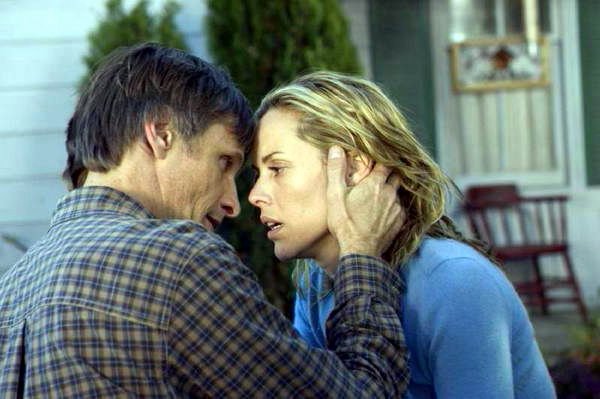
Viggo Mortensen plays Tom Stall, the owner of a local diner in a small town. His life is simple and fulfilling. He starts each day around the dinner table with his beautiful wife, Edie (Maria Bello), infant daughter (Heidi Hayes) and mild-mannered teenage son, Jack (Ashton Holmes). The stall family is functional, happy, balanced. It is both comforting and reassuring to see such a pleasant family where everything isn’t perfect but the effort is being made and the commitment is strong. Everyone does their part, from Jack feeding the dog to Tom sitting up with his daughter after a nightmare to Edie dressing up like a cheerleader to roleplay with her husband. This family seems aware of how fortunate they are to have each other and to live in the town of Millbrook, where people stop to say hello on the street as they walk past, where people aren’t faceless.

Cronenberg takes his time with this setup, allowing us to become drawn in to this comfortable place. Of course, we have the knowledge that something bad is on its way from before the film started which builds tension as we wait. It also makes the fall so much further as there is much at stake for the Stall’s. On one insignificant day, Tom fights back with precision and intensity against two men that hold up his diner and threaten his patrons. Tom’s act of extreme bravery garners him national media attention and subsequently leads some gentlemen, of the disturbing and frightening nature, to the town of Millbrook and his diner counter. Led by Carl Fogerty (Ed Harris), these men accuse Tom of being someone he claims not to be which in turn forces him to face who he used to be, who he has become and how to integrate both of these sides of himself.

Tom’s use of violence is shown as a means to defend one’s self as well as to intimidate at times. This dichotomy debates whether violence is the only solution to violence. In the case of the diner incident, there is a threat of pain and death, forcing desperation and preservation to become the controlling factor. There is no question that Tom did the right thing by protecting himself and his patrons but the nature and reality of the violence is still difficult to stomach for those who witnessed it. To further show a pattern of history and legacy being passed on, Jack takes from his father’s example, consequently blurring the lines when he fights back against a bully in school who accuses him of weakness. Violent tendencies in youth are more primal as they supposedly don’t know any better or don’t have a complete understanding of their emotions forcing them to act out instinctually. To have violence as a natural reaction, as in the case of the unsubstantiated bullying, confirms it as a means to mask a greater fear. To have Jack fight back asserts his power and self-worth but could easily lead to an unhealthy reliance. Like his father, Jack could end up having to walk away from a life where violence is a normal part of that life. But like his father, will he ever truly be able to leave it? Violence can show up anywhere and creep back in at any time.

“A History of Violence” is haunting and disturbing. It is a quiet film that moves at the pace one would expect in a town like Millbrook and when the violence unravels itself on screen, it is quick and sudden. It is cold, senseless and gory and it will both shock and jar you. The unsettling carnage lingers in silence and so will you.