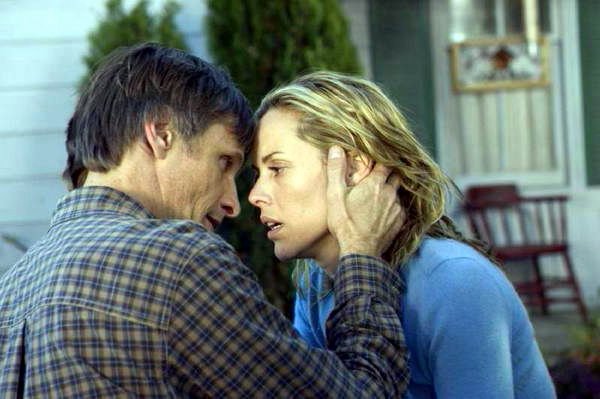
Directed by David Cronenberg

Nikolai: Nice bike. How much do you want for it?
Anna: It has sentimental value.
Nikolai: Sentimental value … I’ve heard of that.
When it comes to films made by veteran Canadian director, David Cronenberg, certain promises are expected to be kept. The name promises something dark and twisted, something gruesome and haunting, something disturbing and seductive. Cronenberg’s latest, EASTERN PROMISES, certainly makes good on all these accounts and solidifies his new, more linear but no less disconcerting approach to filmmaking. Gone are the days of surreal experiments where fetishists get off on colliding cars and the ensuing scars or twin gynecologists playing patients for patsies. Now is the time for the Russian mafia in London to be given a human touch. No, now Mr. Cronenberg is not so concerned with being bizarre as he is with being blunt. As with his last masterpiece, A HISTORY OF VIOLENCE, Cronenberg has made PROMISES into a straightforward story and morality tale, much to the dismay of film students everywhere. Fear not though, students. Accessibility does not make Cronenberg irrelevant. If anything, it means that brilliantly polished stories about the underbelly of humanity can be told without any unnecessary sentiment, allowing for them to be both provocative and bloody as all hell.

It rains just as much in Cronenberg’s London as it does in the real London. The rain ushers in the heavy yet steady hand of this director, whose work always seems to be weighed down by a looming sense of despair and discomfort. Still, though the viewer is pulled into a world where cutting the tips off of fingers and slitting throats is just as normal as a well-balanced breakfast, nothing is so simple as good and evil as absolutes. Like the sky the rain is falling from, everyone is surrounded by an ambiguous grey. Naomi Watts plays a mid-wife named Anna. On one tragic evening, Anna helps to bring a baby into the world at the expense of the very young, heroine-addicted mother’s life. She does not want to see the child fall into the system as the girl cannot be identified to find her next of kin so she makes it her mission to find the girl’s family before this can happen. It may all seem noble but her saintly act also serves to appease the pain she has felt since the miscarriage of her own child months before. She couldn’t save her baby but she can certainly try to help this one. Her search leads her directly to the door of the Russian mafia and this is where she meets Nikolai (Viggo Mortensen). At the moment, Nikolai is just the driver but he’s got hopes to one day be part of the real family. He would be perfect for the job as he is calculated and cold when he needs to be but then again not so as he also takes the time to encourage the slave sex-worker he’s just been with to find a better life. People are complicated; Cronenberg knows this and this is what gives EASTERN PROMISES its depth.

Though regular Cronenberg cinematographer, Peter Suschitzky, guides EASTERN PROMISES with a tranquil glide that sets the pace as both unnerving and engrossing, it is Mortensens’s performance as an aspiring mafioso with a nagging sense of compassion that is most memorable and moving. His face is harsh and guarded behind his dark sunglasses and beneath his slicked back, immaculately placed hair lies a mystery that is being heavily protected. His presence is daunting as he steps from a black town car, dressed to match, from his shoes to his gloves. He is naturally imposing and his icy composure and unflinching dedication to his superiors make him frightening without really trying. He is not so much trying to intimidate others into submission though but rather to keep them away. Yet there is something about him that inspires those around him to see a reason to trust him. Perhaps it is his reliability or perhaps it is just that you know once you meet him that you would rather have him on your side than on the other. Mortensen, working with Cronenberg for the second time after his tortured performance in A HISTORY OF VIOLENCE, is transformed and nearly unrecognizable as Nikolai. And while his character is extremely guarded, he still manages to find himself in a very naked position before the film’s end, in what is a shocking and exhilarating fight sequence that finds Cronenberg, as God, going after Nikolai when he is at his most vulnerable. Proving himself to be a vengeful God, Cronenberg punishes his character for allowing himself to relax for three seconds to appreciate his success.

The fight sequence is already being heralded as one for the books that will be talked about for years to come. I have a feeling we will be hearing just as much talk about Mortensen’s performance, Steven Knight’s script and Cronenberg’s direction come awards season. After setting the groundwork with A HISTORY OF VIOLENCE (which I actually do prefer over EASTERN PROMISES just because it left me with more on my mind), the mainstream film community seems finally ready to reward one of its veteran contributors. If you’re going to sell out, I can’t imagine a better way to do it.