Showing posts with label Greg Kinnear. Show all posts

Saturday, March 13, 2010

GREEN ZONE

Written by Brian Helgeland
Directed Paul Greengrass
Starring Matt Damon, Amy Ryan and Greg Kinnear


Freddy: It is not up to you to decide what happens here.

GREEN ZONE marks the third time actor, Matt Damon, has worked with director, Paul Greengrass. Their previous work on the second and third “Bourne” films must have been pretty mind blowing because Damon has since vowed never to reprise the role that brought him international fame unless Greengrass is at the helm. This action pairing is a new Hollywood powerhouse or at least that’s what Damon and Greengrass would like to think and what the studio is selling. Just like the weapons of mass destruction that are being sought out in the movie though, these claims are based on false intelligence.


Perhaps if Greengrass had not kept Damon running up and down dark alleys all the time, he might have been able to see that the premise of GREEN ZONE had already been brought to light years ago. Damon plays Miller, an army chief on mission to locate WMD’s in the weeks following the U.S. invasion of Iraq in 2003. Shockingly enough, he does not find any and Miller, being the super soldier that he is, figures out that there must be something wrong with the intelligence if he keeps coming up empty handed. He then decides to take matters, and by matters I mean the entire Iraq war, into his own hands and figure out why the U.S. is there to begin with. You may not believe this but the conspiracy involves the C.I.A., the press and the American government.


Maybe if Greengrass hadn’t given instruction to the entire cast to yell at the top of their lungs most of the way through the film, he would have heard how dated the script was. How is accusing the American government on film of fabricating reasons to invade Iraq innovative at all? I almost wanted to laugh at how serious GREEN ZONE takes itself, as if it truly believes it is making a brave point. The laughter stopped pretty quick though and then turned to anger. This is not a brave point. This is exploitation of a now mainstream acceptance of how America duped the world. Brave would have been saying this years ago. Pretending to be brave is just plain cowardly.

Sunday, April 27, 2008

BABY MAMA

Written and Directed by Michael McCullers
Starring Tina Fey, Amy Poehler, Greg Kinnear, Sigourney Weaver and Steve Martin


Kate Holbrook: It’s nice to feel needed, useful, important.
Angie Ostrowiski: I like all of those words.

This one’s for the ladies! Here we have one woman, Kate Holbrook (Tina Fey), who cannot get pregnant and then enlists another woman, Angie Ostrowiski (Amy Poehler) as her surrogate, or in the more contemporary sense, as her BABY MAMA. Angie leaves her dope of a common-law partner and moves in with Kate and the two go from cat fighting to slumber parties in no time. They’re having babies; they’re talking boys; they’re singing along to Cyndi Lauper’s “Girls Just Wanna Have Fun” in the living room. The estrogen practically slinks off the screen in stilettos. If only this expectant comedy didn’t deliver such expected results.


The female bonding originates with Fey & Poehler’s offscreen friendship and makes for some fabulous chemistry and spontaneous hilarity but it never successfully hides the gaping story holes. Having paid an exorbitant amount of money to a firm that screens its surrogates thoroughly should have essentially eliminated Angie as an option, as she has no functional understanding of what it means to take good care of herself. Before long, perhaps to intentionally rattle us from the unoriginal unfolding of the odd couple one would ordinarily expect, Angie’s intentions come into question in such a manner that it becomes practically impossible to continue letting the good times just go on. Good clean fun is replaced by awkward angst.

This contemporary comedy draws our attention to the business of babies. It does so however in such a hackneyed fashion that if it weren’t for the talented mama’s at the forefront of it all, it would be little more than a painful delivery.

Sunday, November 19, 2006

FAST FOOD NATION


Written by Eric Schlosser & Richard Linklater
Directed by Richard Linklater

I’ve tried on a number of occasions to eliminate McDonald’s from my diet. The first time I tried was a few years back, after reading Eric Schlosser’s non-fiction work, FAST FOOD NATION. I remember going to buy fries for the last time before reading the chapter entitled, “Why the Fries Taste so Good.” I had to go for that last fry before I could never look at them the same way again. I went for months without a Big Mac or a Quarter Pounder with cheese but it didn’t last. Eventually I succumbed to my cravings that persisted despite the time that had elapsed. I knew what I was doing was wrong but as I bit into my two all-beef patties, special sauce, lettuce, cheese, pickles and onions on a sesame seed bun, I conveniently forgot about all the chemicals in the meat, the subliminal advertising geared towards toddlers and the migrant, illegal workers in dangerous meat rendering factories that made my burger possible. No sooner had I had my last bite did my stomach twist into a tangled mess. The pain was both horrible and familiar. Unfortunately, Richard Linklater’s narrative interpretation of Schlosser’s novel is nowhere near as nauseating or as a big a turn-off as the feeling of a Big Mac sitting at the bottom of your stomach.

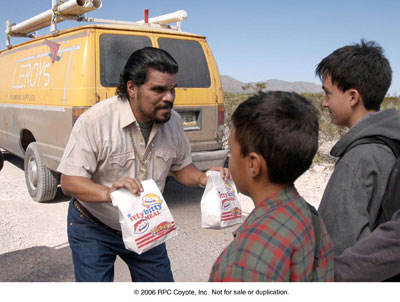
The decision to translate FAST FOOD NATION from a non-fiction work of in-depth investigative journalism into a narrative film is a bold one. I was apprehensive at first but Schlosser’s involvement co-writing the screenplay with Linklater made me less so. Shaping facts into a story certainly humanizes the global implications of the fast food industry but if the narrative is not compelling then there isn’t much of a point. FAST FOOD NATION tells different stories to show the wide reach of how many are affected by the fast food industry. Greg Kinnear plays Don Anderson, an advertising executive responsible for The Big One, the latest burger success at Mickey’s, the fictional fast food chain at the center of the film. Don must investigate reports that there are significant traces of cow manure in the meat (Fun!). Ashley Johnson plays Amber, a teenage Mickey’s employee who juggles school and work while she begins to see her role in the corporate machine that is waiting in her future. Wilmer Valderrama and Catalina Sandino Moreno play Raul and Sylvia, two Mexican illegal immigrants who have been brought into the United States specifically to work at the rendering plant that manufactures the millions of patties that become The Big One. Very little is revealed about the characters themselves as they are merely symbols for the bigger picture. Consequently, there is very little identification with the film. A film that is trying to tell everyone, “America … this is what you’ve become,” needs the audience to feel like this is their America.


What FAST FOOD NATION best exemplifies is America’s complacency with the progression of its society. The problems don’t stop at Mickey’s. The fast food industry is merely just one faceless industry that is driving the American people into hopeless futures. Kinnear’s Don is a prime example. He has spent his life packaging products, feeding them to people the way they like it. All the while, he has also been feeding his convenient lies to himself as well. A successful burger comes at a cost and as he travels from his board room to the assembly line and begins speaking with people who don’t have any stake in the production of The Big One, he understands that there are truths under his lies that he cannot go on ignoring. By the time we see him bite into his third burger, his apprehension to do so is rampant. Yet, he still takes that bite. This is what we do. We get fed a ton of information from different angles. The product pushers tell us how wonderful it is and the non-believers prove otherwise. Schlosser’s book, which clearly details all the subtle atrocities the fast food industry unleashes into the fabric of America to make one more dollar at the expense of its loyal customers, is well researched and fact-checked. The flip side to the convenience of fast food, from obesity to the exploitation of underage employees, is being discussed by too many people and with increasing validity to be ignored. Yet millions still take that bite.

Linklater does not shy away from expressing his disappointment in the American people nor does he mince words about his lack of optimism relating to making change on the subject. Each character’s story is brought to a close and none of them are any better for any of their efforts. Some end up exactly where they wanted not to. Some end up continuing to support the industry despite their newfound knowledge. All these choices are made to ensure money is still coming in, to ensure the American dream is still within reach. Even the youth of tomorrow fail at their attempts to affect the future. The attempt itself does show a trace of Linklater’s hope, albeit it fleeting. Despite all this, Linkalter still wants to do his part. The last ten minutes of FAST FOOD NATION bring about some of the more gruesome footage found in the film. We finally get a tour of the “kill floor” at the rendering plant, with plenty of blood and eaad cow to go around. The nausea comes too late in FAST FOOD NATION but you certainly won’t be rushing for another burger any time soon.

Monday, August 14, 2006

LITTLE MISS SUNSHINE


Written by Michael Arndt
Directed by Jonathan Dayton & Valerie Faris

LITTLE MISS SUNSHINE is this year’s Sundance breakout and nearly all the press its received thus far has lauded it as, well, a little ray of sunshine to carry audiences through the last month of summer. It is the independent underdog that will tickle your funny bone, stimulate your mind and warm your heart. This little movie has so much to live up to and it has barely even gone wide at the moment I am writing this. LITTLE MISS SUNSHINE isn’t generating its own buzz; it’s having its buzz generated by the machine that wants so badly for it to be that movie it could. Y’know which one I’m talking about. The smaller, simpler movie that allows a more mature audience to wind down their summer, to let the ringing in their ears from all the explosive blockbusters subside. What the machine doesn’t understand is that the movie that fills that particular void is not manufactured. It is genuine and it earns that honour all by itself.

This honour is not one I feel LITTLE MISS SUNSHINE would have earned if it weren’t manufactured for it. Albeit an endearing film with authentic moments of hilarity and sentiment, it is often disconnected and unresolved. The dual director team of Jonathan Dayton and Valerie Faris create a believable family unit by giving each member their own personal touch. Dad is a failed motivational speaker; Mom has to deal with loser dad; Grandpa has a heroine problem; older brother has taken a vow of silence until he becomes a fighter pilot; and gay uncle Frank is fresh out of the hospital after trying to kill himself. Dealing themselves such a diverse hand of characters leaves many opportunities to cross the line between quirky and just plain awkward, which they do more often then they should. Then of course there’s Little Miss Sunshine wannabe herself, Olive. With an earnest enthusiasm and innocence beaming from her face (like a ray of … sorry), untouched and uncorrupted Olive reminds the family that they are in fact a family. It’s a lovely story but it is one that only takes shape in the final moments of the film. Prior to that, each character’s individual problems guide all of their own motivations and they only barely have any depth past these problems. Shifting each characters’ focus outwards gives the film some much needed structure but it leaves many an issue either unresolved or resolved far too quickly.


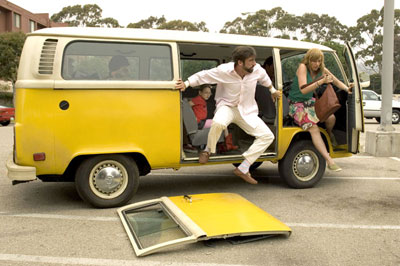
The ensemble cast of LITTLE MISS SUNSHINE reigns as the true heart of this organism. Cramped together in their yellow mini-bus, many different personalities fester. Greg Kinnear and Toni Collette are the heads of the family. Collette is merely a device to highlight the failures of her husband through her aggravation with him. Kinnear’s role however is hefty and he stridently carries that weight as an emasculated patriarch who preaches his failed life lessons to his daughter because she is the only one still buying them. Like another successful family piece, Noah Baumbach’s THE SQUID AND THE WHALE, the influence of the parents on the children manifests before your eyes in a difficult and painful fashion. Steve Carrell plays suicidal uncle, Frank, like a seemingly dormant volcano that may or may not erupt. You just can’t tell. His mystery is heartening and shows promise for his developing capabilities.

As a critic, shedding expectations is a higher state of being I try to achieve before I watch anything. I don’t read other reviews before I see the movie or even before I sit down to write my own, all as an effort to keep it real (dawg). It only takes a quick glance at a magazine cover to get whether people are hating, liking or really loving a movie so it is hard to avoid entirely. But as much as I try to approach each film with a fresh piece of paper to write on, buzz manages to influence the way we see things. When I’m told that something is really solid and it isn’t, even just a little, my disappointment is magnified. LITTLE MISS SUNSHINE has so many things going for it that what it is lacking makes it all the more frustrating because you really want it to live up to the hype. Still ...