Showing posts with label Catalina Sandino Moreno. Show all posts

Sunday, March 1, 2009

CHE

Written by Peter Buchman and Benjamin A. van der Veen
Directed by Steven Soderbergh
Starring Benicio del Toro, Demien Bachir, Catalina Sandino Moreno and Franka Potente


Ernesto Che Guevera: To survive here, to win, you have to live as if you’ve already died.

Steven Soderbergh, the Academy Award winning director of TRAFFIC, would like you to meet someone you already know. He insists though that you only think you know this man and furthermore, that it will take a little over four hours to get to know him the way one should. That man is Cuban revolutionary leader, Ernesto Che Guevera, and Soderbergh’s film is simply, CHE. Broken into two parts, the first entitled “The Argentine” and the second entitled, “Guerilla”, CHE seems daunting on the surface but once you break past that, it is a engrossing experience that is much more forthcoming and straightforward than you would have expected. I admit, I too expected a pompous overwrought work, given the run time and subject matter but Soderbergh continues to impress me with his subtlety and his touch, soft yet still commanding.


Over the course of the two films, Soderbergh gives us Guevera’s rise as a revolutionary and his ultimate and subsequent demise. Guevera is given to us via Benicio del Toro, a man who was practically ignored during awards season for no good reason that I can figure. Del Toro is a patient and practical Che. He understands his mission; he understands its importance concerning the greater good of his country; and he understands that he is just one man making up a much larger whole. Del Toro plays Guevera with such delicate restraint and an untold inner depth that is very rarely allowed to pass his guarded surface. It is an engaging experience to watch him embody this historical figure’s skin and it is his practically perfect performance that gives roots to a film about a man with no specific roots to plant.


CHE is not just about the man but also a telling history lesson that plays out as naturally as one would hope an epic of this size would. And while Soderbergh’s portrayal is decidedly fair and frank, his film is a might stronger than that.

GRADE: B+

Tuesday, May 29, 2007

PARIS, JE T’AIME

Written and Directed by:
Olivier Assayas, Frederic Aubertin, Gurinder Chadha, Sylvain Chomet, Ethan Coen, Joel Coen, Isabel Coixet, Wes Craven, Alfonso Cuaron, Gerard Depardieu, Christopher Doyle, Richard LaGravenese, Vincenzo Natali, Alexander Payne, Bruno Podalydes, Walter Salles, Oliver Schmitz, Nobuhiro Suwa, Daniela Thomas, Tom Tykwer and Gus Van Sant


Francine: Thomas Listen. Listen. There are times when life calls out for a change. A transition. Like the seasons. Our spring was wonderful, but summer is over now and we missed out on autumn. And now all of a sudden, it's cold, so cold that everything is freezing over. Our love fell asleep, and the snow took it by surprise. But if you fall asleep in the snow, you don't feel death coming.

With the sun shining brilliantly on a quiet Sunday that is just about to fully wake up, love can be felt in the soft breeze that sweeps past my feet and can be seen in the smiles of the people I walk alongside. It is the perfect day to stop off for croissants and a cafĂ©-o-lait before heading off to the city of lights and love. Of course, a flight to Paris is not reasonably in this humble film critic’s budget so I had to opt for the next best thing, PARIS, JE T’AIME, a collection of 18 short films by a variety of international directors. Each piece is named after a different Parisian neighborhood and is a reflection on love. Careful not to over glorify the most powerful and persuasive of all human emotions, PARIS, JE T’AIME explores love at the many stages of its own game. The results are spontaneously romantic and surprisingly consistent. And truly, what better way to express the fleeting nature of love and how a moment can change your life than with a collection of filmed moments.


The beautifully poetic quote above is taken from Tom Tykwer’s Faubourg Saint Denis. True to form, Tykwer (RUN, LOLA, RUN) uses time-lapse photography and repetition to demonstrate the entire cycle of love, from inception to dissolution. Originally shot in 2004 and paired down for this anthology, Faubourg stars Natalie Portman as Francine, an American actress in Paris for a part in a film, and Melchior Beslon as Thomas, a blind man she falls in love with. Here, the blind leads the blind through the most unstable of terrain, where two people consume each other to a point where their lives nearly lose their own existences. As love seems to go from dazzling to dizzying, Tykwer reminds us of the tricks it can play on our minds and the illusions it can create when we stray towards doubt.


Perhaps the most giddily romantic offering comes from Sylvain Chomet’s Tour Eiffel. Choosing the city’s most identifiable attraction for its title, Chomet (LES TRIPLETTES DE BELLEVILLE) gives us a little boy who tells the story of how his parents met and fell in love. His father, a mime (Paul Putner), finds himself falling into one surreal scenario after another and eventually lands himself in jail. This is where he meets the woman who will become the love of his life (Yolande Moreau). Miming has become something of a dying art, if it isn’t already dead. Yet by nature, it is dreamy and untroubled. Miming points its silent finger at the ridiculousness of human behaviour and what but love can make people act more absurd? We might find someone special in the least likely of circumstances if we could just take ourselves a little less seriously.


PARIS, JE T’AIME keeps the flow lively by not always focusing on love between lovers. Three memorable shorts focus on the love between a parent and a child. Walter Salles (MOTORCYCLE DIARIES) has Catalina Sandino Moreno singing lovingly to her child before she leaves him to sing the same song with a distant longing to the child she watches over for her living. Nobuhiro Suwa (UN COUPLE PARFAIT) has Juliette Binoche trying desperately to overcome the emptiness she feels after losing her son. Binoche says very little yet, not surprisingly given her immense talent, her struggle is evident in her face as she learns that love sometimes means letting go. And Alfonso Cuaron (CHILDREN OF MEN) weighs in with one continuous shot of a father (Nick Nolte) and his grown daughter (Sara Martins) walking together for what must be the first time in a long while. We see them only from across the street and we only get close to them as the distance between the two characters narrows to a place of comfort and accepting.


The last short to screen is Alexander Payne’s 14ieme Arrondissement. As usual, Payne (SIDEWAYS) takes an ordinary person and shows us what makes them extraordinary. Carol (Margo Martindale) is another American in Paris. She is there alone and for less time than she would have liked as she has dogs waiting for her at home. She is a plain person with an uneventful life who finds herself in a city that is rich and lush. In beautifully delivered Americanized French, she muses about the sights and how being there makes her feel. This woman spends so much time trying to be happy despite life’s numerous disappointments and as she sits in a city made for lovers, she realizes that she is in fact happy and loves herself more than she knew. She falls in love, if only for perhaps a moment, with life and love itself.


The characters that appear but fleetingly in PARIS, JE T’AIME find themselves at the romantic center of the universe. The moments they share with each other, be it helping someone up after a hard fall or reaching out your hand to another person without touching them or without their knowledge, are the moments that give love its flare and flourish. Outside the city of lovers, it can be easy to miss moments such as these but we must remind ourselves of their significance. It takes but a moment for love to shine through a cloudy sky. You just have to keep your heart open to see it. And if one city can be so abundant with love, one has to believe it can find its way one day to your door.

Sunday, November 19, 2006

FAST FOOD NATION


Written by Eric Schlosser & Richard Linklater
Directed by Richard Linklater

I’ve tried on a number of occasions to eliminate McDonald’s from my diet. The first time I tried was a few years back, after reading Eric Schlosser’s non-fiction work, FAST FOOD NATION. I remember going to buy fries for the last time before reading the chapter entitled, “Why the Fries Taste so Good.” I had to go for that last fry before I could never look at them the same way again. I went for months without a Big Mac or a Quarter Pounder with cheese but it didn’t last. Eventually I succumbed to my cravings that persisted despite the time that had elapsed. I knew what I was doing was wrong but as I bit into my two all-beef patties, special sauce, lettuce, cheese, pickles and onions on a sesame seed bun, I conveniently forgot about all the chemicals in the meat, the subliminal advertising geared towards toddlers and the migrant, illegal workers in dangerous meat rendering factories that made my burger possible. No sooner had I had my last bite did my stomach twist into a tangled mess. The pain was both horrible and familiar. Unfortunately, Richard Linklater’s narrative interpretation of Schlosser’s novel is nowhere near as nauseating or as a big a turn-off as the feeling of a Big Mac sitting at the bottom of your stomach.

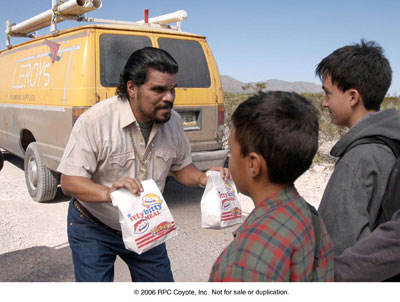
The decision to translate FAST FOOD NATION from a non-fiction work of in-depth investigative journalism into a narrative film is a bold one. I was apprehensive at first but Schlosser’s involvement co-writing the screenplay with Linklater made me less so. Shaping facts into a story certainly humanizes the global implications of the fast food industry but if the narrative is not compelling then there isn’t much of a point. FAST FOOD NATION tells different stories to show the wide reach of how many are affected by the fast food industry. Greg Kinnear plays Don Anderson, an advertising executive responsible for The Big One, the latest burger success at Mickey’s, the fictional fast food chain at the center of the film. Don must investigate reports that there are significant traces of cow manure in the meat (Fun!). Ashley Johnson plays Amber, a teenage Mickey’s employee who juggles school and work while she begins to see her role in the corporate machine that is waiting in her future. Wilmer Valderrama and Catalina Sandino Moreno play Raul and Sylvia, two Mexican illegal immigrants who have been brought into the United States specifically to work at the rendering plant that manufactures the millions of patties that become The Big One. Very little is revealed about the characters themselves as they are merely symbols for the bigger picture. Consequently, there is very little identification with the film. A film that is trying to tell everyone, “America … this is what you’ve become,” needs the audience to feel like this is their America.


What FAST FOOD NATION best exemplifies is America’s complacency with the progression of its society. The problems don’t stop at Mickey’s. The fast food industry is merely just one faceless industry that is driving the American people into hopeless futures. Kinnear’s Don is a prime example. He has spent his life packaging products, feeding them to people the way they like it. All the while, he has also been feeding his convenient lies to himself as well. A successful burger comes at a cost and as he travels from his board room to the assembly line and begins speaking with people who don’t have any stake in the production of The Big One, he understands that there are truths under his lies that he cannot go on ignoring. By the time we see him bite into his third burger, his apprehension to do so is rampant. Yet, he still takes that bite. This is what we do. We get fed a ton of information from different angles. The product pushers tell us how wonderful it is and the non-believers prove otherwise. Schlosser’s book, which clearly details all the subtle atrocities the fast food industry unleashes into the fabric of America to make one more dollar at the expense of its loyal customers, is well researched and fact-checked. The flip side to the convenience of fast food, from obesity to the exploitation of underage employees, is being discussed by too many people and with increasing validity to be ignored. Yet millions still take that bite.

Linklater does not shy away from expressing his disappointment in the American people nor does he mince words about his lack of optimism relating to making change on the subject. Each character’s story is brought to a close and none of them are any better for any of their efforts. Some end up exactly where they wanted not to. Some end up continuing to support the industry despite their newfound knowledge. All these choices are made to ensure money is still coming in, to ensure the American dream is still within reach. Even the youth of tomorrow fail at their attempts to affect the future. The attempt itself does show a trace of Linklater’s hope, albeit it fleeting. Despite all this, Linkalter still wants to do his part. The last ten minutes of FAST FOOD NATION bring about some of the more gruesome footage found in the film. We finally get a tour of the “kill floor” at the rendering plant, with plenty of blood and eaad cow to go around. The nausea comes too late in FAST FOOD NATION but you certainly won’t be rushing for another burger any time soon.