Showing posts with label Winona Ryder. Show all posts

Tuesday, November 30, 2010

BLACK SWAN

Written by Mark Heyman, Andres Heinz and John J. McLaughlin
Directed by Darren Aronofsky
Starring Natalie Portman, Vincent Cassel, Mila Kunis, Barbara Hershey and Winona Ryder


Thomas Leroy: Perfection is not just about control. It is also about letting go.

From my understanding, to be a true ballerina, one must always strive for perfection. Your toes, your torso, your lines must be just so. If you’re serious about ballet, you might be lucky enough to join a company. Only a select few get to be company soloists though. And so, lightly prancing about beneath the stage at any given ballet, you will find dozens of girls all striving toward an unattainable goal - some starving themselves and some hoping the soloist will take a bad fall and need replacing at the last second. It’s a microcosm, ripe with potential for drama and madness, making it the perfect setting for Darren Aronofsky’s latest, BLACK SWAN.


At the film’s start, a single spotlight rises on two feet, tightly wound in the tiniest of slippers. They begin to dance and as they land one after the other, we can see how delicate ballet is and how tortuous it must be to make it look that good. When the camera pulls away to reveal that these feet do in fact belong to Natalie Portman, it is clear just how much grace she will bring to this film. And by the time a beastly creature makes itself known to this frightened dancer, it is clear that Aronofsky is about to, yet again, give us something unlike anything else he’s done.


Portman is Nina, a dancer with the New York City Ballet who has just been cast as the Swan Princess in the upcoming production of “Swan Lake”. To do so in exactly the manner her director (Vincent Cassel) demands, she must embody the spirit of both the white and the black swan. Yes, the thematic conflict for this character is obvious at this point but Aronofsky tells it with complex visual style that jetés between jarring and captivating. And Portman, who has reportedly been in dance lessons since she was a toddler, knows the pressure of the dancer. She is to tightly wound that by the time her dark side begins to show its face, we are just as ready to release as she is. It certainly doesn’t help matters that her mother (Barbara Hershey) pressures her to succeed, a new dancer (Mila Kunis) wants her spot and the soloist she replaced (Winona Ryder) wants her just plain gone.


BLACK SWAN is as theatrical and as dramatic as any ballet that I’ve seen performed on stage. Aronofsky directs but, from behind the camera, he dances alongside the dancers as if he was part of the choreography, forming some hybrid of dance and film that begs repeat performances. It also warrants a resounding standing ovation.


Tuesday, September 14, 2010

TIFF Review: BLACK SWAN

Written by Mark Heyman, Andres Heinz and John J. McLaughlin
Directed by Darren Aronofsky
Starring Natalie Portman, Vincent Cassel, Mila Kunis, Barbara Hershey and Winona Ryder


Thomas Leroy: Perfection is not just about control. It is also about letting go.

From my understanding, to be a true ballerina, one must always strive for perfection. Your toes, your torso, your lines must be just so. If you’re serious about ballet, you might be lucky enough to join a company. Only a select few get to be company soloists though. And so, lightly prancing about beneath the stage at any given ballet, you will find dozens of girls all striving toward an unattainable goal - some starving themselves and some hoping the soloist will take a bad fall and need replacing at the last second. It’s a microcosm, ripe with potential for drama and madness, making it the perfect setting for Darren Aronofsky’s latest, BLACK SWAN.


At the film’s start, a single spotlight rises on two feet, tightly wound in the tiniest of slippers. They begin to dance and as they land one after the other, we can see how delicate ballet is and how tortuous it must be to make it look that good. When the camera pulls away to reveal that these feet do in fact belong to Natalie Portman, it is clear just how much grace she will bring to this film. And by the time a beastly creature makes itself known to this frightened dancer, it is clear that Aronofsky is about to, yet again, give us something unlike anything else he’s done.


Portman is Nina, a dancer with the New York City Ballet who has just been cast as the Swan Princess in the upcoming production of “Swan Lake”. To do so in exactly the manner her director (Vincent Cassel) demands, she must embody the spirit of both the white and the black swan. Yes, the thematic conflict for this character is obvious at this point but Aronofsky tells it with complex visual style that jetés between jarring and captivating. And Portman, who has reportedly been in dance lessons since she was a toddler, knows the pressure of the dancer. She is to tightly wound that by the time her dark side begins to show its face, we are just as ready to release as she is. It certainly doesn’t help matters that her mother (Barbara Hershey) pressures her to succeed, a new dancer (Mila Kunis) wants her spot and the soloist she replaced (Winona Ryder) wants her just plain gone.


BLACK SWAN is as theatrical and as dramatic as any ballet that I’ve seen performed on stage. Aronofsky directs but, from behind the camera, he dances alongside the dancers as if he was part of the choreography, forming some hybrid of dance and film that begs repeat performances. It also warrants a resounding standing ovation.


Saturday, November 7, 2009

ABC: E is for EDWARD SCISSORHANDS


EDWARD SCISSORHANDS
Written by Caroline Thompson
Directed by Tim Burton
Starring Johhny Depp, Winona Ryder, Dianne Wiest and Alan Arkin


I can’t say how many years it has been since I last saw Tim Burton’s EDWARD SCISSORHANDS but I can say that I wasn’t prepared to have it come over me the way that it did when I watched it again recently. There I was, just sitting in my living room alone one night, taking notes on this variation of the “Frankenstein” story, and before it ended, I was crying. I was fully moved by the palpable love that was emanating from my screen and then I remembered something … This is a Tim Burton movie and I’m overwhelmed with love. Hmmm …


In case you’re not familiar, this 1990 film, tells the story of Edward, a man-made man who was unfortunately unfinished at the time of the inventor’s death. He had a head, a heart and a soul but he had no hands. In their place, he had scissors. Having scissors for hands and no interaction with anyone for an undetermined amount of years left Edward detached from society and, without the reassuring touch of another human being, he felt incapable of connecting. He lived in peace, albeit lonesome, atop a hill in a mansion that overlooked this quaint suburban Burbank neighborhood, until one day, when none other than Peg, the Avon lady, knocked on his door. When Peg (Dianne Wiest) saw that Edward (Johnny Depp) needed so much more than cosmetics, she decided to take him home with her. What she didn’t anticipate was how a supposedly normal society would react to such a supposed freak.


Burton considers EDWARD SCISSORHANDS to be one of his most personal works and, when you consider it to be the birthplace of so many recurring Burton themes and motifs, it is easy to see why. Burton himself grew up in Burbank and, although I cannot personally attest to his accuracy in recreating it, I can certainly feel what it must have been like for such a unique artist to have grown up in this type of environment. Edward, with his pale skin, unkempt black hair and, well, scissors for hands, is at first the object of total fascination in this community that consists of cookie-cutter houses that vary in pastel exteriors. Inside these houses are men who all leave for work at the same every day and their wives, the originally desperate ones, who need the drama of the neighborhood to give their lives meaning. With everyone playing house, there is no room for different and no reference as to how to deal with it.


Being the outsider, being misunderstood, being dark and having people wrongly equate that with evil – these are all themes that Burton is obsessed with and certainly also themes that spring directly from his own experiences with society. EDWARD SCISSORHANDS allows him to put himself out there and allows the viewer to see what he presumes to be how a wider audience will react to him. And so, his expectation is that they will embrace and admire his differences at first but eventually come to revile him for them. A burst of excitement is all these rutted people crave but they learn quickly that they prefer the comfort that ruts also often offer. Of course, Burton’s onscreen representation is exaggerated by Depp. At this stage in his career, Depp was seen as merely a teen idol, which was not meshing with how he wanted to be seen or where he wanted his career to go. With his sweet face covered in makeup and scars, Depp was able to show audiences his Keaton-esque side – his humour, his empathy and his charm.


At one point, Edward is on a daytime talk show and one of the audience members asks him if he would have his scissors replaced by hands if that were possible. Edward doesn’t hesitate and says, “Yes.” But then, the lady in the audience points out, he would be just like everyone else, that there would be nothing special about him. This is where this unexpected Burton-esque optimism fills the screen. Peg, sitting next to Edward, says that he will always be special. In that moment, we are all Edward. We all have something unique about us that, if we cannot hide, ostracizes us from everyone else. When you live your life removed from everyone, you do not know the healing qualities of human touch. And when no one has touched you in a long time, you can lose the confidence to reach out and touch someone else. You may even think that you are not even capable of it.


Behind the scissors that keep everyone at a distance, Edward is just a man and, like any man with a sensitive heart, he simply wants to love. And what could be more lovely than the image of a young Winona Ryder spinning freely underneath the snow-like shavings of an ice sculpture that Edward is carving just for her? With EDWARD SCISSORHANDS, Burton shares this wonderful gift with his Edward, with his audience and with himself. Suddenly, the Burbank boy that always felt different knows what its like to touch the hearts of others.

Sunday, July 30, 2006

A SCANNER DARKLY


Written and Directed by Richard Linklater

Three men drive down an American highway on a mission. They are driving to a neighbouring city and they plan on partying it up on the way, while they’re there and all the way home again. Their drug of choice is Substance D, what will be the most popular drug seven years from now, when A SCANNER DARKLY takes place. While speeding along, the car breaks down. What ensues is a hilarious journey into the far depths of drug-induced paranoia. They debate whether this car trouble was pre-meditated, whether their home is simultaneously being ransacked by the same people who sabotaged their car … whether one of them actually anticipated this entire series of events and left the door unlocked and an invitation to enter taped to the front of it. Their plans have been ruined but what they don’t realize is that there was nothing special about this occasion as getting messed up is pretty much what they do every day. As ridiculous as this sequence is, it is also completely useless. It is one in a long string of pointless scenes that are told in a disjointed fashion to give character to what is otherwise a flat and uninteresting film.

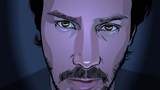
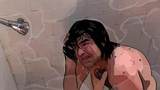
A SCANNER DARKLY is director Richard Linklater’s second film to implement an animation technique called rotoscoping, where loosely flowing animation is laid over filmed live-action sequences. The results are mesmerizing and hypnotic. It is also a technique that is capable of accomplishing what most directors have struggled with for years. It creates the illusion that Keanu Reeves can actually act. Joining Reeves in this animated parallel universe are Robert Downey Jr, Woody Harrelson and Winona Ryder. Reeves plays an undercover narcotics agent named Bob Arctor, who can’t seem to differentiate between his personas. The drugs have blurred his existence to the point that he can’t quite grasp whether the images of a wife and family that he has in his mind are a memory or just an image. As his confusion grows, so does his addiction. The results make it difficult to ascertain what life Arctor is actually leading. Shortly before the film ends, Linklater reveals an element that explains all the jarring elements encountered along the way. Suddenly, the story becomes clear and it is seen as nothing more than a straightforward nark story. The explanation may solidify the arch but it doesn’t appease any frustration one might have, having spent so long trying to make sense of what one thought was something different.


Substance D keeps Linklater’s characters detached from each other and themselves. Although the majority of the characters are addicts without a history, Arctor fell into drugs as a reaction to the perfection he thought he had achieved in his life. Adapting author Philip K. Dick’s autobiographical account of how he fell into drugs, Linklater reinforces how people spend so much time walking blindly towards the achievements they always felt would make their life significant and full. The rejection of that comfort through drug usage ultimately leads to a much larger sense of discomfort. It makes the idea of getting close to someone in a sober, authentic context unthinkable and frightening. Finally, Arctor has run away from intimacy and finds himself wanting to have that again but not being capable of having it because his world no longer makes any sense.

The beauty of A SCANNER DARKLY is in its aesthetic. Remove that and I doubt the film would be watchable. Linklater’s previous attempt at this style, WAKING LIFE, was infinitely more successful because the technique lends to the psychedelic dreamscape setting and existentialist-themed conversations. Here, the technique is a life preserver for a bunch of drowning druggies.