Showing posts with label Natalie Portman. Show all posts

Friday, February 4, 2011

Best of Black Sheep: THE OTHER WOMAN

Written and Directed by Don Roos
Starring Natalie Portman, Steve Cohen and Lisa Kudrow


(Writer's note: This review is two years old. The film, which was originally titled "Love and Other Impossible Pursuits" is only now making it to theatres.)

Don Roos’s career as a director has been spotty at best. His debut feature, THE OPPOSITE OF SEX, showed great promise, a fresh voice that was loud and direct. Hollywood came calling and, after he gave them BOUNCE, they sent him home. That’s where he made HAPPY ENDINGS, which is when I pretty much gave up on him. His latest, THE OTHER WOMAN, finds him back in Hollywood’s good graces and, while his sharp approach may have softened, Roos has matured nonetheless.

The lovely Natalie Portman plays Emilia Greenleaf, a lawyer just starting out who falls for her employer instead of into her work. The non-linear revealing of the story does not always seem succinct but it goes a little something like this. Emilia gets pregnant; her boss (Scott Cohen) leaves his wife (Lisa Kudrow) and marries her. She, in turn, leaves her job and begins a rocky relationship with her stepson (Charlie Tahan) that gets exponentially more difficult when her baby is born and dies three days later. It is all some sort of half-cocked comment on the implausibility of love in our modern, overly complicated existence but polished for wide appeal.

The gravitas may not be there in order to take this exploration from the surface to the depths but the surface itself is smooth enough to see plenty of sentiment in its reflection. Portman is detached but unaffected. She has to carry the film and, though she seems to only be scraping the top layer of her character’s profundity, it is still enough to keep the tears flowing. THE OTHER WOMAN is conventional but sincere and in a time when real intimacy is considered by some to be fairy tale, genuine intention can be worth settling in for.

Tuesday, November 30, 2010

BLACK SWAN

Written by Mark Heyman, Andres Heinz and John J. McLaughlin
Directed by Darren Aronofsky
Starring Natalie Portman, Vincent Cassel, Mila Kunis, Barbara Hershey and Winona Ryder


Thomas Leroy: Perfection is not just about control. It is also about letting go.

From my understanding, to be a true ballerina, one must always strive for perfection. Your toes, your torso, your lines must be just so. If you’re serious about ballet, you might be lucky enough to join a company. Only a select few get to be company soloists though. And so, lightly prancing about beneath the stage at any given ballet, you will find dozens of girls all striving toward an unattainable goal - some starving themselves and some hoping the soloist will take a bad fall and need replacing at the last second. It’s a microcosm, ripe with potential for drama and madness, making it the perfect setting for Darren Aronofsky’s latest, BLACK SWAN.


At the film’s start, a single spotlight rises on two feet, tightly wound in the tiniest of slippers. They begin to dance and as they land one after the other, we can see how delicate ballet is and how tortuous it must be to make it look that good. When the camera pulls away to reveal that these feet do in fact belong to Natalie Portman, it is clear just how much grace she will bring to this film. And by the time a beastly creature makes itself known to this frightened dancer, it is clear that Aronofsky is about to, yet again, give us something unlike anything else he’s done.


Portman is Nina, a dancer with the New York City Ballet who has just been cast as the Swan Princess in the upcoming production of “Swan Lake”. To do so in exactly the manner her director (Vincent Cassel) demands, she must embody the spirit of both the white and the black swan. Yes, the thematic conflict for this character is obvious at this point but Aronofsky tells it with complex visual style that jetés between jarring and captivating. And Portman, who has reportedly been in dance lessons since she was a toddler, knows the pressure of the dancer. She is to tightly wound that by the time her dark side begins to show its face, we are just as ready to release as she is. It certainly doesn’t help matters that her mother (Barbara Hershey) pressures her to succeed, a new dancer (Mila Kunis) wants her spot and the soloist she replaced (Winona Ryder) wants her just plain gone.


BLACK SWAN is as theatrical and as dramatic as any ballet that I’ve seen performed on stage. Aronofsky directs but, from behind the camera, he dances alongside the dancers as if he was part of the choreography, forming some hybrid of dance and film that begs repeat performances. It also warrants a resounding standing ovation.


Tuesday, September 14, 2010

TIFF Review: BLACK SWAN

Written by Mark Heyman, Andres Heinz and John J. McLaughlin
Directed by Darren Aronofsky
Starring Natalie Portman, Vincent Cassel, Mila Kunis, Barbara Hershey and Winona Ryder


Thomas Leroy: Perfection is not just about control. It is also about letting go.

From my understanding, to be a true ballerina, one must always strive for perfection. Your toes, your torso, your lines must be just so. If you’re serious about ballet, you might be lucky enough to join a company. Only a select few get to be company soloists though. And so, lightly prancing about beneath the stage at any given ballet, you will find dozens of girls all striving toward an unattainable goal - some starving themselves and some hoping the soloist will take a bad fall and need replacing at the last second. It’s a microcosm, ripe with potential for drama and madness, making it the perfect setting for Darren Aronofsky’s latest, BLACK SWAN.


At the film’s start, a single spotlight rises on two feet, tightly wound in the tiniest of slippers. They begin to dance and as they land one after the other, we can see how delicate ballet is and how tortuous it must be to make it look that good. When the camera pulls away to reveal that these feet do in fact belong to Natalie Portman, it is clear just how much grace she will bring to this film. And by the time a beastly creature makes itself known to this frightened dancer, it is clear that Aronofsky is about to, yet again, give us something unlike anything else he’s done.


Portman is Nina, a dancer with the New York City Ballet who has just been cast as the Swan Princess in the upcoming production of “Swan Lake”. To do so in exactly the manner her director (Vincent Cassel) demands, she must embody the spirit of both the white and the black swan. Yes, the thematic conflict for this character is obvious at this point but Aronofsky tells it with complex visual style that jetés between jarring and captivating. And Portman, who has reportedly been in dance lessons since she was a toddler, knows the pressure of the dancer. She is to tightly wound that by the time her dark side begins to show its face, we are just as ready to release as she is. It certainly doesn’t help matters that her mother (Barbara Hershey) pressures her to succeed, a new dancer (Mila Kunis) wants her spot and the soloist she replaced (Winona Ryder) wants her just plain gone.


BLACK SWAN is as theatrical and as dramatic as any ballet that I’ve seen performed on stage. Aronofsky directs but, from behind the camera, he dances alongside the dancers as if he was part of the choreography, forming some hybrid of dance and film that begs repeat performances. It also warrants a resounding standing ovation.


Saturday, December 5, 2009

BROTHERS

Written by David Benioff
Directed by Jim Sheridan
Starring Tobey Maguire, Jake Gyllenhaal, Natalie Portman, Sam Sherpard and Mare Winningham


Grace: I can’t feel it. Shouldn’t I be able to feel it?

I have a brother. He is two years younger than me and about five inches taller. Like most siblings, when we were little, we had our moments. We could on occasion play together for hours but we would certainly on many another occasion get into some serious kicking and screaming. Fortunately, unlike most siblings, we managed to find an adult relationship based mostly on respect – based somewhat on trading sarcastic quips back and forth but mostly on respect. Naturally, we have our issues; we are brothers after all. There’s some jealousy here and some competition over there but that’s to be expected and it balances itself out because what we have is real. I wish I could say the same about Jim Sheridan’s BROTHERS but sadly these brothers are too contrived to feel like anything close to the real deal.


The brothers in question here are the Cahill boys, Tommy (Jake Gyllenhaal) and Sam (Tobey Maguire). Their history is so cluttered with the kind of rivalry that can only be concocted by a screenwriter. It’s like reading “Brothers for Dummies” at times. Sam is a decorated army captain while, when we first meet Tommy, he is being released from prison. Fortunately, Tommy’s prison release is perfectly timed with Sam’s departure to Afghanistan. This way, the whole family can get together at the dinner table one last time and, because what would a family dinner be without this, the whole family drama implodes before dessert is served. You see, Daddy (Sam Shepard) is a bit a of a drinker and a former army man himself so you know which of his sons is his favorite. Oh why can’t Tommy be more like his brother, Sam? His father actually asks that. That was the first time I groaned.


What makes BROTHERS watchable, and it is watchable, is the incredibly engaging young cast. Along with Natalie Portman, Gyllenhaal and Maguire dig their boots into this family’s roots, no matter how intentionally tangled they are. They each brave through the warzone of manipulation that is this film’s plot to carve out as memorable a character as they can. When Sam is believed to have been killed in Afghanistan what seems like five minutes after he arrives there, Grace (Portman) finds unexpected solace in the brother that stayed behind. The trouble here is that we know that Sam isn’t dead, that he is only being held prisoner by some of the most clichéd Arab men I’ve seen in a while on film. Instead of feeling unhealthy yet potentially cathartic, their budding relationship, and the one Tommy fosters with her two daughters, just feels like filler until Sam inevitably returns.


I’ve come to expect a certain level of excellence from Sheridan. For the most part, he is able to create simple understandings of complex emotions but he was disadvantaged from the start here. Based on a 2004 Danish film, David Benioff’s screenplay is just too forced and his constraints as a writer place restraints on all the talent attached to BROTHERS. Subsequently, everyone is trying way too hard to make this work when the only way to bring peace to siblings split by life’s different paths is just to get them together and let it happen all by itself.

Thursday, September 17, 2009

THE OTHER WOMAN


Don Roos’s career as a director has been spotty at best. His debut feature, THE OPPOSITE OF SEX, showed great promise, a fresh voice that was loud and direct. Hollywood came calling and, after he gave them BOUNCE, they sent him home. That’s where he made HAPPY ENDINGS, which is when I pretty much gave up on him. His latest, THE OTHER WOMAN, finds him back in Hollywood’s good graces and, while his sharp approach may have softened, Roos has matured nonetheless.

The lovely Natalie Portman plays Emilia Greenleaf, a lawyer just starting out who falls for her employer instead of into her work. The non-linear revealing of the story does not always seem succinct but it goes a little something like this. Emilia gets pregnant; her boss (Scott Cohen) leaves his wife (Lisa Kudrow) and marries her. She, in turn, leaves her job and begins a rocky relationship with her stepson (Charlie Tahan) that gets exponentially more difficult when her baby is born and dies three days later. It is all some sort of half-cocked comment on the implausibility of love in our modern, overly complicated existence but polished for wide appeal.

The gravitas may not be there in order to take this exploration from the surface to the depths but the surface itself is smooth enough to see plenty of sentiment in its reflection. Portman is detached but unaffected. She has to carry the film and, though she seems to only be scraping the top layer of her character’s profundity, it is still enough to keep the tears flowing. THE OTHER WOMAN is conventional but sincere and in a time when real intimacy is considered by some to be fairy tale, genuine intention can be worth settling in for.

Saturday, May 24, 2008

MY BLUEBERRY NIGHTS

Written by Wong Kar Wai & Lawrence Block
Directed by Wong Kar Wai
Starring Norah Jones, Jude Law, Rachel Weisz, David Strathairn and Natalie Portman


Elizabeth: What’s wrong with the blueberry pie?
Jeremy: There’s nothing wrong with the blueberry pie; just people make other choices. You can’t blame the blueberry pie; it’s just … no one wants it.

It doesn’t get much more American than apple pie. I can’t say why that is exactly but that is what they say. And while blueberry most certainly isn’t apple, the reference to pie does make for an appropriate symbolic foundation for famed Chinese director, Wong Kar Wai’s first foray into American cinema, MY BLUEBERRY NIGHTS. And he doesn’t just stop at pie. Kar Wai immerses himself in Americana, taking us on a road trip from New York to Missouri and Las Vegas, with shift work, gambling and heartache along for the ride. Sadly though, Kar Wai crossed the Pacific only to get lost in the Heartland for there is something else distinctly American about this film – it rests comfortably on the surface without much effort to go deeper and dresses itself up in pretty colors to hide it’s lack of profundity.


To solidify his position as a stranger in a strange land, Kar Wai casts singer, Norah Jones in her first acting role. Jones plays Elizabeth and Elizabeth is represented by the blueberry pie. It’s a perfectly good pie but no one seems to ever choose it when there are more traditional slices to be had. Blueberry is apparently the black sheep of pies, if you will. Elizabeth isn’t afraid to try something new though and so she adamantly chooses the neglected pie. Now, she need only learn how to do the same for herself. To learn how, she bolts across the country but while she searches for herself through countless sleepless nights, she finds character after character in worse shape than she. As she gets further and further from New York though, you know there’s only one place that makes sense for her to end up. It wouldn’t be a journey of self-discovery after all if you didn’t finish precisely where you started. Well, it would be if this were earlier Kar Wai but this is America, baby!


As Elizabeth, Jones is in a constant state of bewilderment. It is as though she was just born or just woke up to find the world has stopped making any sense. She looks uncomfortable, agitated, not unlike her stage presence from her earlier touring days. It isn’t clear whether this discomfort is her character or her lack of ability to develop one. It doesn’t help that she is surrounded by a supporting cast all on top of their game. Jude Law smolders as the man who serves her the blueberry pie. He is the guy who once got burned and hasn’t moved since. Rachel Weisz and David Strathairn are a couple on the brink of divorce. She has been hollowed by a disastrous marriage and he spends night after night numbing his pain with drink after drink. She is the nervous wreck to his wasted space. Elizabeth’s final encounter is with Leslie (Natalie Portman), a fast-talking, overly confident poker player. Portman has been better but still has plenty of tricks to teach Jones. Jones knows how to brood but her delivery is too often hollow. She is the mystery at the center of Kar Wai’s America but doesn’t inspire any desire to be solved.


MY BLUEBERRY NIGHTS conjures a certain kind of mood. It captures the state of human damage that we all inevitably encounter at some point but only some figure out how to survive. Our initial instinct may be to run and we may do so by driving as far away as possible or staying still exactly where we are and never risking anything ever again. No matter what we do, the nights can get very lonely and if we’re lucky there is still pie to be had and someone to share it with. If we want to survive though, we must be brave enough to go home again. Now that Wong Kar Wai has gotten sufficiently lost, I think it is time for him to heed Elizabeth’s lesson and do the same.

Wednesday, March 5, 2008

THE OTHER BOLEYN GIRL

Written by Peter Morgan
Directed by Justin Chadwick
Starring Natalie Portman, Scarlett Johansson, Eric Bana, Jim Sturgess, Kristen Scott Thomas


Lady Elizabeth: Our daughters are being traded like cattle for the advancement of men.

Historically speaking, Anne Boleyn was the second wife of England’s King Henry VIII. She was instrumental in England’s political and religious upheaval that saw England ultimately break away from the Catholic Church. When Henry’s first wife was unable to produce a male heir, he began to look elsewhere. His advances toward Anne were not returned, as she did not want to chance pregnancy. Any child born before the King could annul his first marriage to Catherine of Aragon would be a bastard child and therefore not a potential heir to the throne. As if this weren’t enough drama for the Boleyn family, Anne’s sister, Mary, was also involved with the King and rumoured to have had a child he fathered prior to his involvement with Anne. Regardless of how sordid the whole affair might have been, it altered England’s history dramatically and Anne went on to become both a martyr and a feminist icon. You would think that a screenplay about both sisters’ involvement with the King by the Oscar nominated writer of THE QUEEN would be an impartial account of the period but instead, THE OTHER BOLEYN GIRL is nothing but a sexist farce that reduces both the male and female players to tired platitudes before robbing the story of all its humanity.


Men crave power and status. Women crave powerful men that they can manipulate to do their bidding. Men will essentially do anything to get into the skirt of a woman they desire and will lose their minds and capacity for rational thinking if she denies him. Women will in turn step over anyone, including their own sister, in order to bag a supposedly good man. Not only are all of these statements borderline offensive but they are also inane. There is always so much more to it than simply that. These clichés are the stuff great teen movies are made of and perhaps it was unfair of me to expect more from a costume film than insipid, nonsensical melodrama. What most undermines first time feature film director Justin Chadwick’s work is that it is amateurish and not at all convincing. Anne and Mary Boleyn (Natalie Portman and Scarlett Johansson) are introduced as loving, caring sisters. They protect each other, respect each other and love each other. Why then would I believe that either would hurt the other so maliciously? I guess because they’re girls and that’s what girls do when there is a man involved, right? Sure to stereotype both sexes fairly, the men do not escape Chadwick’s narrow view of gender definition. Am I to seriously believe the King of England (Eric Bana) would risk his throne and country’s well being just because a girl he lusts over refuses his royal wanting?


As Anne, Portman is a natural for the period but as she gets caught up in her father’s plans to have her bed the King as a means to better position her family’s standing at court, the inherent intelligence she brings to most of her roles makes it seem entirely unnatural that she would be naïve enough to play along with Daddy’s game. Johansson has never looked more drab as she stands amidst an always-overcast English countryside, her long, golden locks lying limp on her shoulders, her eyebrows almost invisible against her pale face. Though she seems to be playing catch-up to Portman’s supposed ease with the material at first, it is her poise and restraint that make for a more believable and sympathetic Boleyn. While Portman certainly masters the pain, remorse and paranoid fear necessary to convey Anne’s arch, she is incapable of escaping the same trap the entire cast falls into. Perhaps from having seen too many period pieces prior, the ensemble acts as though the events taking place are not actually happening to them as characters. Instead, they come off as amateur theatre actors caught up in the lore that comes with corsets and faked British accents.


THE OTHER BOLEYN GIRL is not all that horrible. I too find myself getting lost in the barrage of bodices. Still, marrying off your children as commodities should not be taken lightly and the knowing twinkle in these girls’ eyes gives away their modern feminist thinking, making their wily behaviour seem all the more implausible. The only thing that makes this all worse is that all this trouble comes about to please the patriarch of the Boleyn family who is nothing more than a pathetic, insecure coward.

Tuesday, May 29, 2007

PARIS, JE T’AIME

Written and Directed by:
Olivier Assayas, Frederic Aubertin, Gurinder Chadha, Sylvain Chomet, Ethan Coen, Joel Coen, Isabel Coixet, Wes Craven, Alfonso Cuaron, Gerard Depardieu, Christopher Doyle, Richard LaGravenese, Vincenzo Natali, Alexander Payne, Bruno Podalydes, Walter Salles, Oliver Schmitz, Nobuhiro Suwa, Daniela Thomas, Tom Tykwer and Gus Van Sant


Francine: Thomas Listen. Listen. There are times when life calls out for a change. A transition. Like the seasons. Our spring was wonderful, but summer is over now and we missed out on autumn. And now all of a sudden, it's cold, so cold that everything is freezing over. Our love fell asleep, and the snow took it by surprise. But if you fall asleep in the snow, you don't feel death coming.

With the sun shining brilliantly on a quiet Sunday that is just about to fully wake up, love can be felt in the soft breeze that sweeps past my feet and can be seen in the smiles of the people I walk alongside. It is the perfect day to stop off for croissants and a café-o-lait before heading off to the city of lights and love. Of course, a flight to Paris is not reasonably in this humble film critic’s budget so I had to opt for the next best thing, PARIS, JE T’AIME, a collection of 18 short films by a variety of international directors. Each piece is named after a different Parisian neighborhood and is a reflection on love. Careful not to over glorify the most powerful and persuasive of all human emotions, PARIS, JE T’AIME explores love at the many stages of its own game. The results are spontaneously romantic and surprisingly consistent. And truly, what better way to express the fleeting nature of love and how a moment can change your life than with a collection of filmed moments.


The beautifully poetic quote above is taken from Tom Tykwer’s Faubourg Saint Denis. True to form, Tykwer (RUN, LOLA, RUN) uses time-lapse photography and repetition to demonstrate the entire cycle of love, from inception to dissolution. Originally shot in 2004 and paired down for this anthology, Faubourg stars Natalie Portman as Francine, an American actress in Paris for a part in a film, and Melchior Beslon as Thomas, a blind man she falls in love with. Here, the blind leads the blind through the most unstable of terrain, where two people consume each other to a point where their lives nearly lose their own existences. As love seems to go from dazzling to dizzying, Tykwer reminds us of the tricks it can play on our minds and the illusions it can create when we stray towards doubt.


Perhaps the most giddily romantic offering comes from Sylvain Chomet’s Tour Eiffel. Choosing the city’s most identifiable attraction for its title, Chomet (LES TRIPLETTES DE BELLEVILLE) gives us a little boy who tells the story of how his parents met and fell in love. His father, a mime (Paul Putner), finds himself falling into one surreal scenario after another and eventually lands himself in jail. This is where he meets the woman who will become the love of his life (Yolande Moreau). Miming has become something of a dying art, if it isn’t already dead. Yet by nature, it is dreamy and untroubled. Miming points its silent finger at the ridiculousness of human behaviour and what but love can make people act more absurd? We might find someone special in the least likely of circumstances if we could just take ourselves a little less seriously.


PARIS, JE T’AIME keeps the flow lively by not always focusing on love between lovers. Three memorable shorts focus on the love between a parent and a child. Walter Salles (MOTORCYCLE DIARIES) has Catalina Sandino Moreno singing lovingly to her child before she leaves him to sing the same song with a distant longing to the child she watches over for her living. Nobuhiro Suwa (UN COUPLE PARFAIT) has Juliette Binoche trying desperately to overcome the emptiness she feels after losing her son. Binoche says very little yet, not surprisingly given her immense talent, her struggle is evident in her face as she learns that love sometimes means letting go. And Alfonso Cuaron (CHILDREN OF MEN) weighs in with one continuous shot of a father (Nick Nolte) and his grown daughter (Sara Martins) walking together for what must be the first time in a long while. We see them only from across the street and we only get close to them as the distance between the two characters narrows to a place of comfort and accepting.


The last short to screen is Alexander Payne’s 14ieme Arrondissement. As usual, Payne (SIDEWAYS) takes an ordinary person and shows us what makes them extraordinary. Carol (Margo Martindale) is another American in Paris. She is there alone and for less time than she would have liked as she has dogs waiting for her at home. She is a plain person with an uneventful life who finds herself in a city that is rich and lush. In beautifully delivered Americanized French, she muses about the sights and how being there makes her feel. This woman spends so much time trying to be happy despite life’s numerous disappointments and as she sits in a city made for lovers, she realizes that she is in fact happy and loves herself more than she knew. She falls in love, if only for perhaps a moment, with life and love itself.


The characters that appear but fleetingly in PARIS, JE T’AIME find themselves at the romantic center of the universe. The moments they share with each other, be it helping someone up after a hard fall or reaching out your hand to another person without touching them or without their knowledge, are the moments that give love its flare and flourish. Outside the city of lovers, it can be easy to miss moments such as these but we must remind ourselves of their significance. It takes but a moment for love to shine through a cloudy sky. You just have to keep your heart open to see it. And if one city can be so abundant with love, one has to believe it can find its way one day to your door.

Saturday, March 25, 2006

V FOR VENDETTA


Written by Andy Wachowski & Larry Wachowski
Directed by James McTeigue

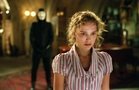
“I wish I wasn’t afraid all the time but … I am.” A young lady speaks these words to a man in a mask who has imprisoned her in his home. This time in captivity is the most free she has ever felt. London waits outside these walls, as does her job, her friends and what she calls home. The insides of these walls are lined with art; the room is filled with history, music, colour, life. The mask the man is wearing is a Guy Fawkes mask, in honour of the man who once plotted to blow up the parliament building in London as part of a Catholic plot to overthrow the British government. The man behind the mask, known simply as V, plans to finish what Fawkes started centuries before and blow up parliament in the name of the British people so that they can reclaim the freedoms of life they gave up to their government out of fear years before. While the government and media, naturally controlled by the government, proclaim V a terrorist, V sees himself more as an artist. For V, the artist is one who uses lies to tell the truth while politicians use lies to cover the truth up. The men behind this brave film clearly feel the same as they make a terrorist into a sympathetic protagonist and draw undeniable lines between the ruling British government of V’s world and the current political relationship of the United States government and it’s people. As writers, the Wachowski brothers choose to highlight fear as the motivating factor in people’s lives but go so far as to implicate the government as the major perpetuator of that fear. This is not a fresh accusation but the Wachowski’s go boldly further to accuse the government, fictional or otherwise, of not only maintaining a stronghold on it’s people through fear but originating that fear to begin with, subsequently forcing the people to abandon the original motivating factor in their lives, love.

The frightened young lady being held captive by V is Evey (Natalie Portman). Director James McTeigue, longtime protégé of the Wachowski’s, instantly links Evey and V together in the opening sequence of the film by juxtaposing the two characters getting ready for their evening. They are both fixing themselves in the mirror, putting on boots. They both watch the same television news program and both shut it off at the same obnoxious point in the commentator’s monologue. They are both putting on their armour to protect themselves in the night, her from harm, him from human connection, and they both have similar views and ideals. The major difference, she’s going out to visit a colleague and he’s going out to blow up a building. As Evey, Portman is composed and confident. Throughout the course of the film, her character learns to open eyes that have been closed in fear since she was a small child when she witnessed her parents’ abduction by a government task force. With her eyes wide open, she can finally stare fear down and see there is a grander design that she is but a small yet vital part of. Hugo Weaving plays the role of V although it may be more appropriate to say the role of V is voiced by Weaving, as we never see him without his mask. Weaving’s delivery is both eloquent and polite making for a poetic and charming terrorist. Together, V and Evey are a delightful couple. McTeigue puts them in very simple and close situations, like sharing a breakfast V prepares for her or cozying up on the couch to watch V’s favorite film, “The Count of Monte Christo”, which Evey enjoys but finds sad as the hero chooses duty over love.


Evey’s quest is in all of us and we all must overcome our fear, as must she. Placing the viewer on par with a terrorist and his apprentice is what makes V FOR VENDETTA so poignant and effective. At a critical moment in Evey’s journey, which can also be ours, she must give herself over to faith and allow herself to be the person she wants to be. Her future self must choose to leave her present self behind her for the present self is too heavily controlled by her past to do what needs to be done to effectuate change. Explosions will ensue and life will be forever changed. It is the change that we cannot fear for we have sacrificed so much of ourselves to that fear. V FOR VENDETTA is dark and bleak. The citizens need a deep extremism, shown here in a stylized pairing of bombs and fireworks set to Tchaikovsky’s “1812 Overture”, to wake them from their complacency. This is where my fears come into play. I fear that we are far too comfortable, far too afraid, and far too apathetic to respond to the call to overthrow those who impede our growth as individuals and as a species. I fear we believe change will come but that it will just happen without any work on our part at all.

V FOR VENDETTA is playful and cheeky. It is exciting and insightful. It can be very wordy but I like wordy. Ultimately, its very root is fearless and that bravery will energize and invigorate the viewer.