Showing posts with label Leonardo Dicaprio. Show all posts

Saturday, July 17, 2010

INCEPTION

Written and Directed by Christopher Nolan
Starring Leonardo DiCaprio, Joseph Gordon-Levitt, Ellen Page, Marion Cotillard and Michael Caine


Eames: If we’re going to perform inception, then we’re going to need imagination.
I knew there was a good reason I fought so hard every night to hold on to my conscious mind and not let my unconscious mind take over.  I’ve got to make sure no pesky extractors get in there to steal my highly sought after secret thoughts.  More importantly, I’ve got to make sure that nobody gets in there and plants an idea that I would go on to believe is entirely my own upon waking up.  This latter assault is called INCEPTION and the extremely dangerous process involved in making it happen is the premise for Christopher Nolan’s film of the same name.  Nolan’s skill as a director gives him the tools to delve deep into the viewer’s mind but after waking up from the dreamlike state INCEPTION creates so delicately, it doesn’t feel like he left anything in there to hold on to.


In order for Nolan to sell INCEPTION, he has a lot of ideas to implant in the audience from the very beginning.  Leonardo Dicaprio and Joseph Gordon-Levitt play professional dreamers, men who, when connected to a fancy box that puts you right to sleep at the push of a button (where can I get this box?!), enter other people’s subconscious minds.  It’s way more complicated than that and INCEPTION does its best to ensure the audience understands its complex ideas.  To begin with, Nolan starts the action with Dicaprio and Gordon-Levitt in the middle of a mission.  This way we get to see first hand what their alternate reality is and it conveniently allows for explanation between characters indirectly aimed to help the audience situate itself.  Comparisons to THE MATRIX are not shocking to me.  Like that film, INCEPTION is a visual marvel that requires a lot of contextualization to get lost in.  And again, like that film, explanatory scenes that stop the action cold are necessary to keep everyone following.  THE MATRIX does one thing differently though – it makes it all about us at the same time so once we do get lost, we have just as much to lose.


Once everyone is on the same page, which takes almost half the film to accomplish, the real mission begins.  Inception, the concept of that is, is thought to be purely theoretical but Dicaprio is determined to make it a reality.  Dicaprio’s team, also including Ellen Page, Ken Wantanabe and the deliciously smarmy Tom Hardy, has been contracted to go deep into the mind of Robert Fischer Jr. (Cillian Murphy), the heir to an internationally successful corporation.  Once they get deep enough, they must implant an idea that will trigger Fischer to want to dissolve the company when he wakes up.  As the leader of the team, and the dreamer who has been doing this the longest, Dicaprio’s personal issues, primarily the ones involving his secretive past with his wife, Mal (Marion Cotillard), keep creeping into the collectively shared dreams.  Here, dreams and memories get easily confused and threaten to bring everything toppling down.  The corporate espionage angle though keeps the audience at a safe distance when we should all be able to draw upon the shared experience of getting lost in dreams.


Visually, there is no question that INCEPTION will have you dreaming of the fantastical sets and effects long after you’ve seen it.  As Nolan takes us deeper into dreams within dreams, he has total control over all the layers he has designed so deliberately one on top of the other.  He wows us with everything going on around us and grips us by making the success of the mission dependent upon a multitude of factors that must align perfectly within a very small window of time.  Considering how much work is involved in getting this deep and keeping all these layers balanced though, it seems odd that Nolan doesn’t appear to have any grander a purpose to achieving this feat other than proving he could.  In order for inception to work, to ensure the idea really sticks, the subject has to believe that the idea came from himself, like true inspiration.  Nolan burrows into the extreme depths of his subjects but leaves little to nothing insightful behind in the viewer to inspire us when we all wake up.

It's still a good time, mind you ...


Saturday, February 20, 2010

SHUTTER ISLAND

Written by Laeta Kalogridis
Directed by Martin Scorcese
Starring Leonardo DiCaprio, Mark Ruffalo, Michelle Williams, Emily Mortimer and Ben Kingsley


Warden: If I were to sink my teeth into your eye right now, would you be able to stop me before going blind?

From the moment this ominous ferry emerges from the thick fog to bring Federal Marshalls, Teddy Daniels and Chuck Aule (Leonardo DiCaprio and Mark Ruffalo) to Shutter Island in the opening shots of legendary director, Martin Scorcese’s SHUTTER ISLAND, you know you’re about to watch a masterful movie made by a mindful man. It is instantly and unavoidably intriguing and it isn’t long after the boat docks that you realize you have as little chance of getting off this island as everyone else there, at least not with your wits about you.


Teddy and Chuck are on assignment to investigate a missing prisoner, I mean, patient, on Shutter Island. The mistake and the correction are made a number of times in the film as it is simply never really clear whether Shutter Island is a correctional facility or a mental facility. Whether there even should be a distinction for these particular prisoner-patients is up for debate just like the intentions of every character we meet on this island. Scorcese makes it so every man on the island is out for himself; even Teddy and Chuck just met as new partners on the ferry over. Subsequently, paranoia and mistrust run rampant in everyone’s mind and each day becomes a balancing act with each person’s personal sanity walking a very tight rope.


SHUTTER ISLAND takes place in 1954, when applied psychology was at a distinct crossroads between older, more barbaric means of treatment and more modern prescription methods to dealing with madness. One of the head doctors on Shutter Island, Dr. Cawley (Ben Kingsley) claims to not subscribe to either school of thought in favour of a more sympathetic approach that relies on the belief that it is actually possible to get through to the mind of a mad man. Despite this, he will not allow Teddy and Chuck to enter the heavily-guarded Ward C, where only the most dangerous, uh, patients are housed. This lack of full disclosure makes it hard to imagine that everything happening on this island is happening according to protocol. Perhaps it is but then what is the established island protocol anyway?


It becomes clear to Teddy that his time on Shutter Island is not meant to be limited to just this investigation. A case is being built against him to show him as just as crazy as every other patient there, effectively silencing any evidence he uncovers in his investigation. But while it may be clear to Teddy, it becomes pretty clear to the audience that nothing on Shutter Island is as it seems. What is the truth and who is actually telling it? Better yet, will we even believe it when we hear it? The answers do come and they are as unsettling as every other moment in this tight two and a half hour production.


As it is put forth a few times in SHUTTER ISLAND, to accuse someone of being insane is truly all you need to do to make it a fact. All protest made by the accused will be seen as logical dismissal of the accusation but not a valid argument against it. Scorcese knows the same rational will apply to the way the viewer will see the film, making visiting SHUTTER ISLAND such a deliberate and delicate mind trip. You may even wonder in fact whether you too don’t belong there by the end. This is what makes Scorcese the undisputed winner of his own elaborately designed game.

Saturday, January 24, 2009

REVOLUTIONARY ROAD

Written by Justin Haythe
Directed by Sam Mendes
Starring Leonardo DiCaprio, Kate Winslet, Michael Shannon and Kathy Bates


John Givings: Now you’ve said it. Plenty of people are onto the emptiness but it takes real guts to see the hopelessness.

The drive from the train station is not that far. Once you get past the first stretch, home to local folk like plumbers, seamstresses and the like, you turn on to a quaint, quiet road. The house that will hopefully soon be the home to you and your children, present and future, sits atop its tiny slope, understated but proud. As you drive past the other homes, you see the people that inhabit them. The children run under sprinklers; the parents sit on their porches and enjoy their afternoon cocktails. They all look so happy, so home. This is what you need. This is what will make you happy too. This is Revolutionary Road. Only, it isn’t really that. What it is really, is Sam Mendes’ REVOLUTIONARY ROAD, and just like the pretty picture it paints, it isn’t as revelatory as it inherently suggests nor does it bring the happiness you thought it might.


Mendes has been down this particular road before. In the Oscar winning, AMERICAN BEAUTY, Mendes explored the trappings of suburban life. It was hardly revelatory when he did it then but screenwriter, Alan Ball’s unique take on the subject made it feel fresh and relevant. REVOLUTIONARY ROAD is based on Richard Yates’ 1961 novel of the same name. It tells the story of Frank and April Wheeler (Leonardo DiCaprio and Kate Winslet), the lovely, new couple who have bought the aforementioned house at the end of Revolutionary Road and who bring with them the promise of youth and vitality. You see, the Wheeler’s are special. Everyone has always said as much. Then they moved to Revolutionary Road. They made their house into a home and filled that home with two wonderful children. It was at this point that they realized that they may not truly be as special as everyone has always said, that perhaps they are not destined for anything greater than what they already have.


Leo and Kate are perfectly cast as the Wheeler’s. More than ten years after TITANIC, the pair are together again and now everyone gets to see exactly what might have happened if the couple had survived the boat going down. (I trust I gave nothing away there.) And while there is nothing romantic about their reunion, they are REVOTIONARY ROAD’s one true revelation. Winslet is remarkable. She is subtly but always at odds with herself inside. She wants to love her life, her husband, and on some level, she does. But she is also yearning and desperate to feel alive. DiCaprio is a bit shaky but while April’s hand is less than reassuring, Winslet’s hand lifts him and elevates his performance to nearly the same level as hers. To watch the two of them go back and forth between being hopeful for their futures and dismally resigned to a lifetime of unhappiness is a ride well worth taking and one that will certainly leave you dizzy by the time it comes to its harrowing close.


The problem with REVOLUTIONARY ROAD is that Mendes seems more concerned in presenting the Wheeler’s as a symbol for the greater point instead of allowing them to just be the relatable characters that they are. Frank and April are special. When we begin to buy into the idea that we are just like everyone else is when we become just like everyone else. When a film tries to make a point instead of just allowing the point to make itself is when a film takes on an importance it did not earn to start. REVOLUTIONARY ROAD could have been beautiful if it wasn’t trying so hard to be the biggest house on the block.

Saturday, October 14, 2006

THE DEPARTED


Written by William Monahan
Directed by Martin Scorcese

This is it, folks. It’s the one you’ve all been waiting for. It is a true return to form, style and relevance. It has been all too easy, almost expected, to laud Martin Scorcese pictures with praise in recent years. The man has talent and has crafted some of cinema’s landmark films, from TAXI DRIVER to GOODFELLAS. The industry was naming his last picture, THE AVIATOR, the film of the year. That seemed exaggerated, an all too safe a thing to say. To name the same of his previous epic mess, GANGS OF NEW YORK, was even more absurd. There seemed to be regret for not crowning him king earlier for more deserving efforts. The later pity praise felt apologetic instead of congratulatory. The films themselves felt manufactured for mass appeal, devoid of personal involvement and often a courting of industry acceptance. This time is different. This time Scorcese feels concise and calculated, like a man with a purpose, focus. This time Scorcese has left his hopes for accolades behind him and engineered his own cinematic rebirth. This time Scorcese says goodbye to his past and embraces THE DEPARTED.

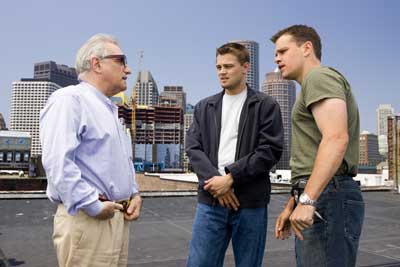
Borrowing its intricately woven story from the 2002 Japanese film, INFERNAL AFFAIRS, THE DEPARTED stars Leonardo Dicaprio and Matt Damon as moles infiltrating both sides of a war between the law and organized crime. Dicaprio plays Billy Costigan, a Boston State Policeman with a family history entrenched in crime. As he is trying to make a new name for his family, he is thrown back into the world he worked so hard to escape. Costigan will go undercover and make his way into the confidence of Boston’s biggest crime boss, Frank Costello (Jack Nicholson). Costello, meanwhile, has his own man on the inside of the Boston State Police, Colin Sullivan (Damon). Sullivan was brought under Costello’s wing when he was just a boy who was doing well in school. Both Costigan and Sullivan sought power. Costigan’s power lied in authority and changing his apparent destiny through hard work. Sullivan was seduced by a different kind of power. He still had to work hard but he had the muscle to back him up when he needed it. Dicaprio’s and Damon’s solid performances heighten the tension and make for insightful character studies. As Costigan, Dicaprio is anxious and unstable. Pretending to be a brute with nothing to live for and no reason to do bad other than it being his genetic makeup goes against everything he’s ever struggled with. His eyes flare up and his whole body flinches every time he is around intense violence; he never seems to get used to it. As Sullivan, Damon is a confident, cocky liar who gets off on how many people he’s fooling and just how well he is fooling them, from his colleagues on the force (a supporting cast consisting of Martin Sheen, Mark Wahlberg and Alec Baldwin) to his psychiatrist girlfriend, Madolyn (the relatively unknown and engaging Vera Farmiga). When it becomes apparent that both teams have been permeated, the game to catch the rat becomes tenser the closer each gets to figuring the other out. Amidst growing suspicion and fear of getting caught, THE DEPARTED becomes unpredictable and entrancing.


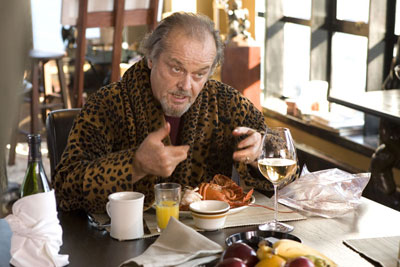
The surprisingly layered performance of Nicholson as Costello is one of THE DEPARTED’s best features. I expected that Nicholson could pull off a mob boss in his sleep but he brings experience and the effects of time to the role. Like one would expect, one doesn’t become a mob boss from being a nice guy. Costello is evil right through. He finds amusement in how a body slumps over to the side instead of forward when he blows a bullet through the back of her head. He has grown accustomed to getting everything he wants, to having no one stand in his way. To some extent though, he has grown bored and complacent with this lifestyle. He knows of nothing else but knows that alternatives exist. He seems to live his life appreciative of his position but with regret, or at least an awareness, that he did not make other decisions. When he speaks of Costigan’s father as a guy who could have been a big boss if he wanted to but didn’t, the acknowledgment alone highlights the power of choice. When he tells Costigan that he should go back to school, it highlights his own choices.

Something Costello is fond of saying is that “No one gives it to you; you have to take it.” It is a mantra for Costello and it seems like one for Scorcese as well regarding his approach to this film. Scorcese’s command of THE DEPARTED can be felt in the composition of each shot, in the energy of the omnipresent soundtrack and the grasp of the subject matter. Like Costello, Scorcese has been coasting in recent years; the results have been passable, at times solid, but always tired. THE DEPARTED announces Scorcese’s return to making affirmative choices again, and the right one’s at that.