Showing posts with label Alejandro Gonzalez Inarritu. Show all posts

Saturday, February 12, 2011

Black Sheep interviews Javier Bardem

A Biutiful Man
An interview with Javier Bardem

I don’t often get to interview Academy Award winning actors. If this is going to become a more common occurrence though, I should probably learn to mind my place a bit better. For instance, when Javier Bardem sat with me at the 2010 Toronto International Film Festival to discuss his heartbreaking role in Alejandro González Iñárritu’s BIUTIFUL, we began our conversation by discussing Iñárritu’s impressions of the actor that led to him writing this role with Bardem in mind. He described Bardem as tough on the outside but soft on the inside, to which Bardem replied, “Like a melon, like Melon Brando!” comparing himself of course to the great method actor, Marlon Brando, but crossbred with the popular fruit.

Who knew Bardem was so cheeky? So I made a note of his witty little quip in my journal and he shot me a look. “Are you going to write that?” he asked, as if surprised that I was there for any other reason other than to take note of his every word. This is when, without thinking at all, I replied, “Oh, but I am,” and shot him a knowing look right back. “Let me see that!” he said, as he went for my notepad. Who also knew that Bardem could be so playful? And here he was, playing with me.

I was actually quite happy to see that Bardem still had the ability to laugh after playing in BIUTIFUL. In it, he plays Uxbal, a father of two who is estranged from his unstable wife, is involved with a number of illegal activities that exploit those who are even less fortunate than he is and, for reasons unbeknownst to him, he has the ability to communicate with the recently departed, if their souls still linger in unrest. As if that wasn’t enough to balance, he also learns at the on-set of the film that he has prostate cancer and not very long to live. Iñárritu’s first turn as both a writer and director is a haunting, evocative experience that leaves an indelible mark on all who see it, but what kind of scars did it leave on those who were in it?

For me it was very important to learn to detach myself from what I was doing. Otherwise, you get lost in your own thing,” Bardem confides about his process. Isn’t that what everyone wants to know? How do you do it? How do you get so lost in this character and yet still manage to find your way back afterward? “Getting lost doesn’t help creativity at all. It is not about feeling what you’re doing; it is about pretending like you’re feeling what you’re doing. Some days are harder than others, of course.”

Bardem is no stranger to difficult roles. He has been perfecting the art of playing complex characters ever since he first appeared on Hollywood’s radar with an Oscar-nominated lead turn in Julian Schnabel’s BEFORE NIGHT FALLS, the first acting nomination in Oscar history for a Spanish actor (Bardem is from the Canary Islands). He went on to win the Oscar for his unforgettable supporting turn in the Coen Brothers’ NO COUNTRY FOR OLD MEN (the first acting Oscar win for a Spanish actor). In fact, it wasn’t until playing in Woody Allen’s VICKY CRISTINA BARCELONA that audiences actually got the chance to see Bardem loosen up a little. Incidentally, this is where he met his now wife and mother of his first child, and Academy Award winner herself, Penelope Cruz. The couple recently had their first child together, little Leo Encinas Cruz. A few days he was born, Bardem received his third Oscar nomination, as Best Actor for BIUTIFUL, a feat that many thought he would not be able to pull off.

Bardem is never to be underestimated though. The layers he brings to his performances are delicately nuanced and clearly leave lasting impressions. How does he find these convincing facets inside himself? “I think it’s on the page,” he explains. “When you do the wrong character, there is no way you can do it good. 50% of a good performance is the character that you are portraying. If he is well constructed, then you have 50% of a good performance already, just doing the lines. Then you have to add the other 50% on your own.”

Bardem is not only modest but apparently a realist as well, giving credit where credit is due. In this case, that would be for his director, Iñárritu. The two have been friends for almost ten years and have talked about working together all that time because they have a great respect for each other and each other’s work. (Iñárritu likens Bardem to a minotaur even!) “I am an admirer of his. You see all these amazing performances in his movies and you wonder what happens there,” Bardem proclaims. “With Alejandro, the material is so powerful that you really have to commit. It’s going to be a journey and you have to be aware of that.”

In recent years, Bardem seems to be allowing the journeys he takes to be a little less emotionally consuming, or at the very least he seems to be oscillating between more relaxed fare and films like BIUTIFUL. He appeared opposite Julia Roberts, a friend who helped campaign for his current Oscar nod, in Ryan Murphy’s summer hit, EAT PRAY LOVE, which he shot immediately after BIUTIFUL (“Take me to Bali!” he said when he put Uxbal to bed.) The contrast has allowed him to see the importance of incorporating both the light and the dark into his life. “As much as you have to bring some seriousness to a comedy set, you have to bring some laughter to a drama like BIUTIFUL. It is the balance that always makes things more enjoyable.”

This balance has Bardem attached to a number of upcoming projects, as varied as a new Terrence Malick film and a potential villain role in the next James Bond movie. Either way, Bardem will bring his almost signature brand of intensity to any project he takes on, just as long as he doesn’t have to die this time. “My mother doesn’t like that very much. She always asks, ‘Are you dying in this one?’”

Even if he does, BIUTIFUL teaches us that death is not an ending. It is just the beginning of a long, hard road ahead. I'm not sure if that is meant to be uplifting but if anyone can find the hope in that, it will be Bardem.

Friday, September 10, 2010

TIFF'D: Friday, September 10


Hey and welcome to the first ever Black Sheep Reviews video blog.  Each day during TIFF, or at least each day that doesn't end with me passed out and forgotten in some theatre somewhere, I will be posting a video blog about my day at the Toronto International Film Festival.  No sense in writing anything really past that.  I'll just let myself do the talking instead ...


TIFF BITS: Friday, September 10


Today marks two very important things.  The first important thing about today is that it is my friend, Christopher's birthday.  I wish I could be spending it with him but he is far and there is the whole matter of the second important things about today that is getting in the way.  Today marks the first full day of screenings at TIFF.  So, I wish you well, Christopher, but duty calls.

The duty I am referring to specifically is my obligation to attend the a screening of Darren Aronofsky's BLACK SWAN this morning.  I could not be more excited about that.  Hopefully, it lives up to my expectations.  Past that, I am interviewing the director of BIUTIFUL, Alejandro Gonzales Inarritu today. I'm a wee bit nervous for this given that he is such a prolific director; this is the man who gave us AMORES PERROS and BABEL after all.  As if that weren't enough, I am also interviewing the film's star, Javier Bardem, the Academy Award winning actor of NO COUNTRY FOR OLD MEN. Be sure to check out my TIFF'd video blog this evening for a full recap.

Now, as for you all, here's what you can expect at TIFF today.  Tonight's big galas are for Tom Hooper's THE KING'S SPEECH and David Schwimmer's TRUST, starring Catherine Keener and Clive Owen.  My full review for THE KING'S SPEECH is posted below and I am only seeing TRUST tomorrow morning so I can't really help you out there.  I can make these suggestions though:


BIUTIFUL
Winter Garden Theatre - 8:00
It isn't always easy to interview people when you don't like their movie.  Fortunately for me, I thoroughly enjoyed this Spanish language film.  Like most of Inarritu's work, it focuses on death and the kinds of perspective it gives you on your life.  Bardem is brilliant in the film and it lives up to its mispelled name in terms of aesthetics.  Both director and star are expected to attend this North American premiere.

I'M STILL HERE
Varsity Theatre - 10:00
I'm going to have to sleep on this one before I make up my full mind about it.  This is the Joaquin Phoenix documentary about his quitting acting and becoming a hip hop recording artist, as lensed by brother-in-law, Casey Affleck.  This documentary could be a hoax but the beauty of it is that you can never be sure as to whether it is or not.  It is vulgar, offensive, uncomfortable and oddly enlightening on the subjects of celebrity, ego and opportunity.  It will be released in theatres soon but check it out at TIFF if you get a chance.

Don't forget to check Black Sheep back at the end of the day for TIFF'd, a video blog about how the whole day went.  Please note that yesterday's TIFF'd had to come down due to some issues I was having with it.  They have been worked out though and video blogging commences again, if that's possible, today!

Bon cinema and happy TIFF!

Sunday, November 5, 2006

BABEL


Written by Guillermo Arriaga
Directed by Alejandro Gonzalez Inarritu

Mexican director Alejandro Gonzalez Inarritu has a point to make with his second Hollywood offering, BABEL. He wants us to see how we don’t listen to each other and to what extent that is making all of our lives more difficult. To do this, he tells four different stories where characters find themselves in situations where they are not understood despite all their efforts to be. These stories stretch across the globe, from Tokyo to Mexico and center around an incident in Morocco that sparks an international scandal. Inarritu treats his imagery like poetry and has created a stunning picture with pacing that ranges from peacefully prophetic to tensely wrenching. But despite its unmitigated design, there is a larger irony undermining BABEL. It is a film concerned with the struggles faced when trying to get your point across that also wants to show how our lives are all connected yet its four storylines stretch to connect to each other and the point gets somewhat lost in that process.

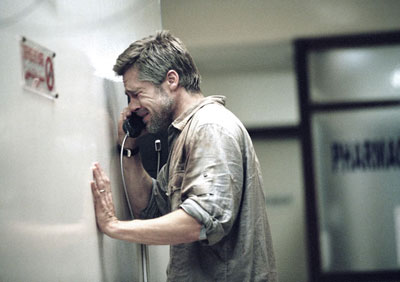
Brad Pitt and Cate Blanchett play Richard and Susan, an American married couple on a sour vacation in Morocco. Their youngest child has just died of natural causes and they have come to try to forget. Instead, the guilt and anger they could not express at home has only become more prominent in their isolation. A stray bullet hits Susan in the shoulder while she glares out her tour bus window and her vacation goes from bad to potentially tragic. The unfolding of this scenario best exemplifies Inarritu’s views on the frustration that often goes alongside communication. A desperately frightened Richard must get his wife medical attention in a town without a hospital and where no one speaks his language. He finds one tour guide who carries him through the experience, facilitating his translation. Speech is not his only barrier as this small Moroccan village’s medical treatment is far from what Richard is accustomed to in his privileged life at home in California. He then runs into trouble where one would not expect him to. He is unable to convey the seriousness of his wife’s condition to the remaining tour bus passengers, most of them American. He requires their support but they don’t listen to a word he says, focusing solely on their own needs, some selfish and some reasonable. As Richard is rightfully focused on his wife’s needs, he isn’t listening to them either and arguments ensue. Richard’s communicative difficulties also extend to one other person, Susan. Writer Guillermo Arriaga brings us to the most intimate frustration with understanding here when these two people require a brush with death to get them to be quiet enough to hear how afraid each other is and how responsible each feels for the death of their child.


The remaining plots branch out from this incident but whereas the execution of the plights is poignantly told, the connections themselves are weak or vice versa. Richard and Susan’s children run into trouble of their own when their Mexican Nanny, Amelia (Adriana Barraza) takes them over the border so that she can attend her son’s wedding. When reentering the United States, the border patrol are suspicious and begin asking many questions. Amelia does not have difficulties speaking English but does not answer their questions as well as she should. The film loses some focus here, as the patrollers’ approaches are more racist in nature than anything else. Whereas racism is certainly another form of fear and misunderstanding, this dire situation feels easily unavoidable and contrived to serve the film’s purpose. Meanwhile, in Tokyo, a deaf and mute teenage girl deals with the loss of her mother and fights to be heard when she can’t make any noise. Cheiko is played by Rinko Kikuchi; it is a vibrant and commanding performance. She herself cannot hear what others are trying to say and is limited in how she can communicate her own feelings and desires. Her struggle is only intensified by her lack of physical connection to other people, as she is an aggravated virgin. All of her attempts to entice are thwarted by her silent aggression and her incapacity to get anyone to hear her is heartbreaking. In many ways, her storyline is the most effective but it is only tied to the whole of the film because her father’s rifle was used in Susan’s shooting in Morocco.

The word “babel” finds its roots in an association to the Hebrew verb “balal,” which means to confuse or confound. Hence, when someone is said to be babbling, they are not communicating their point properly, just spewing out a bunch of unnecessary words that end up being entirely pointless. All of Inarritu’s words and images are carefully chosen and constructed in a concise fashion that is on many levels successful, but by trying to get across so much, he ends up narrowly but sadly missing his own point.