Showing posts with label Crash. Show all posts

Saturday, November 20, 2010

Black Sheep interviews Paul Haggis

Haggis These Days
An interview with Paul Haggis

Films remade for American audiences are controversial to say the least. “I figured if Scorcese could do it, so could I,” quips Canadian born film director, Paul Haggis, referring to his third directorial effort, THE NEXT THREE DAYS, a remake of the 2008 French film, POUR ELLE. It’s a bold statement to put yourself on the same plain as an American film master like Martin Scorcese, especially when you’re a London, Ontario native who has only been making films for seven years now. When you consider that Haggis has been nominated for five Academy Awards and won two in that little time though, both for his breakout debut, CRASH, it doesn’t seem like such a stretch anymore. Incidentally, that’s one more Oscar than Scorcese has.

“There had to be questions that I wanted to ask on the nature of love and the nature of belief.” These questions would become the justification for the remake and how Haggis would make the film very much his own. They’re not the only reason he wanted to make this movie though. “I had always wanted to do a thriller, always wanted to do a caper movie.” His eyes light up when he says this. Boys will always be boys.

THE NEXT THREE DAYS is based on the central premise of POUR ELLE, where a teacher must take desperate action when his life has reached a seemingly impossible crossroads. His wife is in prison for murder and despite the overwhelming evidence to the contrary, he never falters in his belief of her innocence. When her last appeal fails, he sees her lose interest in living and he sees their son heading down the same path. If he doesn’t do something, he will lose what matters most to him in his life, his family.

The solution is to break his wife out of a maximum-security prison and then disappear. Now, that might not be what you or I would do, but if anyone were going to sell this as the only viable solution, it would be Oscar winner, Russell Crowe. Crowe signed on to the project early on and played a heavy hand in shaping his character, John Brennan, a man who isn’t remarkable for anything other than his conviction and commitment. “As soon as he read the script, he knew what I was going for,” Haggis shares when we meet in Toronto the day before THE NEXT THREE DAYS opens in theatres. Despite Crowe’s reputation for being difficult, Haggis insists they explored the internal and complicated nature of John Brennan at length and openly. “We talked a lot. I like when an actor is secure enough to ask questions and challenge you and the director is secure enough to listen and isn’t threatened by that.”

Not only is Haggis able to foster a healthy relationship with a man reputed for unhealthy working relationships, he also pulls an impressive and unexpected performance from his female lead, Elizabeth Banks. “I like taking actors and putting them in roles that surprise you,” says Haggis. “I think if you see actors playing the same roles over and over again, there is no sense in going to the theatre.” And you’ve never seen Banks like this before. As a convicted but potentially innocent killer, she never lets on whether she did or didn’t do what she’s accused of and she does that with great poise. Haggis definitely thinks people will be surprised to see her. “It’s a great gift for an audience to say, ‘Oh, look at her do that.’”

Of course, beyond its solid performances, including brief appearances by Liam Neeson, RZA, Daniel Stern, Brian Dennehy and Olivia Wilde, THE NEXT THREE DAYS is as sharp and as tense as it is because of Haggis’ incredibly grounded screenplay. Haggis, who writes more often than he directs, took an extreme hands on approach to writing this particular caper. He actually placed himself in the position of a prison escapee to plot just how John Brennan would do it. “I just googled how to break out of prison,” Haggis explains, fully serious. Having access to the Pittsburgh prison that is a central setting in the film, Haggis put his internal con man to work. “I got outside the jail and then said, ‘What if I got out? What do I do now?’ And then, ‘Oh look, a train. Will they be waiting at the next station?’” Whether his plan would actually work or not is not the issue. It’s the geographical and circumstantial reality of his plan that makes it believable. “I guess I’m enough of a con to figure it out myself.”

THE NEXT THREE DAYS is Haggis’ third film as director and his first thriller. His approach to direction is still the same though despite the genre change. “I try not to watch any movies when I’m making my own,” he confides. I understand this approach; I don’t read other reviews until mine is written. Who needs outside influence when you’re trying to create? “I really try to stay in that world and let the film find its own imagery and its own voice.”

The voice found in THE NEXT THREE DAYS is a complex one. It is a particularly adult voice and one that Haggis hopes will be heard. “I believe in this kind of a movie. I think there is an audience for it. I think people like to be challenged and I think they like to be entertained.”

Any audience that sees THE NEXT THREE DAYS will see a thriller that is as taut as they come but that still somehow honours love in its purest form, without ever feeling forced or far fetched. “It’s a love story,” Haggis asserts without hesitation. “There is something transformative about believing in somebody that much, even when they can’t believe in themselves.”

Escape from prison, run from the law, risk your life, I guess none of that matters when the reason you’re doing it is love. And after sitting with Haggis for just a half hour, it is pretty clear that he makes movies for the exact same reason.


Author's Note: Mr. Haggis was an excellent interview. I could have easily gone on about our conversation for another 1000 words. Maybe one day, I will.

I want to give a big thanks to the fantastic team at Maple Pictures for making this interview possible. I genuinely appreciate it.

For further Paul Haggis reading, here are past Black Sheep reviews for his films:
(click to read.)

(writer/director)

(writer/director)

(writer)

(writer)

(writer)

Sunday, October 11, 2009

Remembering the year 2005

CRASH
Written by Paul Haggis and Robert Moresco
Directed by Paul Haggis

NOTE: This article has spoilers aplenty and should not be read by anyone who has not seen the movie.


I can still remember the feeling of my stomach dropping when Jack Nicholson announced that the 2005 Best Picture Oscar was being awarded to Paul Haggis’s CRASH, and not the frontrunner, BROKEBACK MOUNTAIN. I wasn’t the only one either who was floored; you could here the jarred pause in Nicholson’s voice when he announced it. The signs were pointing in that direction throughout the evening. First, CRASH took Best Editing, the only award it won that I genuinely feel it warranted, keeping all those simultaneously told stories in check and well balanced. Then it came along and took Best Original Screenplay. I say took but I really mean robbed considering there were three better screenplays that should have won (Woody Allen’s MATCH POINT, George Clooney and Grant Heslov’s GOODNIGHT AND GOOD LUCK and Josh Olsen's A HISTORY OF VIOLENCE). After those two wins combined with the previous win for Best Ensemble Cast at the Screen Actors Guild Awards, taking it all became a serious possibility. After it happened, the guests at my Oscar party could seriously see I was disappointed, distraught even. I popped Gustavo Santaolalla’s BROKEBACK MOUNTAIN score and began picking up after the mess.


It’s not that I don’t care for CRASH. I was just as mortified when Matt Dillon had his hands up Thandie Newton’s dress and just as gripped when he had to rescue her from her burning vehicle the next day. I was just as devastated when that adorable little girl was shot and just as exalted to witness the man-made miracle that allowed for her to survive. CRASH is not without its merits. Incredibly powerful scenes made all the more poignant by often surprising turns by Dillon, Newton, Terrence Howard and Michael Pena. To call it Best Picture though meant ignoring its condescending and manipulative storytelling techniques in favor of the ignorance it so aggressively draws to the surface. Of course race, prejudice and hatred are just as relevant now as they always have been despite the advances made, but Haggis, and I doubt he did it intentionally, preys on his viewer by using the inherent ignorance in each of us to make the film seem superior and revelatory.


CRASH takes place in a rough 24-hour period. In that period, a handful of Los Angeles inhabitants from all walks of life experience so much suffering that you would think the end of the world had arrived. Now, all that transpires is certainly possible but too darn convenient for me to swallow. Newton and Howard are seriously abused by a racist police officer (Dillon) one night and the next day, she ends up in a massive car accident and he ends up in a carjacking that turns into a run-in with the law. I bet the “Honey, how was your day?” conversation between those two had to be impressive after that. And imagine when Newton reveals that Dillon had to save her from the car and Howard is flabbergasted because Dillon’s partner (Ryan Phillippe) from the night before ended up saving his ass earlier that day. The scene between Newton and Dillon in the car cannot work as effectively if the previous scene they share doesn’t happen first but the odds are too overwhelming for me to accept. If this storyline stood on its own then perhaps it would be easier but taken with everything else, it all just feels as though Haggis is moving the pieces on the board one at a time to make the game play out as he needs instead of how it might.


The other writing technique that infuriates me more and more with further viewings of CRASH is the way Haggis delights in playing with his viewer’s ignorance. Larenz Tate and Ludacris walk down a trendy L.A. street at night and debate racial complacency and prevalence in modern society. They look like thugs but everything they’re saying about contemporary attitudes toward race make so much sense to me and must naturally appeal to my white liberal sensibility. It is so obvious that Haggis wants us to sympathize with these poor black guys who can’t get a break. Consequently, we are also supposed to feel disdain for Sandra Bullock and Brandan Fraser as they walk past in their fancy outfits toward their expensive car. Not because their combined acting performances cannot amount to anything more than embarrassment (which might explain why they are the least featured characters in the ensemble) but rather because they judged these fine, young gentlemen by the colour of their skin as they walked past them. They assumed that they look like thugs and therefore must be. Imagine the audience’s shock and disgust with themselves when the thugs actually are thugs and they steal the white people’s cars. Haggis spends all this time exposing the audience’s ignorance in hopes of opening their eyes to it but he finishes by simply reinforcing the stereotypes and insulting my intelligence.


I am aware that I am gay and I am siding with the gay-themed film but BROKEBACK MOUNTAIN had won nearly every major award leading up to the Oscars and was considered a near-lock. The win for CRASH only shows me that the mainstream Academy was not ready to bestow accolades so publicly on a gay-themed film. Not to mention, that as a gay man, I am still a minority, just an invisible one. This can get pretty ugly sometimes when people don’t censor themselves because they don’t realize that we are among them. I suffer prejudice; I am still fighting for some basic human rights because I am still seen as less than human. It is exactly this kind of hatred that makes it impossible for the characters in BROKEBACK MOUNTAIN to experience the love they are so obviously meant to. It is also the exact kind of hatred that CRASH tries so hard to bring to light but yet shines no light on the plight of the gays because theirs is not a racial issue. It still sure feels that way sometimes. As for the love that BROKEBACK MOUNTAIN fights so hard to foster, troubled or not, the characters in CRASH still get to have that and don’t even see for a second how fortunate they are for that opportunity. Despite this, they choose to live in their misery and all any of them can seem to do is blame everything bad in their lives on race.


Black Sheep’s 2005 Top 10

BROKEBACK MOUNTAIN, Directed by Ang Lee
CAPOTE, Bennett Miller
THE CONSTANT GARDENER, Fernando Meirelles
GOOD NIGHT AND GOOD LUCK, Grant Heslov
A HISTORY OF VIOLENCE, David Cronenberg
MARCH OF THE PENGUINS, Luc Jacquet
MATCH POINT, Woody Allen
MUNICH, Steven Spielberg
MYSTERIOUS SKIN, Gregg Araki
THE SQUID AND THE WHALE, Noah Baumbach
WALK THE LINE, James Mangold

Wednesday, October 3, 2007

IN THE VALLEY OF ELAH

Written and Directed by Paul Haggis


Soldier: Before I went, I would never say this, but if you ask me now, I’d say we just nuke ‘em all and watch it all turn back to dust.”

Before going to Iraq, a soldier would not likely even think this, let alone say it out loud in any serious manner. The times have changed though and eyes have seen more than any one pair should. Take Jo Anne’s husband for instance. He’s just returned from Iraq to Fort Rudd, New Mexico, a town built around its army base. You might think this would make Jo Anne very happy but, much to her dismay, this is just not the case. Instead, she doesn’t feel she still knows this changed man. When she goes to the police after he snaps a dog’s neck as punishment for biting, no one listens. Instead, they snicker at her. She is enraged but her anger is not enough to rattle any one out of their apathetic trance. Despite there being a clear need for Jo Anne’s husband to get help, there just isn’t anything to be done. He’s just another returning soldier whose mental stability has been fried under the Iraq sun. This is the side of America that is not often seen – a population exhausted by the weight of the war, be that by supporting it or questioning it or participating in it. And while the fighting is taking place overseas, writer/director Paul Haggis’ IN THE VALLEY OF ELAH aims to show America’s eyes what’s been happening in their homes while their focus was elsewhere.

IN THE VALLEY OF ELAH is Haggis’s first time directing since his Best Picture winning CRASH. In the time since then, he has gone on to work on the screenplays for CASINO ROYALE and LETTERS FROM IWO JIMA. The experience seems to have taught him some valuable lessons about subtlety. While CRASH was intense and moving, it was also contrived and convenient. The pay off may have been worth the trouble but concessions were made for the bigger emotional impact. IN THE VALLEY OF ELAH does not resort to gimmicks to make its mark. Instead, the events unfold like any good mystery, where the pieces come together to reveal that what you’ve been trying to figure out all along is really just a fraction of what’s really going on. This particular mystery begins when Hank Deerfield (Tommy Lee Jones) gets a call from the Fort Deer army base, informing him that his son has gone missing after returning from active duty. Hank has no helpful information as he didn’t even know his son had come back. It becomes clear pretty quickly that something foul has happened and that Hank didn’t know his son very well at all. Yet as he gets to know his son through the clues he comes across while searching for him, Hank realizes that he knows just as little about how the army has changed as he does his son.


IN THE VALLEY OF ELAH is able to make understated commentary about the mental and emotional burden of the Iraq war thanks mostly to Haggis’ direction of his stars, Jones and Charlize Theron. Theron is a single mother and a detective who struggles daily to prove that a woman can make just as good a detective as her sloppy male counterparts. She braves the testosterone that beats down on her from all sides but it is Deerfield’s arrival that shows her how fighting against oppression is taking away from her work. Jones achieves a similar effect on Theron’s performance. He is so strong, so internally tormented and still so unfaltering despite the overwhelming evidence that is chipping away at his impression of his great American hero of a son, that Theron cannot help but step up her game as an actress to avoid looking bland in front of the veteran. As Deerfield, Jones is the silent, proud father and husband. He’s the kind of man who cannot be around a lady while simply wearing an undershirt. He is an old-fashioned army boy in a world where he can watch unscrambled video image from a digital camera his son carried with him in Iraq. All the seedy revelations he is discovering must be made proper again and resolving his two conflicting minds becomes the challenge he needs to overcome in order to find both his son and his peace of mind. Jones is not just up for this challenge; he owns it.


With its simple tone and steady pace, IN THE VALLEY OF ELAH laments the loss of America’s blanketed support and gusto for a war that was meant to protect their way of life and freedom. It is not so much a movie designed to criticize the decision to go to war in the first place. Haggis is too smart to give that tired argument. Instead, it is an expression of grief for the damage the war has weathered on the country, its citizens and the principals that it was initially meant to protect.

Thursday, September 21, 2006

THE LAST KISS


Written by Paul Haggis
Directed by Tony Goldwyn

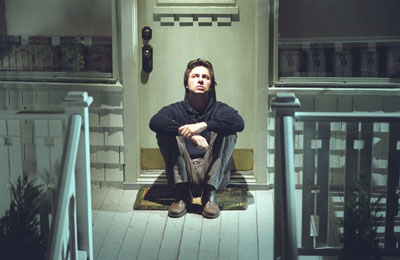
If you spend any time at all at Zach Braff’s myspace page, you would read how excited and proud he is of his latest starring role in THE LAST KISS. In it, he plays Michael, a 29-year-old architect who has everything he’s ever wanted. He has a great position at a large firm in a field he loves; he has a strong group of friends who are always there for each other; and he has a beautiful, intelligent girlfriend who loves him deeply. He knows he’s a lucky man and his friends and family see how he’s about to get luckier with his girlfriend pregnant with their first child. He has them all fooled though because he sees this baby more as permanency than possibility. In many ways, this is the perfect follow-up to GARDEN STATE, in which, in addition to writing and directing, he also plays a man in his mid-twenties who does not know where his life is headed. It is only natural to find a similar character a few years later facing the issues that confront you when you finally get your ducks in line. And whereas Michael’s fear of never being surprised by life again is a real anxiety, the hollow characters that make up this ensemble lend little humanity to this reality. THE LAST KISS plays out, with rare exception, as a once-fresh tale that has been spoiled by one-dimensional characters, unmotivated actions, uninspired dialogue and an expectation that its deeper than it really is.

From the way Braff goes on in his blog postings, one would almost think he wrote and directed this film too. Despite not having any way to test this theory, I wonder if the film would have been better if he had. Braff’s creative influence on GARDEN STATE elevated it to a higher caliber of film making because of its innovative visuals, believably broken characters and timely musings. THE LAST KISS was written by two-time Academy Award winning writer, Paul Haggis (CRASH, MILLION DOLLAR BABY). Haggis juggled an even larger ensemble in CRASH and managed to give nearly every character enough backstory to make them tangible. Here, characters are more like symbolic signifiers for Braff’s Michael to go through his own transformation. One of the more notable examples is his friend, Chris (played by Casey Affleck who brings more heart to his character than any of the other younger cast members). Chris is married and has a newborn, whom his wife has grown so attached to that she no longer has interest or patience for her husband. The insinuation that this hell is what awaits anyone who gets married and has a baby is groan-inducing. Yet another obvious purpose is served in the writing of Michael’s future in-laws (played by the always subtle Tom Wilkinson and always fragile Blythe Danner). They remind Michael, and us of course, that a long term marriage is difficult at best but yet somehow still worthwhile if you work real hard and learn to forgive.


Despite all these poorly hidden character devices, I believe that Haggis’ script is only made worse by Tony Goldwyn’s direction. The problems even begin in the opening shot. Feet stroll by in close-up from each end of the frame while the credits appear amidst the limbs. A car approaches very slowly behind them and the camera tilts up to reveal Michael and his girlfriend, Jenna (Jacinda Barrett), sitting silently. The movement is awkward but the effort is noble. She asks what he is thinking about and he replies that he was wondering how he got so lucky to have her in his life. As he says this, a bus pulls up along side with a lingerie ad on its side. Michael leers and it becomes immediately obvious that THE LAST KISS will be about a man who learns to stop thinking with his penis and start feeling with his heart. Only Braff exudes too much sensitivity for him to come off as a typically uncaring guy. By the time Michael meets Kim (Rachel Bilson) at a friend’s wedding (an event that naturally depresses the typical male because it feels so final), he has cemented his stance as the man who has no idea what he wants. This is perfect because Kim is the younger temptress who knows what she wants but has no idea why. They sit in a tree house and exchange thoughts on how the world moves so fast that it is only natural that people break down far earlier than in past generations. It may be a contemporary theory but it feels as borrowed from GARDEN STATE as the film’s soundtrack does.

Zach Braff, post-GARDEN STATE, has become something of an easily identifiable every man. He filled the shoes for a generation unsure of its path and desperately in need of meaning. And though he merely plays a role in THE LAST KISS, he has become the face of the film thanks to all his praise and enthusiasm for it. I can understand his pride in his performance but his character is flat and unimpressive. The man he once personified may have been lost but was open minded and bravely forging out a fresh, new course for himself. The man he has now become walks down a run down street in worn out shoes and blends in with the crowd.