Showing posts with label Scarlett Johansson. Show all posts

Saturday, May 8, 2010

IRON MAN 2

Written by Justin Theroux
Directed by Jon Favreau
Starring Robert Downey Jr., Gwyneth Paltrow, Dona Cheadle, Scarlett Johansson, Sam Rockwell and Mickey Rourke

Ivan Vanko: If you could make God bleed, people would cease to believe in him.


When the lights went down at the sold out opening night screening of IRON MAN 2 that I attended, there was a particular energy in the air.  It was that moment when you realize that what you’ve been waiting for for so long is really about to take place.  The hushed anticipation was infectious and, as exciting as it was to feel it build, it was just as disappointing to feel that energy die off as the film unfolded.  Iron Man may have a brand new suit but his heavier armour ultimately just weighed this new adventure down.


I had no knowledge of Iron Man before the first film, other than the fact that he existed anyway.  When director Jon Favreau introduced him as an irresponsible billionaire who learns that his legacy would be essentially ensuring continuous and unnecessary destruction until there was nothing left to blow up, I instantly loved the guy.  Tony Stark (Robert Downey Jr.), as privileged as he was, was still human and still had a soul that he didn’t want to see damned.  Super ego still intact but changed nonetheless at the end of the first film, Stark re-emerges now as narcissistic and oblivious again, almost as if to satisfy what test audiences liked most about him after the first film.  It gives the film itself an air of arrogance that it is difficult to recover from.  The Iron Man people know they did good last time out and like Tony Stark, it seems to have gone to their heads a bit too much.


Justin Theroux, the writer of TROPIC THUNDER, is a new addition to the Iron Man team and, despite his clear ability to be laugh out loud funny, he takes Iron Man and Tony Stark to some pretty dark places.  There is nothing wrong with going to these places in a superhero movie but with Stark coming off more smug and callous from the beginning, there isn’t as much sympathy to go around when Theroux finally reveals why Stark is acting this way.  Downey Jr. still nails Stark but despite having some serious mortality issues to deal with this time, he never seems to get to the core of where Stark is coming from.  And, correct me if I’m wrong, but Iron Man is nothing without his core. 


Other newcomers to the Iron Man world include Mickey Rourke as a sinister Russian physicist bent on revenge, Sam Rockwell as a less successful version of Stark himself, Scarlett Johansson as a sultry new member of Stark’s team and Don Cheadle as a replacement for Terrence Howard in the Rhodey role, Stark’s best buddy.  Rourke is certainly scary but he seems to be trying too hard to redefine evil, much like Heath Ledger did as The Joker in THE DARK KNIGHT.  Rockwell is hilarious and stylin’ in the three-piece suits he wears to cover up his inferiority issues.  Meanwhile, Cheadle does nothing with the opportunity that fell in his lap and I would really like to see Johansson do something other than just look sultry for a change.


IRON MAN 2 does get better as it goes on.  I don’t want to make it sound like it’s a bad time.  It’s just easier to focus on what isn’t working when everything worked so well in the past.  Favreau does his best to keep things smooth and fresh; Downey Jr. delivers as expected but ultimately, IRON MAN 2 just isn’t as much fun as the first.  You might say it has an iron deficiency.  You might.


Sunday, August 24, 2008

VICKY CRISTINA BARCELONA

Written and Directed by Woody Allen
Starring Javier Bardem, Scarlett Johansson, Rebecca Hall, Patricia Clarkson and Penelope Cruz


Marie Elena: Only unfulfilled love can be romantic.

What could be more romantic than a summer vacationing is Barcelona? You’re surrounded by art, history and breathtaking scenery. You meet people you’ve probably never met before and will most likely never see again. You can immerse yourself in an entirely different culture, learning something new about life and yourself with every passing day. Or, you can leave your every woe from your difficult life behind you and let it all fall away into the ocean. In Woody Allen’s latest, VICKY CRISTINA BARCELONA, Vicky and Cristina (Rebecca Hall and Scarlett Johansson) do just that. Vicky is going to learn while Cristina follows in hope of escape and before the summer is out both will learn that that which is inherently romantic is also inescapably complicated.


Vicky and Cristina are the kinds of friends that would likely not become friends if they met at this present moment but are good friends regardless because of a long and cherished history. Vicky is practical to a fault. Everything she does has purpose and function, including her fiancé, Doug (Chris Messina, who played the same “I am everything that is wrong with America today” character at the end of “Six Feet Under”). Cristina cannot stomach settling into herself, as she can’t stand that self, so she recklessly pursues paths of abandon in hopes of finding solace. They are opposite in everything they do, right down to their hair colors, but they find one common interest while abroad, Juan Antonio (Javier Bardem), a painter with a dramatic reputation. Juan Antonio is a player but he isn’t playing. He’s unassumingly smooth and sexy in shirts and pants that are dressed down by playful sneakers. He is a passionate man and his provocative proposal to have both ladies join him for a weekend of food, music and lovemaking brings out the American prude in both Vicky and Cristina.


Still, the vacation does everybody good, including Allen himself. Stepping out of New York and into London for his (brief) return to form, MATCH POINT, rejuvenated a vision that was once great but had recently become monotonously unwieldy. Going to the Barcelona country sides for his 40th feature has a similar effect, in that his vision is refreshingly alive. Still, it is different than the London Allen of late. In Barcelona, it feels as if Allen were on his own vacation. This is Woody in sandals, a loose fitting tee and khakis. Sure, he’s still neurotically smothered in sun block but his grip on the film is relaxed, more organic. In fact, the film’s underlying criticism of American materialism and structure suggest that Allen is happy to be away for a while. Besides, if he weren’t overseas, he might not have had the chance to work with Penelope Cruz. Cruz plays Marie Elena, Juan Antonio’s ex-wife who tried to kill him before ultimately leaving him. Her insanity and is eluded to so often before she actually graces the screen that by the time she does, one shakes with anticipation for her arrival. Cruz’s presence is overwhelming, a tumultuous force that commands attention and can either destroy or nurture from one moment to the next. She elevates the overall quality of the film to exciting heights and it was already pretty great before she got there.


After years of troubled relationships both on and off screen, Allen is still going back for more despite it all. Having been around a few blocks though has given the man a fair amount of insight. He may not know what makes the perfect recipe but he’s still in the kitchen cooking because he knows that when you do get all the ingredients just right, you’re in for one hell of a good meal. He throws all of his characters into the fire knowing full well they will all get burned but that they will also all be better people for it. For all its complications, love or sex or however you choose to define your interaction with another human being (or with two or three for that matter) will ultimately transform you. The same can be said for VICKY CRISTINA BARCELONA, a flame well worth getting close to.

Wednesday, March 5, 2008

THE OTHER BOLEYN GIRL

Written by Peter Morgan
Directed by Justin Chadwick
Starring Natalie Portman, Scarlett Johansson, Eric Bana, Jim Sturgess, Kristen Scott Thomas


Lady Elizabeth: Our daughters are being traded like cattle for the advancement of men.

Historically speaking, Anne Boleyn was the second wife of England’s King Henry VIII. She was instrumental in England’s political and religious upheaval that saw England ultimately break away from the Catholic Church. When Henry’s first wife was unable to produce a male heir, he began to look elsewhere. His advances toward Anne were not returned, as she did not want to chance pregnancy. Any child born before the King could annul his first marriage to Catherine of Aragon would be a bastard child and therefore not a potential heir to the throne. As if this weren’t enough drama for the Boleyn family, Anne’s sister, Mary, was also involved with the King and rumoured to have had a child he fathered prior to his involvement with Anne. Regardless of how sordid the whole affair might have been, it altered England’s history dramatically and Anne went on to become both a martyr and a feminist icon. You would think that a screenplay about both sisters’ involvement with the King by the Oscar nominated writer of THE QUEEN would be an impartial account of the period but instead, THE OTHER BOLEYN GIRL is nothing but a sexist farce that reduces both the male and female players to tired platitudes before robbing the story of all its humanity.


Men crave power and status. Women crave powerful men that they can manipulate to do their bidding. Men will essentially do anything to get into the skirt of a woman they desire and will lose their minds and capacity for rational thinking if she denies him. Women will in turn step over anyone, including their own sister, in order to bag a supposedly good man. Not only are all of these statements borderline offensive but they are also inane. There is always so much more to it than simply that. These clichés are the stuff great teen movies are made of and perhaps it was unfair of me to expect more from a costume film than insipid, nonsensical melodrama. What most undermines first time feature film director Justin Chadwick’s work is that it is amateurish and not at all convincing. Anne and Mary Boleyn (Natalie Portman and Scarlett Johansson) are introduced as loving, caring sisters. They protect each other, respect each other and love each other. Why then would I believe that either would hurt the other so maliciously? I guess because they’re girls and that’s what girls do when there is a man involved, right? Sure to stereotype both sexes fairly, the men do not escape Chadwick’s narrow view of gender definition. Am I to seriously believe the King of England (Eric Bana) would risk his throne and country’s well being just because a girl he lusts over refuses his royal wanting?


As Anne, Portman is a natural for the period but as she gets caught up in her father’s plans to have her bed the King as a means to better position her family’s standing at court, the inherent intelligence she brings to most of her roles makes it seem entirely unnatural that she would be naïve enough to play along with Daddy’s game. Johansson has never looked more drab as she stands amidst an always-overcast English countryside, her long, golden locks lying limp on her shoulders, her eyebrows almost invisible against her pale face. Though she seems to be playing catch-up to Portman’s supposed ease with the material at first, it is her poise and restraint that make for a more believable and sympathetic Boleyn. While Portman certainly masters the pain, remorse and paranoid fear necessary to convey Anne’s arch, she is incapable of escaping the same trap the entire cast falls into. Perhaps from having seen too many period pieces prior, the ensemble acts as though the events taking place are not actually happening to them as characters. Instead, they come off as amateur theatre actors caught up in the lore that comes with corsets and faked British accents.


THE OTHER BOLEYN GIRL is not all that horrible. I too find myself getting lost in the barrage of bodices. Still, marrying off your children as commodities should not be taken lightly and the knowing twinkle in these girls’ eyes gives away their modern feminist thinking, making their wily behaviour seem all the more implausible. The only thing that makes this all worse is that all this trouble comes about to please the patriarch of the Boleyn family who is nothing more than a pathetic, insecure coward.

Sunday, August 6, 2006

SCOOP


Written and Directed by Woody Allen

MATCHPOINT was a welcome and impressive return for Woody Allen as a director and a writer. Lush art direction and intuitive camera movement framed performances that brought Allen’s best script in over a decade to a dangerously high boil. It was sensual and provocative with deeply layered imagery. It earned four Golden Globe nominations, an original screenplay Oscar nomination and made this critic’s best film of 2006 short list. It now seems its success has spawned a somewhat awkward offshoot, a relationship between Allen and lead actress of both MATCHPOINT and Allen’s latest picture, SCOOP, Scarlett Johansson. According to the SCOOP press (or perhaps a spirit appeared to me and told me about this while I was being dematerialized, I can’t be sure), Johansson and Allen enjoyed their quick-witted off-screen banter so much that she felt it a shame that the two did not have any plans to work together on camera. I suppose its possible he too felt this was a sad situation, or I suppose its also possible he saw this as a great way to spend more intimate time with his new muse, but anyway you look at it, Allen decided to write a script that would feature the two as the film’s leads. And so SCOOP was born, the story of an American journalism student in London who is on the verge of uncovering the identity of the infamous tarot card serial killer and thus breaking a ginormous story that will give her budding career an enormous head start. Great for her but SCOOP negates in an hour a half all the momentum Allen regained in the first two brilliant minutes of MATCHPOINT. I laughed my way through SCOOP but most of the time I was laughing at the entirely ludicrous root of the story and Allen’s obvious concessions in his script that were necessary to make it still questionably plausible.

Is this exchange between Allen and Johansson really worth all this trouble? Admittedly, they play well off of each other, both in their limited capacities. Hers, despite exhibiting a drastically wide range of emotions in MATCHPOINT, is her sometimes-hollow comedic delivery and his is that distant, glassy look that comes naturally with age but here makes him look like he’s drifting in and out of his senses. They meet when he calls her on stage. He is a magician; she is his unsuspecting audience member who must step into a box. Then, because it was in Allen’s box that she first encounters a spirit that gives her the scoop while she is being dematerialized (now that earlier comment makes sense to you, it?), she insists on solving this mystery with Allen’s help. They quickly become inseparable despite having any good reason to be in this caper together. He is constantly tripping over the lies the pair tells to get close to their suspect, often nearly ruining all their work. Meanwhile, he has no real stake to gain by helping her at all. A typical scene will have the two snapping back and forth, reaching points where they both alternately ask why they bother with the other, followed by the two inexplicably reconciling and eating dinner together.


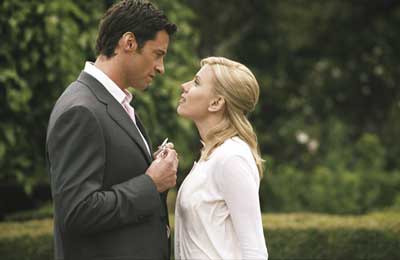
Allen has been directing films since the 1960’s. He should have been able to spot some fairly simple story adjustments that would have better justified the pairing of the two. Instead of perhaps lying to people about Allen being her father, maybe he could have just been written as her father. No way Daddy will walk away and let his daughter investigate a serial killer no matter how much she yells. Instead, Allen plays a relative stranger, leaving the only reason for them to spend time together being that they share some solid chemistry and the same sense of humour. Oh, that was the reason for writing this to begin with. And that glassy look that Allen sports onscreen also found its way off-screen. SCOOP’s aesthetic elements are strained and clumsy. The set designed for the boat to Hades scenes (yes, you read correctly), looks cheap and static. It doesn’t even appear as if the boat were moving amidst the abundant smoke from the machine off camera. The framing and camera work are also uncomfortable and sometimes amateurish. As I found it difficult to focus on anything other than the strange movement, I just became sad realizing the depth and purpose in MATCHPOINT’s aesthetics may have been fleeting. Thank God Hugh Jackman is on hand as the suspected serial killer to distract with his effortless talent and impeccably smooth good looks.

It isn’t entirely fair to repeatedly compare SCOOP to its predecessor, MATCHPOINT, but I cannot comprehend how the same person directed the two. MATCHPOINT has so much cunning and energy whereas SCOOP suffers from Allen’s longtime philosophy that there is no reason why he cannot unleash one movie every year. Here's the reason, Woody. The result is a rushed work full of holes that expose it as a weak excuse to indulge two actors’ egos. Chemistry alone does not a good movie make, especially when the chemistry in question is far from perfect. Um, see MATCHPOINT instead.

Sunday, January 29, 2006

MATCH POINT


Written and Directed by Woody Allen

The ladies who saved my seat at the nearly sold-out screening of MATCH POINT I attended, were having the same conversation probably everyone in the audience has had at one point in time before buying their ticket for the evening’s final showing.

“I know,” the lady furthest to my right exclaimed. “My boyfriend and I were watching the preview and then it was, like, ‘This is a Woody Allen film.’ It didn’t look anything like that.”

“I know,” the closer lady returned. “It looks really good.”

This leads me to two major points of contention when it comes to addressing MATCH POINT. First, the previews look like a drastic departure from Woody’s previous outings. It looks smooth, glossy, and conventional even. The other point refers to the widely established opinion of the movie going public that it has been ages since Woody made a good movie. From two points, stem two questions. Is it really that different? And is it really any good?

Woody Allen has been making movies for just over forty years so it seems reasonable to wonder just how much of a departure MATCH POINT really could be from a director who’s neurotic mistrust of love and life looms over most of his offerings. Even as he gets on in years and no longer takes on the lead acting responsibilities, cutting down to merely writing and directing one film a year on average, the ghost of the Woody Allen caricature finds it’s way into the picture (see Jason Biggs in ANYTHING ELSE or Will Ferrell in MELINDA AND MELINDA.) The lead here, tennis pro turned instructor, Chris Wilton is played by Jonathan Rhys Meyers. We meet him after Woody’s classic plain white text on black background opening credits, interviewing for a job and looking for a London flat. The young lad worked his way out of a poor Irish background into the pro-tennis circuit before retiring for a more stable life where he could appreciate the finer things life had to offer, like opera and art. In opposition to past leads, he is well put together, focused. He has his eye on the ball, if you will. This is not to say he has everything figured out or is without fear. He knows he wants to do something of value with his life, isn’t clear on what exactly that is but also does not let hesitation paralyze him. Upon meeting Chloe Hewett (the glowing Emily Mortimer), Chris’ biggest similarity to the Woody Allen archetype becomes apparent. Despite all his efforts and subsequent accomplishments, he is a pessimist. He may appreciate the finer things but his belief is the finest things are those capable of capturing and communicating everything that is tragic about life. Can a pessimist truly know love? Woody seems to think yes, at least at first. Chloe is an eternal optimist who has never known anything tragic about life and despite their differences they fall in love while walking around London, which Allen frames like postcards in much the same way he has framed Manhattan for years.

Woody has a strong handle on the visual direction, allowing characters to walk in and out of the frame when we would expect them to. There are no surprises, just a natural direction, suggesting that Woody knows exactly what we will want to see as we watch from behind bushes or fences. More importantly, he has an even stronger control on this, his finest screenplay since 1992’s HUSBANDS AND WIVES. MATCHPOINT is ultimately about luck, how little importance we place on luck despite the significant role it plays in our lives and how far we’re willing to push our own luck. Chris, a devout believer in the influence luck has on his life, decides to close his eyes and hope for the best when he embarks on an affair with Nola Rice (Scarlet Johansson), his soon-to-be brother-in-law’s fiancé. The two gravitate towards each other, pulled by an uncontrollable sexual desire. Separately, they each represent opposite ends of the luck spectrum. Chris is still riding his lucky streak, scoring his tennis instructor job, meeting Chloe, getting a job at one of her father’s business firms. Whereas Nola is still trying to escape hers, running away from her dead-end Colorado home, struggling to make it as an actress and eventually losing her fiancé, Tom (Matthew Goode). The question then is how much better is Chris’ luck when all the successes he stumbles upon are not what he wants but what he believes he should want?


Further strengthening Woody’s script, is the issue of class woven in and out of the entire film. Both Chris and Nola come from modest backgrounds at best and are dating members of London’s higher society. Tom and Chloe are happy, High-spirited people with all the time in the world to pursue their interests – opera, tennis, opening an art gallery. Chris and Nola have been working their whole lives to get where they are with Nola finding she still has a great deal of work ahead of her while she’s not certain she has it in her to get there. For Tom and Chloe, there is no flipside to the coin and new opportunities arise all the time. They’ve always been lucky and what makes them descent is at least they can each acknowledge their fortunate existence. Nola has yet to truly know luck and lack of enthusiasm in her speech shows how little faith she has in potentially finding it. But it is the taste of a fortunate man’s life that is new to Chris Wilton. He has a driver now and his new flat no longer has a fold out sofa bed but it does have one of the most spectacular views of London available. So when his affair with Nola begins to threaten his newfound cushion of a life, he is forced to make a decision for the first time instead of leaving everything to chance. This decision brings about a tension and discomfort that is so rarely achieved in filmmaking today. Woody manages to blindside his audience without using it as a gimmick or relying on twists to give the film its ultimate meaning.

Be it lucky in life or unlucky in love, Woody serves up a film about the game itself. We may all think that we have control, that we hold the power over our lives or that we are making the decisions that will move us forward. What Woody wants to remind us is that, like a game, we don’t get to make any of these decisions until it’s our turn to serve and we certainly don’t know what our opponents will do next despite how well we think we know their game.