Friday, August 25, 2006

LE TEMPS QUE RESTE


Written and Directed by Francois Ozon

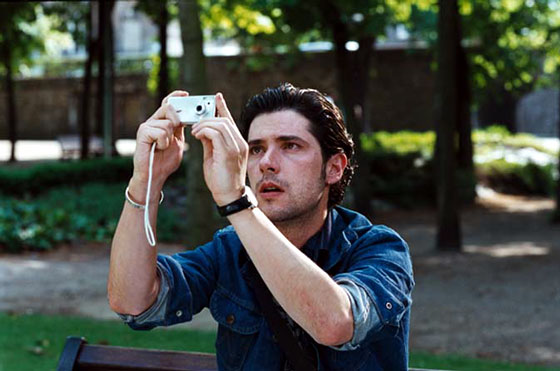
To a great extent, the premise of French director, Francois Ozon’s latest film, LE TEMPS QUI RESTE, reads like a daytime drama storyline. An attractive 31-year-old photographer is told he has an extreme cancer that has spread through his body. It cannot be removed and, though treatment is an option, he does not have a strong chance of survival. He has but a few months left to live. What elevates this film above the potential for clichéd melodrama is the way the photographer, Romain (played by Melvil Poupaud), reacts to this news. He has little time to resolve his life and relationships. He has little time to fully embrace who he is. Yet he does not make peace with everyone in his life, one by one. Instead, he avoids the whole damn thing. Only, as he avoids, he manages to find the foundation of these relationships and begins to understand their significance, how they have helped shape the man he is. He puts his life into perspective his way and finds out that all this time, despite his selfish existence, he has also been a part of something much bigger.

LE TEMPS QUI RESTE is thankfully brief as no one wants to spend too much time watching someone die. It does however make the most of the time it has. When Romain first learns the news, he avoids sharing it with anyone in his life, from his family to his boyfriend to his employer. As he sits at a family dinner and people ask what is new in his life, it is painful to watch him say nothing, especially as he continues to withdraw. Poupaud’s performance humbles Romain as he goes from cocky and assured to constantly being overwhelmed by his own grief. He looks afraid to say that he is dying, to make it real, to place that pain on anyone else. Instead, he buries it and suffers silently. You want so much for him to reach out to the people who clearly love him that when he doesn’t, you just want to wrap your own arms around him. When he finally does share the news, his choice of confidante is calculated. He chooses to tell someone who can understand because, as Romain so plainly puts it, she too will be dying soon.
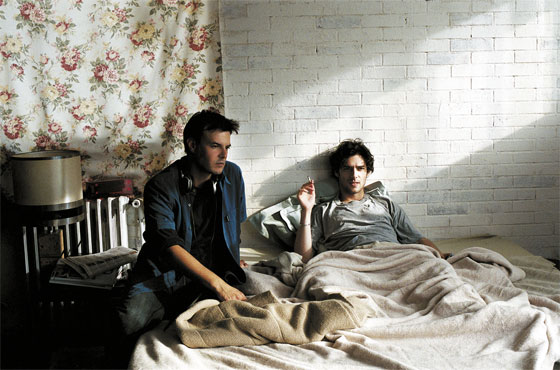

Along with Romain, the viewer has some resolution, some peace brought back to a time of chaos. Romain spends so much time convincing himself that the people around him do not need nor deserve to know about his condition because their relationships are so complicated. Only his solitude brings him the clarity necessary to remember how these relationships began. More importantly, these memories are the ones he associates most cleanly with naïve, unchecked happiness. With death imminently waiting for him, the search for happiness that he gave up on is rejuvenated when he sees how close he was to it all the while. Romain’s memories come to him at random moments and their nature demonstrates the talent of Ozon as writer and director. They are simple memories that may have seemed all too simple at the time they took place but these memories went on to bring Romain closer to others and himself. And as the memories come more frequently, he learns to integrate them into his current reality. Thus when he goes, he goes having lived a short but full life.

Death is a construct, an inevitability, a mystery, a fear to face. In LE TEMPS QUI RESTE, it is also a process that is nothing more than the last clue to understanding your life. In Romain’s final moments, death becomes necessary to complete the journey, a journey that would mean nothing at all if it weren’t ending to begin with.

Monday, August 14, 2006

LITTLE MISS SUNSHINE


Written by Michael Arndt
Directed by Jonathan Dayton & Valerie Faris

LITTLE MISS SUNSHINE is this year’s Sundance breakout and nearly all the press its received thus far has lauded it as, well, a little ray of sunshine to carry audiences through the last month of summer. It is the independent underdog that will tickle your funny bone, stimulate your mind and warm your heart. This little movie has so much to live up to and it has barely even gone wide at the moment I am writing this. LITTLE MISS SUNSHINE isn’t generating its own buzz; it’s having its buzz generated by the machine that wants so badly for it to be that movie it could. Y’know which one I’m talking about. The smaller, simpler movie that allows a more mature audience to wind down their summer, to let the ringing in their ears from all the explosive blockbusters subside. What the machine doesn’t understand is that the movie that fills that particular void is not manufactured. It is genuine and it earns that honour all by itself.

This honour is not one I feel LITTLE MISS SUNSHINE would have earned if it weren’t manufactured for it. Albeit an endearing film with authentic moments of hilarity and sentiment, it is often disconnected and unresolved. The dual director team of Jonathan Dayton and Valerie Faris create a believable family unit by giving each member their own personal touch. Dad is a failed motivational speaker; Mom has to deal with loser dad; Grandpa has a heroine problem; older brother has taken a vow of silence until he becomes a fighter pilot; and gay uncle Frank is fresh out of the hospital after trying to kill himself. Dealing themselves such a diverse hand of characters leaves many opportunities to cross the line between quirky and just plain awkward, which they do more often then they should. Then of course there’s Little Miss Sunshine wannabe herself, Olive. With an earnest enthusiasm and innocence beaming from her face (like a ray of … sorry), untouched and uncorrupted Olive reminds the family that they are in fact a family. It’s a lovely story but it is one that only takes shape in the final moments of the film. Prior to that, each character’s individual problems guide all of their own motivations and they only barely have any depth past these problems. Shifting each characters’ focus outwards gives the film some much needed structure but it leaves many an issue either unresolved or resolved far too quickly.


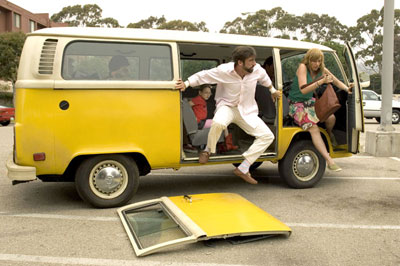
The ensemble cast of LITTLE MISS SUNSHINE reigns as the true heart of this organism. Cramped together in their yellow mini-bus, many different personalities fester. Greg Kinnear and Toni Collette are the heads of the family. Collette is merely a device to highlight the failures of her husband through her aggravation with him. Kinnear’s role however is hefty and he stridently carries that weight as an emasculated patriarch who preaches his failed life lessons to his daughter because she is the only one still buying them. Like another successful family piece, Noah Baumbach’s THE SQUID AND THE WHALE, the influence of the parents on the children manifests before your eyes in a difficult and painful fashion. Steve Carrell plays suicidal uncle, Frank, like a seemingly dormant volcano that may or may not erupt. You just can’t tell. His mystery is heartening and shows promise for his developing capabilities.

As a critic, shedding expectations is a higher state of being I try to achieve before I watch anything. I don’t read other reviews before I see the movie or even before I sit down to write my own, all as an effort to keep it real (dawg). It only takes a quick glance at a magazine cover to get whether people are hating, liking or really loving a movie so it is hard to avoid entirely. But as much as I try to approach each film with a fresh piece of paper to write on, buzz manages to influence the way we see things. When I’m told that something is really solid and it isn’t, even just a little, my disappointment is magnified. LITTLE MISS SUNSHINE has so many things going for it that what it is lacking makes it all the more frustrating because you really want it to live up to the hype. Still ...

Sunday, August 6, 2006

SCOOP


Written and Directed by Woody Allen

MATCHPOINT was a welcome and impressive return for Woody Allen as a director and a writer. Lush art direction and intuitive camera movement framed performances that brought Allen’s best script in over a decade to a dangerously high boil. It was sensual and provocative with deeply layered imagery. It earned four Golden Globe nominations, an original screenplay Oscar nomination and made this critic’s best film of 2006 short list. It now seems its success has spawned a somewhat awkward offshoot, a relationship between Allen and lead actress of both MATCHPOINT and Allen’s latest picture, SCOOP, Scarlett Johansson. According to the SCOOP press (or perhaps a spirit appeared to me and told me about this while I was being dematerialized, I can’t be sure), Johansson and Allen enjoyed their quick-witted off-screen banter so much that she felt it a shame that the two did not have any plans to work together on camera. I suppose its possible he too felt this was a sad situation, or I suppose its also possible he saw this as a great way to spend more intimate time with his new muse, but anyway you look at it, Allen decided to write a script that would feature the two as the film’s leads. And so SCOOP was born, the story of an American journalism student in London who is on the verge of uncovering the identity of the infamous tarot card serial killer and thus breaking a ginormous story that will give her budding career an enormous head start. Great for her but SCOOP negates in an hour a half all the momentum Allen regained in the first two brilliant minutes of MATCHPOINT. I laughed my way through SCOOP but most of the time I was laughing at the entirely ludicrous root of the story and Allen’s obvious concessions in his script that were necessary to make it still questionably plausible.

Is this exchange between Allen and Johansson really worth all this trouble? Admittedly, they play well off of each other, both in their limited capacities. Hers, despite exhibiting a drastically wide range of emotions in MATCHPOINT, is her sometimes-hollow comedic delivery and his is that distant, glassy look that comes naturally with age but here makes him look like he’s drifting in and out of his senses. They meet when he calls her on stage. He is a magician; she is his unsuspecting audience member who must step into a box. Then, because it was in Allen’s box that she first encounters a spirit that gives her the scoop while she is being dematerialized (now that earlier comment makes sense to you, it?), she insists on solving this mystery with Allen’s help. They quickly become inseparable despite having any good reason to be in this caper together. He is constantly tripping over the lies the pair tells to get close to their suspect, often nearly ruining all their work. Meanwhile, he has no real stake to gain by helping her at all. A typical scene will have the two snapping back and forth, reaching points where they both alternately ask why they bother with the other, followed by the two inexplicably reconciling and eating dinner together.


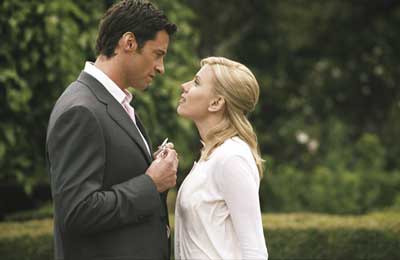
Allen has been directing films since the 1960’s. He should have been able to spot some fairly simple story adjustments that would have better justified the pairing of the two. Instead of perhaps lying to people about Allen being her father, maybe he could have just been written as her father. No way Daddy will walk away and let his daughter investigate a serial killer no matter how much she yells. Instead, Allen plays a relative stranger, leaving the only reason for them to spend time together being that they share some solid chemistry and the same sense of humour. Oh, that was the reason for writing this to begin with. And that glassy look that Allen sports onscreen also found its way off-screen. SCOOP’s aesthetic elements are strained and clumsy. The set designed for the boat to Hades scenes (yes, you read correctly), looks cheap and static. It doesn’t even appear as if the boat were moving amidst the abundant smoke from the machine off camera. The framing and camera work are also uncomfortable and sometimes amateurish. As I found it difficult to focus on anything other than the strange movement, I just became sad realizing the depth and purpose in MATCHPOINT’s aesthetics may have been fleeting. Thank God Hugh Jackman is on hand as the suspected serial killer to distract with his effortless talent and impeccably smooth good looks.

It isn’t entirely fair to repeatedly compare SCOOP to its predecessor, MATCHPOINT, but I cannot comprehend how the same person directed the two. MATCHPOINT has so much cunning and energy whereas SCOOP suffers from Allen’s longtime philosophy that there is no reason why he cannot unleash one movie every year. Here's the reason, Woody. The result is a rushed work full of holes that expose it as a weak excuse to indulge two actors’ egos. Chemistry alone does not a good movie make, especially when the chemistry in question is far from perfect. Um, see MATCHPOINT instead.

Sunday, July 30, 2006

A SCANNER DARKLY


Written and Directed by Richard Linklater

Three men drive down an American highway on a mission. They are driving to a neighbouring city and they plan on partying it up on the way, while they’re there and all the way home again. Their drug of choice is Substance D, what will be the most popular drug seven years from now, when A SCANNER DARKLY takes place. While speeding along, the car breaks down. What ensues is a hilarious journey into the far depths of drug-induced paranoia. They debate whether this car trouble was pre-meditated, whether their home is simultaneously being ransacked by the same people who sabotaged their car … whether one of them actually anticipated this entire series of events and left the door unlocked and an invitation to enter taped to the front of it. Their plans have been ruined but what they don’t realize is that there was nothing special about this occasion as getting messed up is pretty much what they do every day. As ridiculous as this sequence is, it is also completely useless. It is one in a long string of pointless scenes that are told in a disjointed fashion to give character to what is otherwise a flat and uninteresting film.

A SCANNER DARKLY is director Richard Linklater’s second film to implement an animation technique called rotoscoping, where loosely flowing animation is laid over filmed live-action sequences. The results are mesmerizing and hypnotic. It is also a technique that is capable of accomplishing what most directors have struggled with for years. It creates the illusion that Keanu Reeves can actually act. Joining Reeves in this animated parallel universe are Robert Downey Jr, Woody Harrelson and Winona Ryder. Reeves plays an undercover narcotics agent named Bob Arctor, who can’t seem to differentiate between his personas. The drugs have blurred his existence to the point that he can’t quite grasp whether the images of a wife and family that he has in his mind are a memory or just an image. As his confusion grows, so does his addiction. The results make it difficult to ascertain what life Arctor is actually leading. Shortly before the film ends, Linklater reveals an element that explains all the jarring elements encountered along the way. Suddenly, the story becomes clear and it is seen as nothing more than a straightforward nark story. The explanation may solidify the arch but it doesn’t appease any frustration one might have, having spent so long trying to make sense of what one thought was something different.


Substance D keeps Linklater’s characters detached from each other and themselves. Although the majority of the characters are addicts without a history, Arctor fell into drugs as a reaction to the perfection he thought he had achieved in his life. Adapting author Philip K. Dick’s autobiographical account of how he fell into drugs, Linklater reinforces how people spend so much time walking blindly towards the achievements they always felt would make their life significant and full. The rejection of that comfort through drug usage ultimately leads to a much larger sense of discomfort. It makes the idea of getting close to someone in a sober, authentic context unthinkable and frightening. Finally, Arctor has run away from intimacy and finds himself wanting to have that again but not being capable of having it because his world no longer makes any sense.

The beauty of A SCANNER DARKLY is in its aesthetic. Remove that and I doubt the film would be watchable. Linklater’s previous attempt at this style, WAKING LIFE, was infinitely more successful because the technique lends to the psychedelic dreamscape setting and existentialist-themed conversations. Here, the technique is a life preserver for a bunch of drowning druggies.

Tuesday, July 18, 2006

SUPERMAN RETURNS


Written by Michael Dougherty & Dan Harris
Directed by Bryan Singer

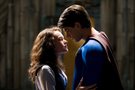
A distant planet explodes, announcing the arrival. It is followed swiftly by large retro/electro credits flying directly towards the audience while a familiar score reemerges after twenty years. Superman has returned. From the very start, director Bryan Singer infuses his interpretation with an energy that reverberates respect and admiration for the legend that is Superman. Care is being taken and a calculated effort is being made not to disparage a character that is beloved by so many, Singer included. At a two and half hour running time, SUPERMAN flies by (not faster than a speeding bullet but fast enough). Not noticing the time ordinarily signifies an enjoyable event but here it serves better as a mask to hide the multitude of strange decisions that make the mighty SUPERMAN RETURNS weak and exposed.

Like any revival of a lucrative movie franchise, the script for SUPERMAN RETURNS went through many hands before it ended up in those of Michael Dougherty and Dan Harris, past Singer collaborators (X-MEN 2). Despite the amount of care being given to this project, the script choices, above all else, are responsible for occasionally killing the illusion. The jarring plot points fall into two categories, bizarre and irresponsible. The bizarre is best exemplified in a scene meant to show that Superman has started cleaning up the streets of the world again. After saving many situations from ruin around the world, Superman, played by the impeccably smooth-skinned Brandon Routh, finds himself back in Metropolis, where he is about to foil a bank robbery. The robber has positioned himself on the top of the bank with a rapid-fire machine gun so large that it requires an immense stand to prop itself upon. I am first unclear how the robber felt his mission would go so wrong that it made sense to bring such a monstrosity. Mind you, the building does end up surrounded by police officers so I guess it was good he planned ahead. However, when Superman has the gun turned on him, each bullet is deflected because, and I’m sure had I done any research before going I would have known that Superman is completely indestructible. You can even shoot him in the eye and he’ll get you anyway. He’s that frickin’ awesome. And I know this because Singer just spent a good ten minutes shoving it in my face. Fear not, I gave nothing of the story away as the scene serves no purpose in the larger picture.


Superman stands for truth, justice and all that is good and noble. So why does he have no issue putting the moves on Lois Lane (Kate Bosworth), a woman in a long term relationship with a six-year-old child? My brother would argue that nowhere does it say that Superman stands for loyalty but I’m fairly positive he’s supposed to be comparatively selfless. Whereas it makes perfect logistical sense for Lois to have moved on after Superman disappeared six years prior without a word (although, judging from the age of her son, she moved on pretty quickly), it makes for a very poor example of a couple to hope for. Lois’s boyfriend, Richard White (James Marsden working with Singer for the first time with his eyes open), is a good man. Sure, he’s a little jealous of Superman but he’s a good father and a supporting boyfriend and c’mon, how could you not be jealous of Superman? So why should an audience want for Lois not to be with Richard but with Superman instead? Singer expects his audience to root for Lois and Superman because of their iconic status instead of showing us something tangible between them to build on. Their constant flirting paints Lois as a confused woman who settled for the sake of her child, taints Superman as a guy who despite all his heroics is really out for himself, and leads me to wonder if the next Superman movie will begin with Superman helping Lois tell her son who his real father is. Never mind that Lois’ son, Jason kills a bad guy at one point and no one even thinks to see if the kid might be a little upset or if he understands the severity of what he’s done. That’s a whole other level of irresponsibility that I don’t have time for.

Superman is everything that everyone wishes they could be. He changes the world; he saves people’s lives; he is indestructible and inherently good without having to try. What Singer forgets more than anything is that he is also Clark Kent. Clark is not meant to stand out, he is not meant to save the world. However, he does exist. In SUPERMAN RETURNS, Clark is more the myth that Superman is. At no point, do we see any aspect of Clark, the real-life ego of this superhero, manifest himself in Superman. Superman embodies the best of what we all can be but if he is entirely disconnected from the person he really is, then he is not a better version of himself but rather an entirely different version that is trying to be someone he’s not.

Saturday, July 8, 2006

CARS


Written and Directed by
John Lasseter and Joe Ranft

The crowd is uproarious. The stadium is practically shaking. Two checkered flags are waved and they’re off … to a sad and unfortunately slow start. I say “unfortunate” because I am speaking of Pixar Animation Studio’s seventh feature, CARS, and the Pixar name usually ensures sophistication, wit and insight in addition to awe-inspiring, revolutionary animation. Further to that, it usually means a darn good time but CARS drags its wheels, leading me to think Pixar might be due for a good tune-up. The problem is not with the quality of the animation, which bursts out straight away in the opening sequence. We are introduced to Lightning McQueen (voiced by the ever laid back, Owen Wilson), a spunky red sports car with a lot of scattered energy to burn and not enough experience or patience to see things through to the finish. He cruises past the rest of his competitors as he races for the Piston Cup, the highest achievement in race-car driving. The arena lights blare down on to the track and into our eyes as the cheers from the stands erupt to deafening new heights. Everything is as it should be but for one jarring detail. The patrons that fill the stands are other cars. Yes, people go to watch other people race against each other but this is a world inhabited by nothing but cars. It’s like “Planet of the Cars” and directors John Lasseter and the late Joe Ranft do very little to ground this reality. And yes, it’s an animated film but I couldn’t get past wondering how the cars managed to build the stadium and all the roads leading up to in the first place.

While on his way to another race in another town, Lightning gets lost and ends up arrested, or in this case impounded, in a middle-of-nowhere town after accidentally tearing up their road. He is sentenced to repairing the road before he can leave. Here he meets an expectedly colourful group of cars that run through a gamut of stereotypes, from the hippie minibus to the military standard hard-ass to the pimp-my-ride 59 Chevy. I have never seen the folks at Pixar deliver such one-dimensional three-dimensional characters. There is no good reason that these cars would inhabit the same town and so why would we even be there? The only resident that seems like he belongs there is a tow-truck by the name of Mater (as in to-mater). Voiced by Larry the Cable Guy, Mater is the dimwitted naïf who unknowingly bestows wisdom upon others. He is hilarious without realizing and is the most believable element of this film.


The clichés don’t stop at the characters either. The moral foundation of CARS focuses on being in too much of a hurry to get nowhere in particular. Upon being forced to slow down, Lightning learns that there is more to life than winning races and scoring cool sponsorships. When you aren’t speeding down the highway, you can see the cars around you and maybe even become their friend or fall in love. Lightning brings some much needed life to this dreary waste of a town and the inhabitants show him a thing or two about loyalty and the simpler pleasures that come from standing still. A good chunk of this lesson comes from Lightning’s love interest, Sally (a coy Bonnie Hunt), a car who studied law and climbed the corporate ladder before she realized she had no idea who she was. Ordinarily, I would find these themes engaging but cars are built for speed, not for taking the time to smell the motor oil.

The beauty of a Pixar film is best exhibited in their 1998 offering, A BUG’S LIFE. The ants and circus bugs that make up the majority of the characters have personality that more than makes up for the lack of time to develop them all. More importantly, the bug world is believable because it co-exists with a human world, bringing light to a universe that we ignorant humans don’t even know is right beneath our feet. Even the entirely unreal monsters of MONSTERS INC have doorways that lead to an earthly plain. CARS had an inherently huge obstacle to get past from the start line but instead of pushing harder, Lasseter and Ranft left CARS on cruise control. The result is more a casual Sunday drive then a high speed race – enjoyable and pleasant but lacking purpose and drive.

Sunday, June 18, 2006

A PRAIRIE HOME COMPANION


Written by Garrison Keillor
Directed by Robert Altman

Real life American radio show, A PRAIRIE HOME COMPANION, becomes fictional fodder in director, Robert Altman’s film of the same name. After 32 years on the air, the show has not changed a bit. Host, Garrison Keillor (played by Keillor himself) broadcasts live from a Minnesota theatre in front of a loyal audience. Various acts perform songs, ranging in message from spiritual to romantic to borderline naughty while messages from sponsors are interspersed throughout. Gracing the stage in song are colorful, quirky (read Altman-esque) characters played by a gamut of folk from Meryl Streep to Lily Tomlin to Woody Harrelson to John C. Reilly. It doesn’t stop there either. The cast continues to round out with the likes of Kevin Kline, Virginia Madsen, Tommy Lee Jones and little Lindsay Lohan. And those are just the A-listers. Nearly the entire story takes place over the course of the show’s final broadcast, practically shutting out any possibility for conventional structure and allowing for character work and integrated back story. Altman has given us a backstage pass to A PRAIRIE HOME COMPANION’s swan song, what ultimately becomes a contemplation on death that is served with soothing melodies that soften the looming sadness and grief.

At 81 years old, director, Robert Altman, admits that mortality is in his thoughts and it is certainly running rampant through the wings and dressing rooms of this homely theatre. The death of the comforting show opens the door to conversations about corporations crushing simple people and sensitive souls as well as the neighborly values sung about in the songs. An aging character dies on this fateful night allowing cast and crew’s reactions to permeate to the surfaces of their faces. Should something be said in his honour? Should words be said about the demise of the show in its honour? Is death a reason to honour life or is life reason enough? As both host and screenwriter, Keillor seems more in favor of honouring life while it is still with us, choosing to perform each show like it were his last. This makes the last show no more significant than any of the others, at least not just because it is the last one. Death is so acutely prominent on this night that it even takes the form of an angel of death, dressed in a glowing white trench coat. She presides over the duration of the show, visible only intermittently to those around her and not even all of them at that. Her function, as an angel of death, is to take souls to whatever comes next when their time has come. Though her duties for the evening had already been fulfilled, she cannot leave as she is haunted by her own death, which came while listening to A PRAIRIE HOME COMPANION. Even angels cannot fully piece together the puzzle that is the transition from life to death.


As the angel of death, a character billed as Dangerous Woman, Madsen sadly gives one of the film’s weaker performances. Though not entirely her fault as her white over coat is a little too white, too perfect, her stride is more of a glide and her speech is always calm, docile. Together, these approaches come off as more farcical than supernatural. Equally clichéd is Guy Noir, an over glorified security guard played by Kline. His private eye speak seems out of place amidst the rest of the realistically based characters. Luckily, Altman’s strange decisions to have these characters play to such stereotypes did not detract from all the rest. Individually, the rest of the major players are strong but they are stronger still as part of the miniature groupings they belong to. As duo Dusty & Lefty, Harrelson and Reilly play off each other like they’ve been doing it for years. Not surprisingly but still seriously appreciated are Streep and Tomlin as the Johnson sisters, Yolanda and Rhonda. They round out each other’s stories and harmonize like only sisters would. Tomlin even has a hint or irritation in her eyes whenever Streep drifts towards a more whimsical train of thinking. Of course, many an eye is on Lohan to see how she holds up as the third wheel to these two unquestionable talents. And hold up she does as the next generation representer of the Johnson family,
A daughter who sings of death but at least she sings. Some things don’t die; they just evolve.

In true Altman style, all of these different lives converge to create a world unto itself. This world is reinforced by Altman standard elements like lengthy credit sequences, conversations running over others and fluid camera movement crossing from the back stage to the actual stage and from floor to floor. The result is a multi-leveled maze that Altman somehow manages to make sense. Whilst doing so, Altman also sneaks in the film’s greatest irony, that some traditions don’t die but continue to thrive after four decades of filmmaking.

Sunday, June 11, 2006

THE BREAK-UP


Written by Jeremy Garelick & Jay Lavender
Directed by Peyton Reed

Although I try to limit my reading of celebrity gossip rags to while I’m waiting in line at the grocery store, I will admit to being taken in by the plight of frequent cover girl, Jennifer Aniston. She’s the girl next door and the poor thing was left behind by one of the prettiest boys on the planet for one of the prettiest girls on the planet. She locked herself away in her Malibu beach house and spoke to no one but family and former cast mates from FRIENDS, the TV show that made her into an international star but whose success is making it very difficult for her to establish herself as bankable movie star. When THE BREAK-UP began filming in Chicago, the irony of the casting caught on and before long the rumours spread that Aniston and co-star, Vince Vaughan, were getting close. As they have no interest in confirming details of their relationship to the public, the intrigue is still high more than a year later. In that time, countless articles have dropped about the broken girl and the man determined to bring happiness into her life again and each of those articles has made mention of this movie. THE BREAK-UP is the world’s keyhole to peer through for a glimpse of what Jen and Vince are really like.

Of course that’s ridiculous as they are actors playing parts in the movie but neither of these actors stretches themselves much further than their established personas so its pretty darn close. And director, Peyton Reed (BRING IT ON, DOWN WITH LOVE), gives the audience exactly what its been craving without delay during an opening credit montage of photographs of the happy couple doing nothing but being madly in love. It’s a succession of every photograph the paparazzi wishes it could get hold of. Jen and Vince, who should count themselves very fortunate their names don’t blend well into one defining moniker, play Brooke Meyers and Gary Grubowski, two people who look simply natural and happy photographed playing games with friends or dressed as cows for some costume contest. Not only does this satisfy the bizarre celebrity fascination that inexplicably drew us to the theatre in the first place, it also serves a great function for the film as well. We are now set up to realize what these two are throwing away when they break up in the next scene.


The break-up itself exemplifies what works and what does not about this film. It comes fast and early in the film and it is not pleasant to watch. There are many an angry word said and the condo the couple share stinks of regret, uncertainty and fear once all the doors have been shut. The level of pain reached in this scene is unexpected and atypical for a romantic comedy but commendable for it’s striving to be realistic. Break-ups are not funny; they hurt and this scene does not pretend otherwise. But are break-ups still happening because of the tired issues these two have? He wants to just come home and have a beer and a minute to himself while she wants him to want to do the dishes. Obviously, there is more to it than that but neither one of them seems to have a clue how to say it and instead of realizing that they’re both not expressing themselves properly, they yell louder so the other can really get it. Not surprisingly, that doesn’t work.

And so the now defunct couple fights for ground and supremacy for the rest of the film. The war that ensues grows out of hand with mixed results. Fighting with witty banter can energize a viewer to take sides and get into it but fighting that pretty much entails nothing more than screaming hurtful things is just awkward and can make the viewer want to leave the room to give them some privacy. And while the laughs do come, they are not always enough to forget that these two never really wanted to break up in the first place. Their antics make it more and more impossible to go back and repair their busted relationship that the hope they will finally learn how to say what they truly need to each other, like the not-so-complicated “I just want us to see each other, be there for each other and not take the other for granted”, falls further away. Before you know it, this romantic comedy has become a romantic tragedy.

Friday, June 9, 2006

AN INCONVENIENT TRUTH


Directed by Davis Guggenheim

The crowd is hushed in anxious anticipation as the man they wait for makes his way through the maze of the backstage corridors. The fervor builds as the man stops to shake another’s hand, pose for a photograph. We can only see him from behind. We can barely make out who it is. Until, the wait comes to its end. Ladies and gentlemen, the man you’ve all been waiting for, the self-described man who used to be the next president of the United States, Al Gore! And, the crowd explodes in a respectfully enthusiastic show of admiration and reasonable applause.

In AN INCONVENIENT TRUTH, former Vice-President of the United States, Al Gore, plays host to a lecture series audience on the impending impact global warming will have on our planet in his and your potential life time. Although it may sound odd in passing, Gore’s lecture series has been given around the globe, hundreds of times. In the time since he lost the bid for presidency, he has rededicated his life and passion to the subject of global warming and made it his priority to increase the awareness of its importance to people everywhere. Contrary to what one might expect from a lecture given by Gore, for example a long snooze, this particular series is actually thoroughly engaging. Of course, the subject matter itself is compelling enough as Gore walks us through image after time-lapsed image demonstrating a shockingly sparse amount of ice where once there was plenty and numerous graphs, be them bar or line, showing significant hikes in temperature and carbon dioxide emissions in the earth’s atmosphere from recent years. No matter the topic, one needs a compelling host to make sure the message hits where it should. The shock of the advanced progression of global warming may end up taking a back seat to the complete personality readjustment of Al Gore as he is charming, witty, sarcastic without being obnoxious and ultimately very comfortable, both with the material and himself. One can’t help but wonder why he didn’t demonstrate this side of himself when running for the presidency in the first place.


One also can’t help but wonder that because filmmaker Davis Guggenheim breaks up Gore’s seminar with allusion to Gore’s past from his upbringing to the election debacle in the state of Florida in 2000. The goal is to demonstrate how Gore came to be crusading for global warming awareness. Drawing a link between the death of his sister from lung cancer due to years and years of excessive cigarette smoking despite the knowledge of its likely tragic outcome and the general population’s ignorance towards the effects of global warming and our need for tragedy to inspire action is one thing. Drawing a link between a near-fatal car accident his son had when he was very young and Gore’s conviction towards the importance of human life makes sense but detracts from the focus of the film. Gore’s motivation or interest in the subject seems almost entirely irrelevant as the film is about the presentation, not the guy giving it. Not only does this filler detract but it also taints. Bringing up America’s decision to ultimately vote George W. Bush into office seems somewhat damning, as if to suggest that global warming is not getting any better because of you America. You voted for someone who doesn’t care about the environment and therefore disasters like Hurricane Katrina, which the film says was much worse due to the warming of the ocean water it traveled over between Florida and New Orleans, might not have been as bad had you voted in a president that cared about the planet. I’m sure Guggenheim isn’t trying to make such strong accusations but the implication is still made through his editing and the film falls off track occasionally as a result.

AN INCONVENEINT TRUTH is being dubbed the “Must-See” documentary of the summer, picking up where past hits THE MARCH OF THE PENGUINS and FARENHEIT 9/11 have left off. I have a difficult time agreeing with this praise. I do believe it to be must-see but this is because the content is important and the facts need to heard. And albeit an enjoyable experience, the content cannot be all that is judged as it is still a film and it is one that is flawed.

Tuesday, May 30, 2006

THE DA VINCI CODE


Written by Akiva Goldsman
Directed by Ron Howard

Writer's Note: I don't bother masking the conspiracy theory at the root of this film. Read at your own risk.

Ordinarily, I would think it grossly unfair to criticize a work directly regarding its translation from book to film. The literary medium offers its readers the opportunity to imagine the events unfolding any way they would like while the cinematic medium does all the imagining for you. In the case of Ron Howard’s adaptation of author Dan Brown’s international phenomenon, THE DAVINCI CODE, there isn’t much imagination happening on the filmmaker’s part though. Avoiding comparison here would actually be the great injustice as the immense anticipation that preceded the release of this film was all to do with the ultra-wide popularity of the book. Brown’s novel is easily digested. It’s lead characters, Robert Langdon and Sophie Neveu, are being chased by numerous parties throughout lavish and romantic European settings. The chase and threat of capture keeps people turning the pages and the international flavour makes people feel as if in the presence of culture. For likely many others, and myself, these were the least intriguing elements of the book. What kept me coming back and barreling through hundreds of pages at a time was the book’s unapologetic and relentless blasphemy against the Christian faith. Brown immerses the viewer amidst characters and settings that exist to varying degrees in real life, thus blurring the lines between fiction and non. Somewhere in between the facts and the fabrications, Brown drops his theoretical bomb – that the ever-elusive Holy Grail, the cup of Jesus Christ, is in fact not a cup at all but rather a person, a woman. The woman in question is the infamous Mary Magdalene and the chalice is her womb, the carrier of the bloodline of Jesus Christ. Yes, you heard right, folks! Jesus got it on with the prostitute and she went on to have his child and their descendants are still here on earth today. I am not for attacks on Christians without purpose but this is not an attack so much as an alternate theory to the foundation their shaky religion rests upon.

I can understand why the Vatican is concerned about the impact this film could have. If you forget for a second, it’s easy to get sucked into all this lore and accept it as fact or at least as potentially true. That being said, it is borderline insulting of the Vatican to presume the film-going public is not intelligent enough to know the difference between history and plain story. Their concern is not for the entire film-going public though, it is more so for the middle of the road viewer who just passively absorbs images without thinking. When I think of these filmgoers, I think of the ideal Ron Howard fan. Howard doesn’t make bad movies (OK, HOW THE GRINCH STOLE CHRISTMAS was bad) but he also doesn’t make spectacular movies (and no, I don’t have an example to refute that). THE DAVINCI CODE has all the elements one would expect from a large-scale Howard production, from big names to big locations. But what it attempts to mask with size is not a lack of substance but rather a lack of control over that substance. Howard coaxes performances from the cast that are inconsistent and hollow. As Langdon, Tom Hanks is sensible, curious and introspective. Ian McKellan plays Leigh Teabing, a Holy Grail expert as playful and cheeky. On the other hand, the usually deep Alfred Molina is farcical and Audrey Tautou looks lost and confused as Neveu; at times she barely seems to know where to stand.


One of the book’s major criticisms, aside from it relying too heavily on conspiracy theories and barely bothering with style, is that it reads like a high-spirited Hollywood blockbuster. Ironically, Howard’s film interpretation plays out nothing like one. It is tiring at times and stale at others. The hackneyed script by frequent Howard collaborator, Akiva Goldsman, cuts out numerous Grail factoids from the book that lend to the theory’s credibility but yet still manages to get frequently bogged down in Grail history throughout the film. The result is slowed pacing during scenes that are meant to be suspenseful. Lengthy background explanations take place during car chases and moments when killers are waiting to attack in the next room but the danger never presents itself until the explaining is all done (leading me to wonder if perhaps the attacker took a bathroom break). With the action forced to wait its turn, the viewer feels the flaws and loses their patience. Howard has taken a book that seemed to have been written with a film deal in mind and made a mess of the already carefully laid plans. As cheap as it is to say this, I must. You’re better off reading the book.