Showing posts with label David Strathairn. Show all posts

Friday, October 8, 2010

HOWL

Written and Directed by Rob Epstein and Jeffrey Friedman
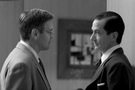
Starring James Franco, Jon Hamm and David Strathairn

Mark Schorer: Sir, you cannot translate poetry to prose. That is why it’s poetry.

I seriously doubt this could happen today, that a poem could spark such outcry as to demand it be banned in the courts as obscene. Fifty years ago though, that is exactly what happened to American poet, Allen Geinsberg, with his poem, “Howl”. The poem depicted the darker underbelly of America, a side of the country that the majority didn’t want to acknowledge. It spoke of the impoverished, the bohemians, the homosexuals and anyone else that really that didn’t fit into the status quo because of who they were or what they did with their days and nights. And so the debate is on – does different mean obscene simply because you cannot understand it?

The trial, the poet and the poem itself are portrayed separately and cut together to form what is the first narrative film by the Academy Award winning documentary filmmaking team of Rob Epstein and Jeffrey Friedman (THE CELLULOID CLOSET, THE LIFE AND TIMES OF HARVEY MILK). Named after the poem, HOWL can only loosely be described as a narrative though. Albeit a somewhat safe choice for their first fiction foray, the filmmakers based their screenplay on court transcripts, archival footage and interviews, giving HOWL a very documentary feel. Ginsberg himself, played calmly and coolly by James Franco, is only ever shown in interview or in flashback, never driving any plot forward. The lack of formal focus makes for a free flowing experience but also never allows the film to truly find a firm foundation.

Like the point being proved in court by the “Howl” defense attorney (Jon Hamm) though, form needn’t be formal for the themes to be meaningful or have literary merit. Each component of the film, including a dark and rich animated interpretation of “Howl” from Monk Studios, functions fine individually and creates a whole unique unto itself. In that sense, HOWL honours its inspiration as best it can and proves the timelessness of the poem by allowing its relevance resonate even still today.

Saturday, May 24, 2008

MY BLUEBERRY NIGHTS

Written by Wong Kar Wai & Lawrence Block
Directed by Wong Kar Wai
Starring Norah Jones, Jude Law, Rachel Weisz, David Strathairn and Natalie Portman


Elizabeth: What’s wrong with the blueberry pie?
Jeremy: There’s nothing wrong with the blueberry pie; just people make other choices. You can’t blame the blueberry pie; it’s just … no one wants it.

It doesn’t get much more American than apple pie. I can’t say why that is exactly but that is what they say. And while blueberry most certainly isn’t apple, the reference to pie does make for an appropriate symbolic foundation for famed Chinese director, Wong Kar Wai’s first foray into American cinema, MY BLUEBERRY NIGHTS. And he doesn’t just stop at pie. Kar Wai immerses himself in Americana, taking us on a road trip from New York to Missouri and Las Vegas, with shift work, gambling and heartache along for the ride. Sadly though, Kar Wai crossed the Pacific only to get lost in the Heartland for there is something else distinctly American about this film – it rests comfortably on the surface without much effort to go deeper and dresses itself up in pretty colors to hide it’s lack of profundity.


To solidify his position as a stranger in a strange land, Kar Wai casts singer, Norah Jones in her first acting role. Jones plays Elizabeth and Elizabeth is represented by the blueberry pie. It’s a perfectly good pie but no one seems to ever choose it when there are more traditional slices to be had. Blueberry is apparently the black sheep of pies, if you will. Elizabeth isn’t afraid to try something new though and so she adamantly chooses the neglected pie. Now, she need only learn how to do the same for herself. To learn how, she bolts across the country but while she searches for herself through countless sleepless nights, she finds character after character in worse shape than she. As she gets further and further from New York though, you know there’s only one place that makes sense for her to end up. It wouldn’t be a journey of self-discovery after all if you didn’t finish precisely where you started. Well, it would be if this were earlier Kar Wai but this is America, baby!


As Elizabeth, Jones is in a constant state of bewilderment. It is as though she was just born or just woke up to find the world has stopped making any sense. She looks uncomfortable, agitated, not unlike her stage presence from her earlier touring days. It isn’t clear whether this discomfort is her character or her lack of ability to develop one. It doesn’t help that she is surrounded by a supporting cast all on top of their game. Jude Law smolders as the man who serves her the blueberry pie. He is the guy who once got burned and hasn’t moved since. Rachel Weisz and David Strathairn are a couple on the brink of divorce. She has been hollowed by a disastrous marriage and he spends night after night numbing his pain with drink after drink. She is the nervous wreck to his wasted space. Elizabeth’s final encounter is with Leslie (Natalie Portman), a fast-talking, overly confident poker player. Portman has been better but still has plenty of tricks to teach Jones. Jones knows how to brood but her delivery is too often hollow. She is the mystery at the center of Kar Wai’s America but doesn’t inspire any desire to be solved.


MY BLUEBERRY NIGHTS conjures a certain kind of mood. It captures the state of human damage that we all inevitably encounter at some point but only some figure out how to survive. Our initial instinct may be to run and we may do so by driving as far away as possible or staying still exactly where we are and never risking anything ever again. No matter what we do, the nights can get very lonely and if we’re lucky there is still pie to be had and someone to share it with. If we want to survive though, we must be brave enough to go home again. Now that Wong Kar Wai has gotten sufficiently lost, I think it is time for him to heed Elizabeth’s lesson and do the same.

Saturday, November 5, 2005

GOOD NIGHT AND GOOD LUCK


Written by Grant Heslov and George Clooney
Directed by George Clooney


“Good Night, and Good luck” is one of those Hollywood films that get made at the hands of a major Hollywood player because they’ve played within the system for so long. When you’re George Clooney, you can make the film you want and get a bunch of your high-profile actor friends (from Patricia Clarkson to Robert Downey Jr. to Jeff Daniels) to come on board and no one in the system stands in your way. A certain leeway is afforded you and you needn’t worry about making a film that criticizes some of today’s North American societal staples such as television, the media or even the current presidential rule. I guess it doesn’t hurt to make these criticisms indirectly though.

Of course, no one would care what you had to say if your film was unwatchable so it’s a good thing that Clooney has a skilled hand when it comes to directing. He tells the story of CBS newsman, Edward R. Murrow (played here with restraint and dignity by David Strathairn) in 1953, as he takes on Senator Joseph McCarthy, intent on exposing his means to protect the United States from the inside threat of Communism for the witch hunt it actually was. The smooth film invokes a sense of exuberant energy with its high-contrast black and white cinematography and jazz interludes (sung on screen by soulful Dianne Reeves). Clooney crafts a neo-hipster, fast-paced look back at a time when people not only didn’t realize the dangers of smoking but, as in Murrow’s case, they did so while they gave their composed telecasts.

Murrow is introduced as nervously smoking backstage before accepting an award from his media peers. There is a sense that he knows that what he is about to say will be unpopular but it must be said. He then approaches the podium and warns of the potential dangers of television on society as a device that will stump and shelter our minds, ultimately casting a shadow of complacency over all under it’s control. This fearless usage of his power and position of respect will continue throughout the film and his career.

Next on Murrow’s hitlist is the media itself. Much like Peter Weir’s 1976 film, “Network”, a film that takes place about twenty years after this period, “Good Night, and Good Luck” presents media professionals aware of the direction their field is heading. They see the future as one where the media will not challenge authority but simply report it without question, essentially becoming a tool for the government to design the image it wants as opposed to exposing it for what it truly is. Murrow is fully supported by his producer and good friend, Fred Friendly, played by Clooney himself in an amusing supporting role that mirrors his role off camera. Neither is hellbent on taking on the system but merely determined to say what is not being said while they are in a position to have people listen.

“Good Night, and Good Luck” is smart and refreshing. It dares draw links between the McCarthy era and the Bush Administration, painting them as bullies and consequently showing today’s media as afraid to be the voice of the people it is meant to speak both to and for. Though the point is thinly veiled in nostalgia, it is still a necessary and welcome one.