Showing posts with label Grant Heslov. Show all posts

Saturday, September 12, 2009

Black Sheep TIFF Review: THE MEN WHO STARE AT GOATS


I’m not sure what I was expecting considering the title. I can say that what I got from Grant Heslov’s new film, THE MEN WHO STARE AT GOATS, I could never have expected even if I tried. Heslov tells you right away that most of what you’re about to see is truer than you would think, which implies that at least some of what you’re about to see is a fat lie. What actually follows is so entirely ludicrous that it’s hard to imagine it as either made up or the truth. The other thing I wasn’t expecting before going in was laughing as hard and as often as I did.


Ewan McGregor is back in familiar territory as an earnest, likeable lead. He plays reporter and underachiever, Bob Wilton. His wife has just left him and he has, in turn, left the United States for Iraq. It is 2003 and he wants to prove to the world and himself that he is worth something by writing the best post-Iraq war feature ever written. He decides the best angle for his story is to be found with Lyn Cassidy (George Clooney). Cassidy, an army man himself, used to roll with the U.S. Army’s New Earth Division, a division based on the principal that peace is the only thing that can actually win a war and that takes from the paranormal studies to develop its weaponry and calls its top soldiers Jedi warriors. Cassidy himself is said to be able to stare at goats long enough to make their hearts stop. How the U.S. army could have funded any of this is beyond me but it was … or at least some of it was.


I’ll be honest; I am not sure whether Heslov is suggesting that this approach is just as nonsensical as the military methods that we’re familiar with now or that war makes no sense no matter what your plan of attack is. All I know is that when McGregor asks Clooney what a Jedi warrior is, the theatre erupts in laughter. Now, that’s using the force.
Saturday, November 5, 2005

GOOD NIGHT AND GOOD LUCK


Written by Grant Heslov and George Clooney
Directed by George Clooney


“Good Night, and Good luck” is one of those Hollywood films that get made at the hands of a major Hollywood player because they’ve played within the system for so long. When you’re George Clooney, you can make the film you want and get a bunch of your high-profile actor friends (from Patricia Clarkson to Robert Downey Jr. to Jeff Daniels) to come on board and no one in the system stands in your way. A certain leeway is afforded you and you needn’t worry about making a film that criticizes some of today’s North American societal staples such as television, the media or even the current presidential rule. I guess it doesn’t hurt to make these criticisms indirectly though.

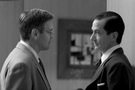
Of course, no one would care what you had to say if your film was unwatchable so it’s a good thing that Clooney has a skilled hand when it comes to directing. He tells the story of CBS newsman, Edward R. Murrow (played here with restraint and dignity by David Strathairn) in 1953, as he takes on Senator Joseph McCarthy, intent on exposing his means to protect the United States from the inside threat of Communism for the witch hunt it actually was. The smooth film invokes a sense of exuberant energy with its high-contrast black and white cinematography and jazz interludes (sung on screen by soulful Dianne Reeves). Clooney crafts a neo-hipster, fast-paced look back at a time when people not only didn’t realize the dangers of smoking but, as in Murrow’s case, they did so while they gave their composed telecasts.

Murrow is introduced as nervously smoking backstage before accepting an award from his media peers. There is a sense that he knows that what he is about to say will be unpopular but it must be said. He then approaches the podium and warns of the potential dangers of television on society as a device that will stump and shelter our minds, ultimately casting a shadow of complacency over all under it’s control. This fearless usage of his power and position of respect will continue throughout the film and his career.

Next on Murrow’s hitlist is the media itself. Much like Peter Weir’s 1976 film, “Network”, a film that takes place about twenty years after this period, “Good Night, and Good Luck” presents media professionals aware of the direction their field is heading. They see the future as one where the media will not challenge authority but simply report it without question, essentially becoming a tool for the government to design the image it wants as opposed to exposing it for what it truly is. Murrow is fully supported by his producer and good friend, Fred Friendly, played by Clooney himself in an amusing supporting role that mirrors his role off camera. Neither is hellbent on taking on the system but merely determined to say what is not being said while they are in a position to have people listen.

“Good Night, and Good Luck” is smart and refreshing. It dares draw links between the McCarthy era and the Bush Administration, painting them as bullies and consequently showing today’s media as afraid to be the voice of the people it is meant to speak both to and for. Though the point is thinly veiled in nostalgia, it is still a necessary and welcome one.