Showing posts with label The Exorcist. Show all posts

Saturday, December 4, 2010

The Lucky 13 Returns! Week Five: Hanukkah


Mel Brooks gave us Jews in Space, but this week in The Vault of Horror--as well as Brutal as Hell--we're giving you Jews in horror! That's right, it's Hanukkah, the Festival of Lights! And this time around in The Lucky 13 series, we're casting our oil lamps on Jewish horror directors. Specifically, I've chosen to write about my very favorite horror film by a Jewish director, and my dear colleague Ms. BJ-C of The Vault's sister blog Day of the Woman has taken an even broader approach, spotlighting three of her very favorite horror directors among the Chosen People.

So put down that dreidel, stop giving your poor mother so much shpilkes with all your meshugass, grab a bissel cake and read on...

B-Sol on The Exorcist

It may seem a tad silly selecting this film, since it could very easily top the list of most people's favorite horror movies, period--let alone horror movies from Jewish directors alone. Nevertheless, since The Exorcist went mysteriously absent from the original Lucky 13 series (Not even in the Devil & Demons category?? Come on, people!), this is my chance to right that heinous wrong.

What can possibly be said about this classic to extol its greatness that hasn't already been said? It was nominated for the Oscar for Best Picture, and remains the highest-grossing horror movie ever made. And although it has its detractors--as all great films do--there can be little doubt that The Exorcist is one of the all-time triumphs of American cinema, a crown jewel from an era that gave us so many.

With stellar performances from Ellen Burstyn, Max Von Sydow, Linda Blair and especially Jason Miller in particular as the beleaguered Father Damian Karras, this is a film of great depth and weight, finished in a way in which few horror films are finished, with the deft touch of a master auteur. It's unfortunate that Friedkin never quite equaled the heights he achieved with The Exorcist, his masterpiece, but it nevertheless remains as what it has been for much of the past four decades--not just a great horror film, but the great horror film.

BJ-C of Day of the Woman on David Cronenberg, Eli Roth & Sam Raimi

Cronenberg:
Okay, so I'm sort of splitting hairs on this one, considering Cronenberg has denounced his Jewish faith and identifies himself as an atheist. Regardless, he was raised in a Jewish household and that's good enough for me. Cronenberg is easily the king of venereal horror films. No one can make a film as gruesomely intelligent as Cronenberg. His films often times explored the fear factors humans possess when it comes to infection and bodily transformations. For me, someone with an uncontrollable fear of being diagnosed with leprosy, he hits the nail on the head every. single. time. A small little tidbit is that Cronenberg was considered to be the director for Return of the Jedi, and I can honestly say that the world wouldn't have been able to handle that much awesome in one film, and the results would have been the equivalent to dividing by zero... So I guess it's a good thing he didn't pick up that job. But Cronenberg will forever be the king of body horror.

Eli Roth:
Oh, Eli Roth, you sexy sexy bear Jew, you. As much as the world is fully aware of how much of a douchebag you are in real life, I can't take away the fact that you directed some of the most highly thought-of horror films of the last decade. Personally, I disliked Hostel, but I'd be a fool if I denied the fact that his films have developed an almost cult-like following. Roth definitely has a fiery passion for the genre and for that, he has my respect. As for his actions on Twitter towards other horror journalists... he's on the fence ;)
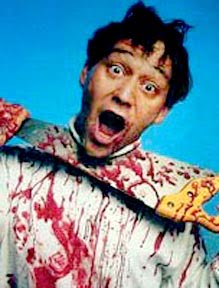
Sam Raimi:
Alright, Sam Raimi is the God of my world. He gave me our savior, Bruce Campbell, and his Necronomicon Ex Mortis serves as my Holy Word. There is absolutely nothing that this man touches that didn't turn to perfection. I'm including Spider-Man 3. There, I said it.

* * * * * * * * * *

Join us next wee for an edition of the Lucky 13 that will be very near and dear to my heart... as we commemorate Frank Sinatra's birthday weekend with a look at our favorite musical horror films! Ring-a-ding-ding, baby!

Week 1: Halloween
Week 2: Man vs. Nature
Week 3: Veteran's Day
Week 4: Thanksgiving

Tuesday, July 21, 2009

The Tuesday Top 10: Faith-Based Horror Movies

I was recently asked to put together a list of the top faith-based horror films for Bloody-Disgusting... However, because Brad "Don't call me Mr. Disgusting" Miska is a busy dude, the list was accidentally assigned to two different writers--and damn it, I wasn't fast enough! Not one to let good copy go to waste, I've decided to "repurpose" the list--as we say in the marketing business--which means that now all you loyal Vault Dwellers get to enjoy it exclusively!

BJ-C had been helping me put this one together, but she's off the hook now--saved by baton nationals! However, keep your greasy eyeballs peeled for the newest VoH/DotW collabo in the days/weeks to come... For now, enjoy this breakdown of the most memorable horror flicks with religious themes:

10. Angel Heart (1987)
Robert DeNiro plays the Devil (oh excuse me, Louis Cypher) in this horror noir which was unfairly maligned upon release, but has since aged like a fine wine. Plus it has that infamous sex scene between Mickey Rourke and Lisa Bonet. What would the Cos say? Oh wait, he was too busy asking interns to tug on his Jell-O pudding pop...

9. Stigmata (1999)
I didn't expect much from this one when I first saw it, but it surprised me--both in its effectiveness, and its knowledgeable use of Christian folklore. Patricia Arquette is freaky in the title role of Frankie Paige, a girl afflicted with the wounds of Christ. And of course, Gabriel Byrne is Gabriel Byrne. As a recovering Catholic, this one was much appreciated.

8. Signs (2002)
I might catch heat for this one, but Signs deals very pointedly and frankly with the common problem of crisis of faith. If that doesn't make it "faith-based", I don't know what would. Mel Gibson plays a fallen priest whose brush with invading aliens causes him to reassess his relationship with the magic dude in the sky.

7. Seven (1995)
Yes, I refuse to spell it in that goofy way with the number 7 in the title. I'm cranky that way. Anyway, thanks to BJ-C for suggesting this one. For the handful of you that might not know the plot, Seven features the serial killer John Doe, whose murders are each based around one of the seven deadly sins. Think of him as Jigsaw, if Jigsaw had gone to Sunday school.

6. Hellraiser (1987)
While not so much tied into any recognizable organized religion, Clive Barker's masterwork is highly spiritual in nature. And of course, there's the whole "Hell" thing, which is kind of hard to get around. The Cenobites are clearly New Age demons, and there is much made of the universal balance of good and evil, which is all very Zoroastrian. Thank you, liberal arts education!

5. Faust (1926)
Four years after Nosferatu, F.W. Murnau delivered his other amazing epic, the screen's finest adaptations of one of Christianity's most famous legends. God and Satan do battle over the soul of Faust in Goethe's literary masterwork, brought to life in boldly visual fashion by the master of German Expressionism.

4. Rosemary's Baby (1968)
Yes, we're getting into the "predictable zone" here, so sue me. This is the film that ushered in the era of "Satanism chic" in horror, and spawned more copycats than you can shake a pitchfork at. Mia Farrow is impregnated by Beelzebub, and delivers her impish progeny to an apartment building filled with eager Devil worshippers. Shocking stuff for its day, and still packs a punch now.

3. The Omen (1976)
Gregory Peck delivers one of horror's all-time classiest performances in this wicked tale of Satan's attempt to reincarnate himself on Earth in the cute little form of Damien Thorn. Another great example of a film that makes the most of Christian folklore, crafting a story that draws us in, whether we buy into the faith-based stuff or not.

2. The Wicker Man (1973)
Ask any horror fan who's seen it, and they'll tell you that The Wicker Man is one of the genre's truly great discoveries. A much bigger deal in the UK than in the States, this twisted morality tale pits devout Christian police officer Edward Woodward against a cryptic Pagan cut led by the sublime Christopher Lee. Avoid the remake at all costs, in large part because it ejects much of the religious subtext.

1. The Exorcist (1973)
What would be the point of even trying to be cute and picking anything but this? William Friedkin's enthralling piece of filmmaking so impacted the culture into which it was released that it actually raised the ire of the Catholic church, and polarized audiences with its intense, and gripping take on the struggle between Satan and the soldiers of Christ in a world in which good and evil are very real forces. Based on William Peter Blatty's best-seller, it's the perfect example of a faith-based horror film directed at an often faithless modern world.

* HONORABLE MENTION*

Constantine
End of Days (direct hate mail to BJ-C :-))
The Exorcism of Emily Rose
Prince of Darkness
The Prophechy
The Seventh Sign

Tuesday, July 7, 2009

The Tuesday Top 10: Most Well-Made Horror Films

I know I may catch some flak for this one, and maybe be labeled a "film snob". So be it. Maybe I am one, a little. Let me explain what the concept behind this week's list is...

There is a big difference between a favorite movie and a great film. Just as when you're asked, "what's your favorite movie ever?", it's a very different question from, "what do you think is the best movie ever made?"

With that in mind, I'm putting together a list of the ten most well-made horror films ever. These are films that I would put up against any straight drama nominated for a Best Picture Oscar in its respective year--and, in fact, in some cases these films were actually nominated, or won. More than just great horror flicks, these are excellent films, period.

Let me explain the difference. As much as I love George Romero, and Dawn of the Dead is my favorite horror movie of all time, I can admit that I love it because it's a cool horror movie. It has flaws--the acting is often stiff, the editing sometimes sloppy, the soundtrack delightfully cheesy. That's all irrelevant to why I love it. As much as I adore it, if we look at the films nominated for Best Picture that year, we find movies like The Deer Hunter and Midnight Express. You can hurl tomatoes at me if you want, but I'm not going to put DOTD in a category with those movies.

On the other hand, if we look at a movie like The Exorcist, in my opinion, we're looking at a film that is superbly made from every aspect--apart from being a great horror movie, it is just a great film, plain and simple. And it was nominated right alongside films like American Graffiti and The Sting--and deserved to be. That's the difference I'm talking about. Film snob? So be it.

Got it? OK, let's proceed...

10. 28 Days Later (2002)
Before he became a mainstream darling with Slumdog Millionaire, Danny Boyle gave us this frenetically paced and brilliantly photographed picture. I remember seeing it at the time and thinking it was made with more quality than any horror films that had come along in a while, and I still stand by that opinion.

9. The Silence of the Lambs (1991)
Although I hesitate to call it a horror movie, it is generally considered as such, and thus it didn't seem right to leave it off. Jonathan Demme's masterwork became the first horror film to win Best Picture, and also took home statuettes for director, actor, actress and screenplay. This was truly horror's greatest moment in the sun.

8. The Haunting (1963)
Powerhouse director Robert Wise, who made his bones under Val Lewton in the 1940s, delivered this, the finest ghost movie ever made. Without ever showing us a thing, Wise creates an atmosphere of sheer terror. The editing is crisp, the camerawork restrained and effective. This is an awe-inspiring fright flick.

7. The Bride of Frankenstein (1935)
While I enjoy the first Frankenstein more (and ranked it higher on my '30s movies list), I have to agree with most critics that this is a film of slightly higher quality. Working from a clever, satirical script, James Whale imbued his sequel with rich symbolism and wit. The sets are gorgeous. And that cabin scene with the blind man is one of the finest scenes in any movie--ever.

6. Jaws (1975)
Another flick I never quite considered horror, but I am decidedly in the minority, apparently. This is Speilberg at the height of his powers, and it earned him a Best Picture nom. Some of the finest performances you'll ever find in the horror genre, courtesy of Roy Scheider, Richard Dreyfuss and the great Robert Shaw.

5. Alien (1979)
Ridley Scott turned what could've been your by-the-numbers alien critter-in-space B-flick into a superb piece of filmmaking. With a knockout cast, flawless effects, captivating set design and beautiful cinematography, it is a true pleasure to watch. And I stand by the opinion that James Cameron's sequel, while perhaps a more action-packed popcorn flick, is in every way inferior.

4. Let the Right One In (2008)
Folks have called this the finest vampire film ever made, and I'd say that's accurate. But beyond that, this is a work of heart-breaking beauty that literally transcends the genre. Without the vampirism, it would still be outstanding. In a few more years, with a little more perspective, it is entirely possible that I would put it into the number-one position (as BJ-C suggested).

3. The Exorcist (1973)
The 1970s was perhaps the greatest decade for film, and this was horror's greatest contribution to the new movement. William Friedkin's finest moment, it's characterized by an excellent script from novelist William Peter Blatty and incredible performances from Ellen Burstyn, Linda Blair and Jason Miller. Nominated for the big one, and deservedly so. Never gets old.

2. Psycho (1960)
Alfred Hitchcock's proto-slasher has become a film school standby, and one of the most revered films ever made. And it's not even Hitchcock's best. A true master of the medium, Hitch dazzles effortlessly with gorgeous composition and a pacing rhythm that gives you no choice but to watch. Anthony Perkins is a revelation, and the landmark Bernard Herrmann score needs no hype.

1. The Shining (1980)
This whole shebang is a matter of opinion, and in my opinion The Shining is the finest horror film ever made. Stanley Kubrick's cinematic jewel is a work of absolute genius from top to bottom. This is a film so rich in texture and flawless in execution that I find it a rewarding experience to watch every single time. More than a horror movie, this film is a work of art.

Thursday, May 14, 2009

The Thirteen Most Badass Heroes in Horror

RayRay is back again, true believers, and this time I am bringing you my exclusive list of the 13 greatest horror movie heroes. Why thirteen? Why not? And thirteen is a pretty scary number, so I am going with it. Or maybe I couldn’t come up with 15. Whatever.

This list was inspired by B-Sol’s post a short while ago regarding his top ten favorite horror movies characters, and I realized that there was only one protagonist. Since then I have thought deeply about the subject of the protagonist, and realized there were too many. So I decided to go for the heroes.

In any event, I want all to know I do not think this list is exhaustive, and would like stir some discussion on the topic. I surely missed some great horror heroes, and want to hear about it.

Also, I want to let everyone know this list is not about the final girl, or last survivor, or the best scream queen. This list is reserved for characters that saw the evil with their own eyes and went out to confront it, and then did so in as badass a manner as humanly (or superhumanly) possible, and often paid the ultimate price for their heroism.

So, without any further delay:

13) Dr. Sam Loomis (Halloween, 1978, Halloween II, 1981)
Dr. Loomis, played by the wonderful Donald Pleasance, did it more with his brains rather than brawn. But he was also the only person to realize the depth of the evil in Myers, and realized he had to try to keep him locked away. When he realized that was impossible, he knew he had to confront his patient, and knew he had to pack heat to do so. And when it came to it, he also knew he had to sacrifice himself to do the deed. [After the sequel, the series sorta dumbed down a lot].

12) Alice (Resident Evil, 2002, etc.)
Milla’s Alice, one of the few heroes on the list that could do a swimsuit calendar, is one lady you don’t want to mess with. She deals with the chemically undead caused by the T-virus handily, never backing down. She is a bad broad, and as the series went onward, only got badder.

11) John Constantine (Constantine, 2005)
Maybe you hate Keanu, and maybe you didn’t think this was the best movie. But to be real, the man is accursed and condemned to Hell, yet in thrall to God, and still wrestles demons like hillbillies rassle ‘gators, and is one of the few humans that can tell Satan to shove it. Plus, the crucifix-come-shotgun is a badass weapon.

10) Hellboy (Hellboy, 2004)
Hellboy, played by Hollywood’s man in makeup, Ron Perlman, is a super, duper badass. He has it all: no looks, one good hand, and a Good Samaritan. Plus, he can speak to the dead. Being the son of Satan, yet fighting for the good guys has to wear on a guy’s psyche, but that has not stopped ol’ Red yet. Few of our heroes can deliver a snappy line while fighting creatures of Lovecraftian terror, like Samiel, The Desolate One.

9) Michael (Dawn of the Dead, 2004)
Michael, played by Jake Weber, is the Superego awash in Id at the Crossroads Shopping Mall. He keeps his cool, puts the other hormonally challenged males in their place, and quietly becomes the leader of the small band of survivors. He faces the horror of the situation without fear, and when his chips are cashed, he walks away from the table with a nary a complaint.

8) Dutch (Predator, 1987)
I am sure I will hear it that this is not really a horror movie, but if not, then neither is Godzilla. In any event, Dutch, one of Ahnold’s best played roles, is a super badass. First, he and his team dispose of an entire company of bad guys, and then, like little Indians, his squad is picked off. But does Dutch panic? No, he tells the little Commie girl to get to the chopper, and then takes care of business. Which is not a problem, except business is 7 feet tall and packs a small nuke. Just for surviving, Dutch makes the list.

7) Wray (Planet Terror, 2007)
Not only does Freddie Rodriguez’s Wray never miss, he makes his girl Cherry Darling into a walking zombie destroyer. But before she rules the wasteland, he has to take care of business, which includes taking out most of the zombies in Texas. Though his origins aren’t clear, what is is that Wray was an undercover agent and/or commando, and if killing was his business……

6) Clarice Starling (Silence of the Lambs, 1991)
Jodie Foster’s Starling is at once a delicate, pale West Virginian girl running from demons, and at the same time a vicious hellcat with a big brain. She not only figured out who he was, she single-handedly went after Buffalo Bill into his lair. Not for the faint of heart. And while she did get a little lucky that Bill was cocky, as they say: fortune favors the bold. And most importantly, she was the music to tame the most savage of hearts, that of the good doctor’s.

5) Professor Abraham Van Helsing (Bram Stoker’s Dracula, 1992)
Sir Anthony’s Van Helsing was, in my humble opinion, the version of the character played with the most vim and vigor. While stodgy and old, he was nonetheless the most knowledgeable of the vampire hunters, as well as the one who stiffened the others’ backbones for the hunt and kill of “wampyres…….nosferatu……” Not to mention he seemed to get a kick out of it, and the slaying of the blood sucking undead never seemed to bother his appetite for rare beef or strong, dark ales. My kind of guy!

4) Father’s Merrin & Karras (The Exorcist, 1973)
For this one there is a double bill. I could not decided which of Pazuzu’s nemeses to choose, so I went with both. Max von Sydow’s Merrin brought gravity and professorial steadiness, while Jason Miller’s Karras was devotional anger at the defilement of innocence. Both priests fought for the soul of young Regan, no matter what temporal torments, or whose voice, the demon threw at them. And in their single combats each paid the ultimate price for that little girl, but they succeeded.

3) Ash (Evil Dead I-II, Army of Darkness, 1992)
I know this is going to get me grief. Ash is only number 3?!! Sorry, kiddies, but at least he cracked this rarified air. Hey, if asswhippery were a religion, Ash would be the patron saint. He also gets points for introducing the phrase “pillow talk” to medieval Europe. But the man can’t remember 7 lousy syllables. However, he did lop off his own hand, and he can handle a rifle like few others. And he saved the world in both the 13th and 20th centuries, so he gets to be in the high pantheon. Plus, being the King of the One Liners makes him that much more awesome.

2) Ellen Ripley (Alien 1979, Aliens 1986, etc.)
Sigourney Weaver’s Ellen Ripley is the very first female action hero. She goes from junior officer on a doomed interstellar freighter to leading a bunch of badass space marines, to the savior of mankind. Not only does she tangle with one of the most fearsome creatures man ever encountered in the stars, she wins. And she only got angrier and more badass as the series went along, though the quality of the movies declined as an inverse proportion to her badassery. Notwithstanding, she took the Queen on, woman to woman, and it was no small feat to have defeated such an implacable, indefatigable foe. Especially one so pissed off.

1) R.J. McReady (The Thing, 1982)
Kurt Russell’s McReady, the surly, Scotch swilling, chess playing chopper pilot at
Outpost 31, is number 1 on this list. This may be controversial, but that’s why people do silly lists like this. McReady is number 1 because a) he faces what I consider to be the scariest monster of all time, b) he does it in the worst conditions I can think of, c) he rapidly realizes the gravity of the situation and does not lose his mind (unlike Blair, who does, or Fuchs, who commit suicide), and computes that this is a battle for the planet. He also gets that if they lose, humanity is gone. He takes control in a situation more suited to madness, never loses his cool, and is willing to pay the ultimate price from the word go. That, and he is handy with a flamethrower.

So there it is, true believers. I look forward to hearing from all the Vault Dwellers on how awesome I am for making this list. I hope you enjoy chewing it over as much as I enjoyed making it. Until next time……..

Tuesday, March 10, 2009

Want to Know What Scares Me? (Part the 2nd)

As I was saying before I was so rudely interrupted by total exhaustion and gainful employment, I got exposed to a lot of frightening stuff on TV as a kid that helped pave the way for my lifetime horror obsession. Why TV, you ask? Mainly because I was too young to be taken to see horror movies in the theater. But since daytime TV in those days was fairly polluted with old horror flicks, that didn't mean I never saw theatrical films, too.

Case in point: The Changeling. No, not the admittedly excellent, if overlong Angelina Jolie Oscar bait. I'm talking about the George C. Scott classic that I still consider among the finest ghost stories ever filmed, perhaps second only to The Haunting. I caught this one as a wee lad, all alone in my grandparents' living room, while the rest of the family argued downstairs in that uniquely Italian-American way.

Can you say nightmares? And lingering trauma? The image of the little boy being drowned in the bathtub was burned into my consciousness, and I could not approach a full tub, or even a toilet bowl, without first checking for a submerged face after that.

But there was a big difference between the relatively tame movies shown on afternoon syndicated TV and the kinds of movies my parents loved going to the theater to see, and renting to watch on that newfangled contraption we hooked up to our TV in the mid 1980s. See, I grew up during a golden age of gore cinema, when video store shelves were stocked to overflowing with forbidden fruit. No, I'm not talking about that section behind the beaded curtain (although that held a taboo appeal, as well). I'm talking about the horror section, filled with box covers which on their own were enough to shock me.

My parents were big horror nuts, but knew enough not to let me watch with them. They knew I wasn't ready yet. But that didn't stop me from being fascinated to listen to the terrifying sound effects coming from the living room downstairs as I tried to sleep, accompanied occasionally by a startled yelp from my mom. Or from listening in as they would gleefully describe their favorites to friends and family, movies like The Evil Dead, Friday the 13th and A Nightmare on Elm Street.

The first time they ever tried to initiate me was far from a success, but it is what officially kicked off my love of horror nonetheless, and sums up in a nutshell my relationship with it. That was the time they cautiously relented and allowed me and my younger sister (!), after prolonged begging, to watch The Exorcist with them. As I look back now, they were clearly teaching me a lesson...

I'm proud to say I held together pretty well. That is, until the moment when Regan turns on her caregivers, her eyes rolled up into her head, a subhuman voice emanating from her lips. In a scene my father likes to describe as reminiscent of a terrified Oliver Hardy, my sister and I simultaneously lept from the couch, wailing with fright as we scrambled upstairs and into our beds.

Yet despite my dismay, I kept thinking back to what I had seen, more intrigued than ever. This was a step beyond anything I had ever seen on Channel 9. This was fear in its purest, distilled form. And despite my dread, I couldn't help wanting more. And it has been the same ever since.

As I got older, I got a little more freedom in my viewing choices, and so began seeking out the kinds of movies I was never allowed to see before. Thanks to home video, I got a crash course in my preteens and early teens in the modern classics of the genre. The first one to enthrall my imagination, as I've discussed at length before, was The Return of the Living Dead.

But that movie was only a prelude to the one I'd discover at the age of 15, and which would fill me with a kind of visceral horror that's been unequaled since. It was a lazy afternoon in November 1990, and like the geeky third wheel I was, I sat bored on the couch in the den of my friend's girlfriend's house, my pal and his gal off in another room. Needless to say, I was bummed, and in my search for something to watch, I came across a VHS tape on the shelf marked "Dawn of the Dead".

I popped it in, and after about ten minutes, I was way too distracted to continue feeling sorry for myself. I couldn't believe what I was seeing. That would kick off a completely irrational fear of zombies that would last for more years than I can admit without being a bit embarrassed.

I don't need a degree in psychology to realize that my bone-chilling phobia of the fictional undead was directly connected to a deep-seated fear of death I had been living with ever since first fully grasping the concept of my own mortality. Romero's zombie concept seemed tailor-made to keep me awake at night: Here was death itself, personified in the actual bodies of the dead refusing to politely disappear. And not only were they right in your face, but they also wanted to eat you. Could it get any worse?

The fact that I understood logically that zombies did not exist was little consolation. They were a reminder of the inevitability of death, which was enough. Not to mention they were also the source of years of nightmares, which unbelievably enough, persisted stubbornly into my adult years. Yet true to form, I remained morbidly fascinated, seeking out the most gut-wrenching zombie fare I could find (hence my Fulci obsession). There was a time when viewing such films was a truly upsetting experience, but one which I nonetheless compelled myself to endure.

But I got over my zombiephobia. I think having kids played a big part. You don't realize how much it changes you until it happens, and one of the biggest symptoms of maturity is the relinquishing of silly childhood hangups. The fictional fears that consume the self-centered years of youth suddenly dissipate when you're faced with the real fears and concerns of grown-up life. I mean, who has time to be worried about zombies and vampires when you're busy worrying about feeding a family, paying a mortgage, and the very real horrors that inspire parents to protect their children at all costs?

And so, my attitude toward horror movies has actually taken a dramatic shift in recent years. The outlandish, supernatural horror that once sent me into cold sweats I now find harmless fun. I see the humor in such movies that my unironic teenage mind never grasped. Rather, it's the more plausible, realistic stuff that freaks me out these days. Maybe because I'm more aware of the real horrors the world contains, I find myself strongly put off by movies most would describe as "torture porn".

Sometimes, while watching movies like Hostel and the like, I find myself wondering if I'm losing my edge and turning into an old fogey. Because I just don't have the stomach for it anymore. Even a well-made film like Inside, for example, will leave me with a bad taste in my mouth. Part of it is wondering what goes on in peoples' minds that even leads them to come up with such stories and scenarios. But the more honest part of me also is repulsed by my own desire to watch it in the first place.

And so, the bizarre, inexplicable lifelong fixation on the limits of my own fear continues-- transformed, but ever present...

Wednesday, February 18, 2009

What Goes Bump In the Night…….? Chapter II

(We join our regularly scheduled blog post, already in progress.)

While still young, I did succumb to more than one “devil movie.” The two most famous were of course The Exorcist and The Omen. While The Exorcist was one thing all to itself, The Omen was rather the flagship to a genre of ‘70s devil movies. While The Omen was creepy, mostly because of that chubby little kid, there was one titled Devil Dog, Hound of Hell. Now this sounds stupid, like a Drake’s cake gone wrong. But to the ten year old me who decided to watch it on either the “Five Star Movie” or “Drive in Movie” on channel 5 one Saturday afternoon, it was a little more than that.

Now that lousy movie “Devil Dog…” was one of those poorly shot, poorly produced, poorly scripted ‘70s horror endeavors where the film is so bad that it is dark during the day time. And I think it was this poor film quality coupled with a fairly decent devil story. Now, why were devil stories so effective? I think it can be summed up in that a) the devil (or Devil), is all consuming evil, way more evil than just a zombie or slasher, and b) the devil always came in the package you were least expecting: a little girl, a little boy, or, in this case, a little puppy. It is the destruction and the perversion of the innocent into something diabolical that really makes devil movies, and their related genre scary. The same effect can be applied to other stories of a similar vein, like Children of the Corn, and for its part, Pet Semetary’s Gage.

I won’t say much about The Exorcist, as it is like a 5 tool player in baseball (it scares for average, scares for power, etc…), except that a) some of the really scary parts are when you just see the shadows of the demons, and b) when Regan bends over backwards to scuttle down the stairs – whoa, that’s a bad 3 seconds of film. Why? Because it is friggin’ weird, and weird is scary.


A few weeks back B-Sol was good enough to do a post on Hieronymous Bosch’s Garden of Earthly Delights, and in particular, the Hell portion of the triptych. The thing is, while the Hell portion is obviously terrifying, the other two panels, one of Eden, and the other of Earth, are both so weird (and ahead of their time, for purposes of fantasy and science fiction), that they border on the scary. Scary in the sense of making no sense, the horror of a topsy-turvey world. In the Eden Panel, there are the naked Adam and Eve with a clothed Jesus (ok, nothing weird yet), but the surroundings are filled with never-before-seen animals, and a really strange castle in the center. The middle portion of Earth is even worse, with a multitude of nude figures with an enormous amount of oversized birds, fruit, strange vehicles, and in the far background, even stranger creatures and weirder architecture. And the Hell portion is, well, Hell. What is all the fuss? Well, what I am saying is that the weird can be scary, and this triptych is friggin’ weird.

A recent example as to the frightening nature of the weird is the video from The Ring. There really isn’t anything scary about it. But it is shot in that off-color, with strange set pieces (ladder against a wall, centipede running through a living room, the silhouette of the tree), weird sounds, and doesn’t make much sense. But there is a malevolence running through it that is expressed via its strangeness, which fills one with unease. Unease is the first level of fear.

Mr. Hungus cited David Lynch’s Lost Highway as an example of unnerving cinema. I agree, and put forth that another Lynch classic, Blue Velvet, while also not a horror movie by any stretch, is also disturbing as the characters are nearly alien in their various versions of madness. It has always turned my insides how the characters seem to choose to follow the wrong path at every turn, how it almost doesn’t make sense.

Weird first scared me when I saw the Beatle’s Yellow Submarine. While the Beatles are about the least scary rock band in history, Yellow Submarine, with the Blue Meanies, can scare any little kid. Why? In part because the story is really weird, with really strange creatures, and makes little sense, and also because the Blue Meanies are really weird as well, and in addition, they are cruel for cruelty’s sake. Now, I don’t think Yellow Submarine is scary as an adult, it does bring me to my next observation – cruelty is scary.

Cruelty has a tremendous effect on me. That otherwise normal human beings are capable of the most inhuman acts is the terrifying part of being human. Not to wax political, but we in America are often given to the illusion that all we have wrought is good because we are good, and only the bad people have done awful things. Things that the Communists did in Russia, China, or Cambodia. Things that the Nazis did in Germany, Austria, or Poland. Or the Japanese did in the Pacific.

What is lost in this worldview is that the awful occurrences did not happen outside the purview of good people, but rather despite them, or with their assistance. Horrible human acts by otherwise normal people are not impossible. Cruelty has, more often than not, been the norm. And it percolates just below the surface of all of us. All it might take is one act, or one person, one event to bring it all up, and terrible deeds will come to pass.

Torture porn, a genre of which I am not a great fan, attempts to use cruelty for this sake, to get at us under our skins. Like in Hostel, where there is systematic kidnapping/torture/murder, the scary thing isn’t the torture itself, but that people want to torture, to maim, to kill, and even videotape it, like in Vacancy. It is scary because we are all, in the right time and place, capable of some very awful things.

For instance, the most horrible scene of cruelty in the classic Texas Chainsaw Massacre comes not when Leatherface is chasing anyone with his saw, but when he suddenly appears from a corridor, smashes a fellow human on the head with a mallet, and then, while the body is violently twitching, drags it inside, and then slams the door closed. It is the casual nature of the act which reinforces the cruelty. On the other hand, over time, other slashers, like Jason Voorhees or Michael Myers, are rendered less scary in that they only do what they do but for no other reason than that’s what they do. They do not do it out of any cruelty – they are essentially knife/axe/machete wielding zombie automatons.

Sometimes annihilation comes from large groups. Being faced with the overwhelming force of a community bent on my own destruction, like Invasion of the Body Snatchers, is a form of group cruelty, in that it seeks the end of my person, if not my torture. The scary aspect isn’t that they are alien plants, but that it is everyone but me. Body Snatchers is about being the last free thinking man amongst the Nazis, the Bolsheviks, or the Khmer Rouge.

The Shining is a similar dynamic, but instead of human cruelty, or reeducation via seedpod, the overwhelming forces arrayed against the Torrance family is that of ghosts through the transmitter of a sentient building, the Overlook Hotel. But that malevolence is something more seething than apparent, and only is truly manifested in the third act of the film. But it is its cruel nature, wanting sacrifices of blood, that makes the Overlook such a scary hotel.

In that vein, I think we begin to return to the unseen. I wrote my first post about The Thing by John Carpenter, and state unequivocally that it was the scariest horror movie of all time. I think that the horror from this movie is that, like Body Snatchers, the monster lurks within, with other factors elevating the terror. This is no longer an anti Communist, anti-intellectual screed (as was its titular predecessor, as well as Body Snatchers). Rather, the fright is of the psychological nature, when the civilization of the men involved breaks down (fear of madness), when they realize they no longer know each other, or truly know themselves. What could be more frightening than not knowing if you continued to be you? Couple this with the thought that if in fact you are you, at best one of your colleagues is harboring a very slimy and malevolent monster under his skin. The isolation of each character, from himself, from his friends, and from the rest of the world, is total. Personally, I think I would have flipped my lid like the character Windows, and beat a hasty trail right to the arsenal (I often think how the shotgun would vitiate most horror movies plots, but probably not The Thing).

Well, that’s about it for now, gentle reader. As Mr. Hungus asked: What scares you?

Monday, November 17, 2008

Friedkin and Blatty Reunite for Exorcist Blu-Ray Special Feature

I'm trying real hard to resist jumping on the Blu-Ray bandwagon, only because I despise the idea of being suckered into buying the same titles over and over again (and really, how goddam clear do I need my picture and sound to be???) That said, it's getting harder and harder.

William Friedkin, director of The Exorcist, is a major fan of the Blu-Ray format, and has been working hard to generate a boatload of special features for the impending Blu-Ray release of his masterwork, despite the release still being nearly a year away.

The National Ledger reports that Friedkin has reached out to Exorcist author William Peter Blatty, and the two men will engage in a walking tour of all the famous locations in and around Georgetown, where the movie was filmed some 35 years ago. The tour will be filmed, and included on the Blu-Ray special edition. I just eat up that sort of thing. As anyone would be, I'm looking forward to seeing that sick staircase. Hopefully it still exists.

This doesn't mean ol' B-Sol is ready to make that switch to Blu-Ray just yet. For one thing, I'm looking forward to DVD prices dropping through the floor in the next couple years once the rest of you saps make the switch!

* * * * * * * * * *

HORROR SURVEY UPDATE: For those wondering, the tallying process for my grand poll of the "Cyber-Horror Elite" is currently well underway. In fact, the first round is done, and I have a list of the fifty. My issue right now is that several of the titles are tied for various positions, so I'm hosting a series of back-room run-off elections to determine the final positioning. When all is said and done, it should be one hell of a list: The 50 greatest horror movies of all time, as determined by some of the web's most prominent horror bloggers and writers. And I'm honored to have folks like Brad Miska of Bloody Disgusting, Stacie Ponder of Final Girl, Kim Paffenroth, John Kenneth Muir, BC of Horror-Movie-a-Day, Pierre Fournier of Frankensteinia, Chad Helder and many others participating. Stay tuned, it won't be much longer now...

Wednesday, February 20, 2008

Ms. Alba, Haven't You Done Enough Harm Already?

As if her lame retread of the Chinese cult favorite The Eye hasn't built enough ill will toward Jessica Alba amongst genre fans, the vacuous actress has now seen fit to desecrate some of the finest horror films ever made.

In a new cover story for Latina magazine, Alba ineptly attempts to recreate famous scenes from her five supposedly favorite horror movies. Check out this cringe-worthy Psycho shot:


If only young Jessica possessed a tenth of the poise, class and chops of a Janet Leigh, this might not be nearly as sad. Want more? Here's her take on Rosemary's Baby:


Check her out displaying the acting skills she honed on the Disney Channel. And speaking of sacrilege, here's Jessie's impersonation of Tippi Hedren in The Birds:


Alba has some better luck with Scream, in which she steps into the shoes of an actress nearly as inane and irritating as herself:


Notice how they made sure that Ghostface can actually be seen creeping up on her, just so readers would be able to tell what movie it's supposed to be? Nice touch. If you have the constitution for one more, here's a rather artful--if only loosely adapted--tribute to The Exorcist:


Now if only that ceiling wasn't there, then maybe she might have simply floated away into the stratosphere, so that we would no longer have to be subjected to drek like Good Luck Chuck and FF: Rise of the Silver Surfer.

Sunday, February 3, 2008

Blood & Guts: A History of Horror Movies, Part 5

In the wake of the turbulent 1960s, the horror genre had been dramatically and permanenently altered. One taboo after another was being torn down, and it would be in the following two decades--viewed by some as the genre's second golden age--that the doors would be completely blown off.
In many ways, the 1970s represent an era in horror flicks which has yet to be equalled in terms of shocking themes, graphic violence and unflinchingly grim outlook. The demise of the restrictive Hays Code spawned two branches: one in which top-flight films began to be made with horror subject matter, and the other in which blood-soaked low-budget exploitation material meant easy money.
The success of Rosemary's Baby led to 1973's The Exorcist, often hailed as the most frightening horror film ever made. Whether or not it was, The Exorcist was a mainstream American film dealing with demonic possession--something that would've been unheard of just several years before. A series of occult and Satanic-themed pictures would follow, including Alice, Sweet Alice (1976) and The Omen (1976). All dealt frankly with matters of religion, and contained powerful dramatic performances.
On the other end of the spectrum, American audiences were confronted with a type of horror they were thoroughly unprepared for, and in the process some of horror's finest directors would make their names. Wes Craven emerged on the scene in 1972 with The Last House on the Left, featuring brutal scenes of rape and disembowelment. Two years later, Tobe Hooper created what was arguably the pinnacle of the subgenre, the nightmarish Texas Chainsaw Massacre. And in 1978, George Romero followed up his seminal '60s masterpiece Night of the Living Dead with Dawn of the Dead, this time ratcheting up both the gore quotient and the social commentary.
This explosion of explicit gore content was unheard of in the history of cinema, particularly American cinema--and it didn't go unnoticed outside U.S. boundaries. Other countries, most notably Italy, soon followed suit. Italian filmmakers such as Dario Argento, Mario Bava and Lucio Fulci churned out films that in many ways surpassed their American counterparts in terms of their power to both disturb and revolt.
Popular horror fiction writer Stephen King would become a force to be reckoned with in the movie world, as well. Beginning with 1976's Carrie, his novels and short stories would prove a fertile source of film material. Perhaps the greatest of them all would be Stanley Kubrick's The Shining (1980), quite possibly the best-made fright film ever.
By the end of the 1970s, the new style of horror was firmly in place, and even some of the old subgenres would begin to be reinvigorated by it. Ridley Scott gave us Alien in 1979, capitalizing on the success of Star Wars to bring back the horror/sci-fi movie. And it was the year before that John Carpenter produced a film that would take the territory first mined by Psycho to a whole new level, defining 1980s horror in the process.
Halloween was a new kind of horror flick, specifically, it was a slasher flick, portraying a superhuman, stalker/killer (in this case, Michael Myers) who systemically murders a series of hopeless victims over the course of 90 minutes. Although most still regard it as the high watermark of slasher movies, it spawned literally countless followers.
Chief among them would be Friday the 13th (1980) and A Nightmare on Elm Street (1984), the franchises which gave the world Jason Voorhess and Freddy Kreuger, respectively. The 1980s would be dominated by these types of horror movies and their limitless sequels. And although today a generation of fans who grew up on them look back with fondness and nostalgia, at the time they were viewed by critics and older fans as the genre's all-time nadir.
Nevertheless, by the early 1980s horror had begun to struggle again at the box office. Some point to the advent of VHS home video, with most low-budget flicks in general having trouble competing for audience dollars with massive Hollywood productions. Horror would find a new home in the video market, with releases such as The Evil Dead (1981), The Fly (1986) and Re-Animator (1985) becoming run-away hits with audiences that found it easier to pay less and watch in their own homes. In the U.K., this led to the phenomenon of the so-called "video nasties"--movies deemed by British censors to be unacceptable due to home video's availability to children. Naturally, these pictures would become the most sought-after for British horror fans.
The 1980s' other major contribution would be the proliferation of horror comedy. Although humor had always had a place in the genre, never before had gut-wrenching violence been so deftly meshed with black comedy as it was in such pictures as Sam Raimi's Evil Dead II (1987), Dan O'Bannon's The Return of the Living Dead (1985) or Peter Jackson's Bad Taste (1987). With the almost mind-numbing level horror movie violence had achieved, it was a natural reaction to spoof it.
The 1970s and 1980s produced some of the most powerful and disturbing horror movies ever seen. Some would even argue the genre hasn't reached similar heights since. Yet despite changing times, the standard set during those years would become a benchmark to inspire and motivate every horror filmmaker who came after.
Other major releases:
Part 1: The Silent Dead
Part 2: Gods & Monsters
Part 3: It Came from Hollywood
Part 4: The Times, They Are a-Changin'
Soon to come - Part 6: From Post Mortem to Postmodern